


















Lesson 24 of 49 · Medieval and Renaissance Art
Chapter 4 Review: Medieval and Renaissance Art
Review chapter 4 of the art history course: Byzantine, Romanesque, Gothic, Florentine, High and Northern Renaissance art, with a one-page summary, flashcards and a ten-question quiz.
This chapter covered over a thousand years of European art, from the first Christian images to the age of Bruegel. The easiest way to hold it together is to remember the main question each style answered. Byzantine artists asked how to show heaven. Romanesque and Gothic builders asked how to hold up a stone roof and fill it with light. Florentine artists asked how to picture real space and human bodies. High Renaissance masters asked how to make those discoveries harmonious and grand. Northern artists asked how to capture the surface of the visible world in oil and in print.
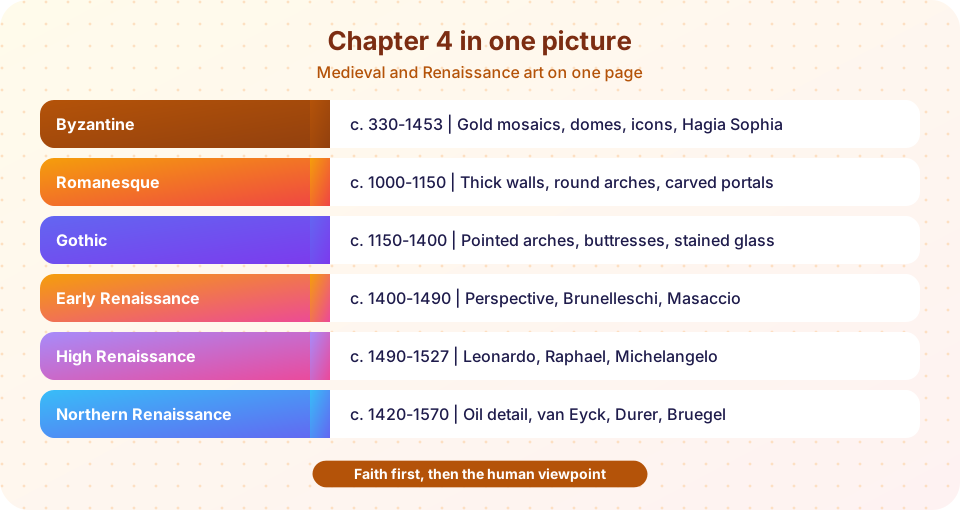
Recap
| Lesson | Big idea | Landmarks |
|---|---|---|
| Byzantine and Early Christian Art | Gold, domes and icons present heaven rather than a view of the world | Hagia Sophia (537), San Vitale mosaics (about 547), Christ Pantocrator at Sinai |
| Romanesque and Gothic Art | Structure shapes the look: thick walls, then pointed arches, ribs and buttresses | Conques, Durham, Saint-Denis (1144), Chartres, Notre-Dame |
| The Early Renaissance in Florence | Perspective, solid bodies and humanist patrons | Giotto's Arena Chapel, Brunelleschi's dome (1436), Masaccio's Holy Trinity |
| The High Renaissance | Harmony, monumentality and mastery; Venice's color | Last Supper, Mona Lisa, School of Athens, David, Sistine ceiling |
| The Northern Renaissance | Oil glazes, detail, print and everyday life | Ghent Altarpiece, Dürer's engravings, The Ambassadors, Hunters in the Snow |
Three comparisons to practice
- Byzantine mosaic versus Masaccio fresco. Gold ground and frontal figures versus consistent light, shadow and perspective.
- Romanesque versus Gothic. Thick walls and small windows versus ribs, buttresses and stained glass.
- Italian versus Northern. Perspective and ideal bodies versus layered oil detail and everyday objects.
When you meet an unfamiliar work from this period, ask four questions: Is the space measured or symbolic? Is the figure idealized or specific? What is the medium? Who paid for it?
A worked comparison: two ways to show the Annunciation
The Annunciation, when the angel Gabriel tells Mary she will bear a child, was painted countless times, so it is a good test for style. Imagine three versions.
A Byzantine mosaic. Gabriel and Mary stand against a gold ground. Their poses are formal, their faces calm and frontal, and there is no room, only a symbolic space. A beam of light or a hand from heaven might reach Mary. Everything tells you this is a sacred event outside ordinary time.
A Florentine fresco of about 1450. The scene takes place in a loggia drawn in careful perspective, with a column in the center and a garden beyond. Gabriel kneels; Mary sits, her robe falling over a believable body. A beam of light with a dove crosses the space. The room makes the miracle seem to happen in a place you could walk into.
A Netherlandish panel of about 1430. Mary is in a middle-class room, reading at a table. The room is full of objects: a lily in a vase, a candle just snuffed, a towel on a rack, a window with a view of a town. Many of these things have religious meanings (purity, the presence of God), yet they are also just things, painted with loving detail in glazed oil.
The three images tell the same story with different priorities: timelessness, rational space and the holy hidden in the everyday. That is the chapter in a nutshell. When you meet a new Annunciation in a museum, you can place it in a few seconds by asking where the figures stand and what the room looks like.
Patrons behind the styles
Style follows patronage as much as taste. Byzantine emperors and bishops paid for mosaics and icons that told people what to believe. Monastic orders and city communities paid for Romanesque and Gothic churches that became civic symbols. In Florence, guilds and banking families paid for altars, doors and chapels; in Rome, popes paid for the grandest projects of all; in the Netherlands and Germany, merchants, courts and printers paid for portraits, small devotional panels and prints. If you want to understand why a work looks the way it does, ask who paid and what they wanted to show.
Try it
Check your understanding
Quick check · 10 questions
of 10 answered You scored / 10 · perfect!
-
1. Which feature distinguishes a Byzantine mosaic from a Renaissance fresco?
Byzantine images present holiness in a timeless space; Renaissance images build believable space. -
2. Why could Gothic builders use huge windows?
The pointed arch, rib vault and flying buttress together moved load to piers. -
3. Which pair is correctly matched?
Masaccio painted the Holy Trinity, Michelangelo the Sistine ceiling and Pietà, and Leonardo the Last Supper. -
4. What makes Venetian painting distinctive?
Venetian artists such as Titian built forms with color and light. -
5. Which statement about Dürer is correct?
Dürer visited Italy in 1494-95 and 1505-07 and sold prints across Europe. -
6. What is an altarpiece?
The Ghent Altarpiece is a famous Northern example. -
7. What is the main danger of the story that the Renaissance followed a 'dark age'?
The story comes from Renaissance writers like Vasari, and historians now stress medieval achievement. -
8. What is anamorphosis?
Holbein's skull in The Ambassadors is the famous example. -
9. Which of these did the Reformation encourage in northern art?
As church commissions fell, artists turned to secular subjects and the open market. -
10. Which statement about the Mona Lisa is best supported?
It is about 77 by 53 centimeters, in oil on poplar, and its fame was boosted by the theft.
Summary
- Each style answered a question: heaven (Byzantine), structure and light (Romanesque and Gothic), space and bodies (Early Renaissance), harmony (High Renaissance), surface and print (Northern).
- Compare constantly: mosaic against fresco, Romanesque against Gothic, Italy against the North.
- "Renaissance" is a useful but contested label.
- Chapter 5 follows art into the dramatic world of the Baroque, Rococo, Neoclassicism and Romanticism.
Track your progress
Create a free account to tick off lessons and pick up where you left off on any device.
of Art History lessons completed