


















Lesson 35 of 49 · Impressionism to Modernism
Chapter 6 review: Impressionism to Modernism
Review Impressionism, Post-Impressionism, Expressionism, Cubism, abstraction, Dada and Surrealism with a one-page picture, matching game and ten-question quiz.
Seventy years, ten movements, and one long argument about what a picture is for. This review puts the chapter on one page. First look at the summary illustration, then scan the table, then try the matching game and the long quiz. If you can explain how each movement answered the one before, you have understood the chapter, not just memorized names.
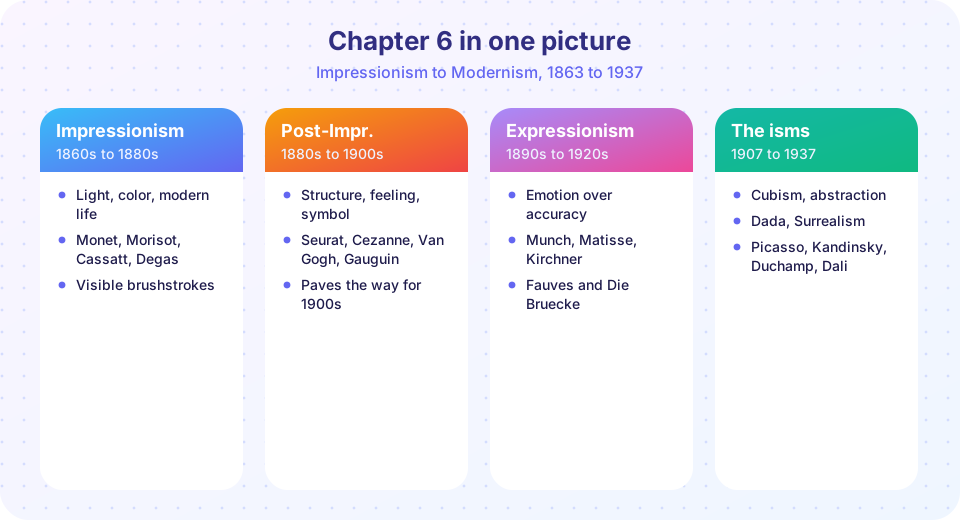
Recap table
| Movement | Approx. dates | Idea | Key names | Example works |
|---|---|---|---|---|
| Impressionism | 1860s to 1880s | Capture light and modern life | Monet, Manet, Morisot, Cassatt, Degas | Impression, Sunrise (1872) |
| Post-Impressionism | 1880s to 1900s | Structure, feeling, symbol | Seurat, Cezanne, Van Gogh, Gauguin | La Grande Jatte (1884 to 1886), The Starry Night (1889) |
| Fauvism | 1905 to 1908 | Pure, non-natural color | Matisse, Derain | Woman with a Hat (1905) |
| Expressionism | 1890s to 1920s | Feeling over accuracy | Munch, Kirchner, Kollwitz, Schiele | The Scream (1893) |
| Cubism | 1907 to 1914 | Many viewpoints, collage | Picasso, Braque | Les Demoiselles d'Avignon (1907) |
| Abstraction | 1910 onward | No recognizable subject | Kandinsky, af Klint, Malevich, Mondrian | Black Square (1915) |
| Dada | 1916 to 1924 | Protest and anti-art | Duchamp, Hoch, Ball | Fountain (1917) |
| Surrealism | 1924 to 1940s | Dreams and the unconscious | Dali, Magritte, Ernst, Carrington, Kahlo (associated) | The Persistence of Memory (1931) |
Five patterns to remember
- Photography changed the job. Painting moved from record to interpretation.
- Each step loosens the link to appearance. Color first (Impressionism, Fauvism), then form (Cezanne, Cubism), then subject (abstraction).
- Alternative institutions matter. Independent exhibitions, dealers and journals made the avant-garde possible.
- War and politics shape art. Dada responded to 1914 to 1918; Guernica responded to 1937.
- Histories get revised. Af Klint, Morisot, Cassatt and Duchamp's Fountain show how new evidence changes the story.
Press Run (or Ctrl + Enter) to see the result here.
Program input · what you'd type while the program runs
Type the answers before you press Run, one per line. Each time the program reads a line (with input()), it gets the next line from this box.
How the lessons connect
The movements in this chapter are best read as a series of questions, each opening the next. The Impressionists asked what happens if a painter records light instead of a story. The Post-Impressionists answered that light alone was not enough: Seurat wanted a system, Cezanne wanted solid structure, Van Gogh wanted feeling and Gauguin wanted symbol. The Expressionists and Fauves pushed that further and let color and distortion speak for emotion without regard to how things look.
Cubism asked a different question: what if a picture showed an object from many sides at once? That broke the single viewpoint that had governed painting since the Renaissance. Once the viewpoint was gone, the subject itself could go, and abstraction followed by several routes. Dada and Surrealism then asked what art is for at all, one answering the First World War with ridicule and the other searching the unconscious. Guernica shows that the same fragmented language could become a cry of protest.
Compare and contrast prompts
- Monet's Impression, Sunrise and Seurat's La Grande Jatte: both explore light and color, one by speed and one by system.
- Van Gogh's The Starry Night and Munch's The Scream: swirling skies, but who is the subject, and how do they differ in what they ask of the viewer?
- Picasso's Les Demoiselles d'Avignon and Malevich's Black Square: from broken figures to no figure, which assumptions does each overturn?
Common exam traps
- Mixing up Impressionism and Post-Impressionism. Post-Impressionists often studied Impressionism first, then reacted against it.
- Saying Cubism "has cubes in it". The label was a critic's joke about the geometric shapes.
- Treating Dada as a style rather than an attitude and a set of practices.
- Forgetting women in the narrative: Morisot and Cassatt in Impressionism, af Klint in abstraction, Hoch in Dada, Carrington and Varo in Surrealism.
Check your understanding
Quick check · 10 questions
of 10 answered You scored / 10 · perfect!
-
1. What gave the Impressionists their name?
Louis Leroy's 1874 review ridiculed the title and the group adopted the name. -
2. Which pair is correct?
Seurat's La Grande Jatte is built from tiny dots of color. -
3. What does 'Fauves' refer to?
The critic's joke about the 1905 Salon d'Automne. -
4. In Analytic Cubism, why were palettes mostly brown and gray?
Restricting color let the viewer focus on planes and viewpoints. -
5. Which artist began large abstract works in 1906 but kept them mostly private?
Af Klint's Paintings for the Temple were shown to the public only decades after her death. -
6. Dada began in which city, in which year?
The Cabaret Voltaire opened in Zurich in 1916. -
7. What did the readymade claim?
Duchamp separated art from craft skill and put the weight on choice and context. -
8. Which method did Surrealists use to bypass rational control?
They drew on Freud and used automatic drawing, chance and dream logic. -
9. Which painting was made in response to the 1937 bombing of a Basque town?
Picasso painted Guernica for the Spanish Republic's pavilion in Paris. -
10. Why is it risky to call Frida Kahlo simply a Surrealist?
Breton claimed her, but she rejected the label and stressed her lived experience.
Summary
- Each modern movement loosened painting's ties to appearance in a new way: color, form, subject, then convention.
- Photography, independent exhibitions, war and politics all shaped the story.
- Revisions (af Klint, women of the Impressionist circle, Fountain's attribution) remind us that art history is still being written.
- Labels simplify; test every label against the actual picture.
Track your progress
Create a free account to tick off lessons and pick up where you left off on any device.
of Art History lessons completed