


















Lesson 5 of 49 · Getting Started
Chapter 1 Review: Getting Started
Review chapter 1 of the art history course: the three lenses, six jobs of art, the big timeline and the limits of periods, with flashcards and a ten-question quiz.
You have now met the three basic tools of art history: a set of questions (form, context, meaning), a way of sorting purposes (six jobs for art) and a map of time (eight big periods). Before chapter 2 teaches you to look more precisely, this review pulls everything onto one page and tests it.
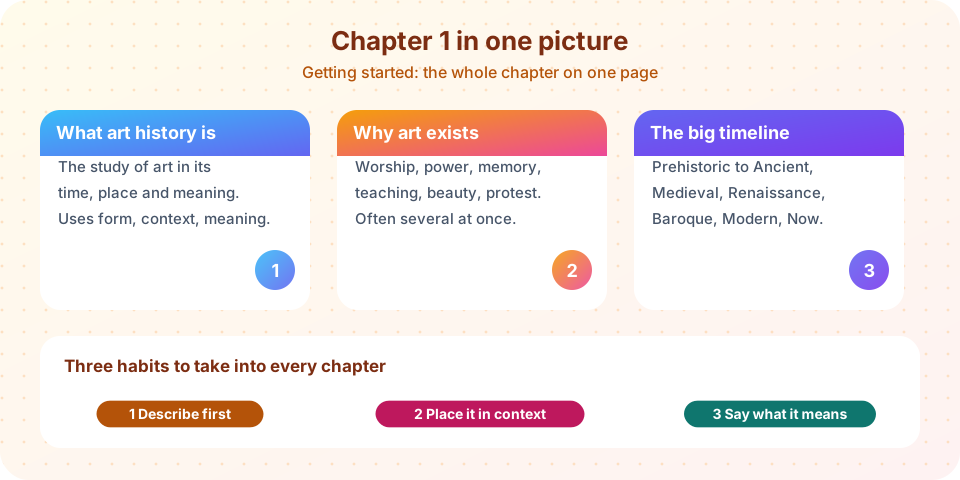
Recap
| Lesson | Big idea | Example to remember |
|---|---|---|
| What Is Art History? | Read each work through form, context and meaning, using evidence | Vasari's Lives (1550) began the story; X-rays and tree rings help today |
| Why People Make Art | Six jobs: worship, power, memory, teaching, beauty, protest | Hagia Sophia (537), Augustus of Prima Porta, Trajan's Column (113), Chartres, Water Lilies, Guernica (1937) |
| The Big Timeline | Eight periods are useful labels, not walls | Gothic, Baroque and Impressionism began as insults or nicknames |
Three questions to carry forward
- What do I see? Describe the object in plain words.
- What was it for, and for whom? Patron, setting, date and job.
- What does it say? Subject, symbols and the ideas it expresses, supported by evidence.
If you can answer those for any new work, you are already doing art history.
Worked example: Trajan's Column in three lenses
Here is how the three lenses and the six jobs come together on one work you met in this chapter.
Form. A tall marble column, with a spiral band of relief carving that winds around the shaft about twenty-three times, roughly 200 meters of picture in all. The figures are small, carved in low relief and arranged in continuous scenes that read from bottom to top. The shaft stands on a large base and was topped by a statue.
Context. It was dedicated in Rome in 113 CE, in the forum of the emperor Trajan, between two libraries, close to temples and law courts. Its subject, Trajan's wars against the Dacians in what is now Romania, ended only a few years earlier. The patron was the Roman state; the audience was the citizens who walked through the forum, and the emperor's own successors. Later, the base held Trajan's ashes, so the monument also functioned as a tomb.
Meaning. The carving shows Roman soldiers building roads and bridges, the emperor addressing the troops and the enemy surrendering. It tells a story of disciplined, victorious and humane power. It does not show Roman defeats. An art historian would say that the column turns a war into a lesson about what Rome stands for.
Jobs. Memory and record, certainly. Power and status, just as strongly. Teaching, because the story could be read by anyone. Notice how one object serves three jobs, and how the lenses help you separate them.
Three mistakes to avoid
- Jumping to meaning. Saying what a work "is about" before describing it. Always describe first.
- Treating periods as boxes. A work does not stop being Roman because the date says 476. Check your labels against the evidence.
- Forgetting the viewer. The same object means different things to its patron, its maker, its first audience and us. Say which viewer you are talking about.
Study plan for chapter 1
If you want to lock this chapter in, spend ten minutes on each of three tasks. First, pick any image on your phone or in a book and write down the three lenses for it in one sentence each. Second, choose three works from the timeline picture and say which of the six jobs each one did best. Third, test yourself with the flashcards below and the quiz, and re-read any lesson where you missed a question. A short, repeated routine beats one long session.
Try it
Check your understanding
Quick check · 10 questions
of 10 answered You scored / 10 · perfect!
-
1. A catalogue entry says a painting was bought by a Dutch merchant in 1650, passed to a duke in 1710 and given to a museum in 1900. This is its:
Provenance is the recorded chain of ownership. -
2. Which is a question about form?
Eye movement and composition are visible qualities, so they belong to form. -
3. Which pair of lenses does a question about the original altar setting and the guild that paid for it mainly use?
Setting and patron are circumstances of making and use, which is context. -
4. Which author's 1764 history treated ancient art as a sequence of styles?
Winckelmann's History of the Art of Antiquity was a decisive step toward modern art history. Vasari is earlier (1550), Panofsky and Nochlin later. -
5. Augustus of Prima Porta mainly serves which job of art?
It presents the emperor as calm, victorious and legitimate. Other jobs may also be present, but power is dominant. -
6. Why is it risky to treat periods as if they were rock layers?
Periods are tools. Older styles often continued alongside new ones. -
7. Which work is correctly matched with its period?
Michelangelo painted the Sistine ceiling in 1508-1512. The pyramid is Ancient, Lascaux Prehistoric and Chartres Medieval. -
8. What does a good art historian say about a work's meaning?
Meaning is layered across patron, artist and audiences, and claims should rest on evidence. -
9. What did Linda Nochlin's 1971 essay ask?
The essay examined how education and institutions shaped who was remembered, a landmark of feminist art history. -
10. Which tool can reveal a painting under a painting?
X-rays pass through paint layers differently, showing earlier compositions. Tree-ring dating works on wooden panels.
Summary
- Form, context and meaning are the three lenses; evidence supports every claim.
- Art does six main jobs, often several at once.
- The eight periods are a map, with overlaps and regional variation.
- Next you learn the vocabulary of form so that "describe first" becomes precise.
Track your progress
Create a free account to tick off lessons and pick up where you left off on any device.
of Art History lessons completed