


















Lesson 10 of 49 · Looking at Art
Formal Analysis and Iconography: From Looking to Interpreting
Learn Panofsky's three levels, how to write a formal analysis, how to read symbols without over-reading them, and the Arnolfini Portrait as a case study.
You now have words for what you see: elements, composition and media. The next step is to put them to work. Art historians use two main tools to move from looking to understanding. Formal analysis explains how the visible qualities of a work create its effect. Iconography identifies subjects and symbols and explains what they signified. Used together, and supported by context, they let you build an interpretation you can defend.
This lesson shows both tools at work, walks through the three levels of reading introduced by the art historian Erwin Panofsky, gives you a template for a clear written analysis, and warns about the traps beginners fall into, especially the temptation to find a hidden symbol in everything.
What you will learn
- The difference between formal analysis, iconography and iconology.
- Panofsky's three levels and how to use them on a work.
- A five-part structure for writing about a picture.
- How to read symbols with caution, using the Arnolfini Portrait as an example of a contested reading.
Key terms
- Attribute: an object that identifies a figure, such as the keys of Saint Peter.
- Pre-iconographic description: describing the plain visible facts, such as a woman holding a wheel.
- Iconology: interpreting what a work reveals about the values and beliefs of its time.
- Intentional fallacy: assuming that a work's meaning is only what the artist meant.
- Anachronism: reading a past work with ideas that belong to a later time.
Formal analysis
Formal analysis is the careful study of how a work is made to look the way it does. It uses the vocabulary from this chapter: line, shape, color, value, texture, space, composition and medium. Its main question is how do these choices produce an effect? A formal analysis of a Roman portrait bust, for example, would observe that the face is lit evenly, the creases around the eyes are carved deeply and the hair is cropped short, and conclude that the sculptor wanted a sober, experienced, unflattering realism. It does not need to know the sitter's name to say that.
The art historian Heinrich Wölfflin (1864 to 1945) pushed formal analysis far. In Principles of Art History (1915) he compared Renaissance and Baroque art through five pairs of qualities such as linear versus painterly and closed form versus open form. Critics later argued that he left out content and context, but his pairs remain a good way to train the eye.
Iconography and iconology
Iconography is the study of subject matter: who or what is shown and what signs identify it. It is a kind of detective work using texts. In Christian art, many figures carry attributes: Saint Peter holds keys, Saint Catherine a wheel, Saint Lawrence a gridiron, the Virgin Mary often wears blue. A lamb can refer to Christ as the sacrificial lamb, a white lily to purity. In Greek art, Athena wears a helmet and carries a shield, Hermes wears winged sandals. Knowing the "code" of a tradition lets you read scenes that would otherwise look like a list of random objects.
Iconology, in Panofsky's sense, goes a step further: it asks what the work reveals about the deeper attitudes of its time and place. Why were martyrs so important to medieval worshippers? Why did Dutch merchants in the seventeenth century love still lifes of lemons and silver cups? What does a monarch's portrait tell us about how power was imagined?
Panofsky's three levels
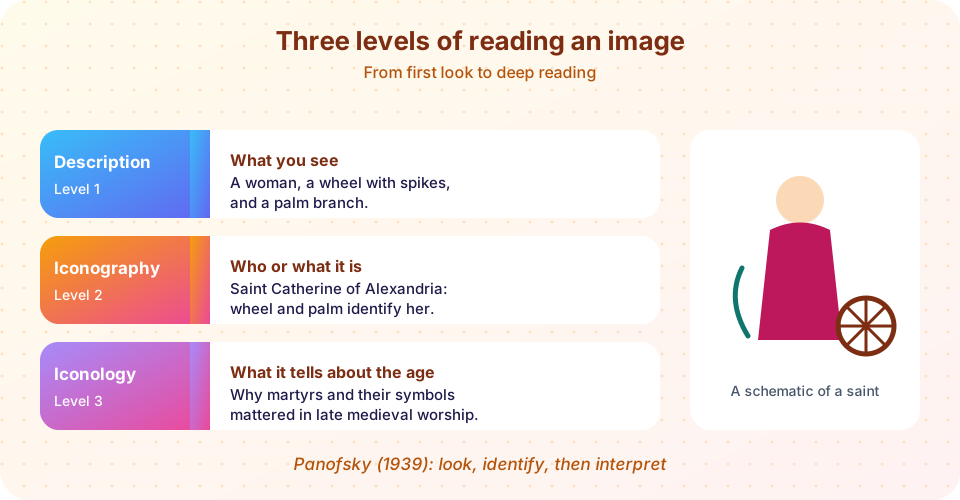
In his 1939 book Studies in Iconology, Panofsky described three layers of reading:
- Pre-iconographic description. What do you see, in plain terms? "A woman, in a long red robe, a spiked wheel next to her, a palm branch in her hand." You rely on everyday experience.
- Iconographic analysis. What does it represent, according to the conventions of the time? "Saint Catherine of Alexandria, identified by the wheel of her martyrdom and the palm of victory." You need knowledge of sources: the Bible, saints' lives, myths.
- Iconological interpretation. What does it reveal about the culture? "The image fits the late medieval devotion to female martyrs and the way such stories taught virtue." You need broad knowledge of history, religion and society.
The levels depend on each other. If you misread level one (taking a palm for a feather), level two fails. And a rich interpretation at level three is worthless if the lower levels are wrong.
Writing a formal analysis
A clear analysis has five parts.
- Identify the work. Artist (if known), title, date, medium, size or location. One sentence.
- Describe it. What is shown, in a few precise sentences. Stick to what anyone could verify.
- Analyze the form. Pick the two or three most important formal features (a color contrast, a diagonal, a use of light) and explain how each creates an effect. Use the pattern: feature, evidence, effect.
- Interpret. What do the formal choices suggest about the subject or meaning? Bring in iconography and context here, and say how sure you are.
- Conclude. One or two sentences connecting your observations to a larger point.
Every claim should be something a reader could test by looking at the picture. If you write "the artist was clearly sad," ask what the picture shows that supports it.
A case study: the Arnolfini Portrait
Jan van Eyck's Portrait of Giovanni(?) Arnolfini and His Wife (1434), now in the National Gallery in London, is one of the most studied paintings in the world. Level one: a man and a woman stand in a furnished bedroom; she wears a green gown; a small dog stands at the front; a convex mirror hangs on the back wall; a chandelier has a single lit candle; fruit lies on a windowsill. Above the mirror, in Latin script, is the inscription "Johannes de eyck fuit hic 1434" ("Jan van Eyck was here, 1434").
Level two invites readings. For many years the dog was read as a symbol of fidelity, the single candle as the presence of God or a marriage vow, and the removed shoes as a sign of holy ground. In 1934 Panofsky argued that the painting records a marriage, with the inscription acting like a witness's signature. Level three then links it to the importance of the sacrament and of legal documents in the burgher society of Bruges.
But later scholars have questioned several points. Is it a marriage at all, or simply a portrait of a wealthy couple at home? Is the man even Giovanni di Nicolao Arnolfini, a merchant from Lucca, or his cousin? Were the objects symbols, or just the expensive things a rich couple would own? A careful art historian says: "Panofsky read the scene as a wedding; some later scholars doubt that, noting that the evidence for a ceremony is thin and that many objects could simply signal wealth." The painting remains a good lesson in how an interpretation can be strong at level one and uncertain at levels two and three.
Pitfalls
- Over-reading symbols. Not every apple is a symbol of sin and not every dog is fidelity. Ask whether the tradition and the date support a symbolic reading, and whether a simple explanation (the dog was a common pet) would do.
- The intentional fallacy. A work's meaning is not limited to what the artist said. Viewers and later history add meanings. But do not claim an intention without evidence either.
- Anachronism. Reading the Arnolfini picture as an early "selfie" or a Roman statue as "propaganda" in the modern sense imports ideas that did not exist in the same way.
- Taste as analysis. "It's ugly" is a reaction. "The figures are cramped against the frame, creating tension" is analysis.
- Ignoring the setting. A picture that looks like private art today may once have been an altarpiece. Always ask where it was meant to be seen.
Common misconceptions
"Symbols have fixed meanings." The same object can mean different things in different traditions and periods. A snake can be evil in one story and healing in another (the staff of Asclepius).
"Formal analysis means no context." Formal analysis focuses on appearance, but a strong essay brings in context to explain why those choices were made.
"The last level is the 'real' one." All three levels matter. An interpretation is only as good as the observation underneath it.
Try it
Check your understanding
Quick check · 5 questions
of 5 answered You scored / 5 · perfect!
-
1. Which sentence is a pre-iconographic description?
Level one describes what is visible in plain terms, before identifying the subject. -
2. What is an attribute in iconography?
Attributes are conventional signs, like Saint Catherine's wheel. -
3. Why is the Arnolfini Portrait a good example of a contested interpretation?
The painting (1434) is secure at level one. Whether it shows a wedding and whether the objects are symbols is debated. -
4. What is the intentional fallacy?
Meanings can emerge from audiences and later history as well as from the artist's intention. -
5. In a formal analysis paragraph, which pattern works best?
Name a visual feature, point to where it appears and explain what it does.
Summary
- Formal analysis explains how visual choices create effects; iconography identifies subjects and symbols; iconology asks what the work reveals about its age.
- Panofsky's levels: describe, identify, interpret. Each depends on the one below.
- A strong written analysis identifies, describes, analyzes form, interprets and concludes.
- Read symbols with caution: check date, region and sources, and prefer the simplest explanation that fits.
- The Arnolfini Portrait shows that a work can be secure at level one yet debated at higher levels.
Next: Chapter 2 Review
Track your progress
Create a free account to tick off lessons and pick up where you left off on any device.
of Art History lessons completed