


















Lesson 14 of 49 · Ancient and Classical Art
Egyptian Art: Pyramids, Tomb Paintings and the Rules of the Figure
Understand ancient Egyptian art as a system built for eternity: pyramids, the canon of proportion, composite view, the Amarna revolution and Tutankhamun, with two interactive demos.
Ancient Egyptian art looks unmistakable: profile heads with a frontal eye, rows of figures on bands, calm faces, gold and blue. It is so consistent that you can recognize it across nearly three thousand years of history, from the first pharaohs around 3100 BCE to the Roman conquest in 30 BCE. That consistency was not laziness or lack of skill. It was the result of a deliberate system, built to do a specific job: to preserve life, order and the king's power forever.
This lesson explains that system. You will see how pyramids work, why figures look as they do, how a short, shocking break from the rules happened under Akhenaten, and how to read one of the most famous tomb treasures in the world. Throughout, think about the idea of eternity: Egyptian art was made to last and to work, not to be viewed in a gallery.
What you will learn
- Why Egyptian art focuses on tombs and temples, and how belief in the afterlife shaped it.
- How pyramids developed from the Step Pyramid to Giza.
- The canon of proportion and composite view, and why they were used.
- What changed at Amarna, and what Tutankhamun's tomb contained.
Key terms
- Ka: in Egyptian belief, a person's life force, which needed a home such as the body or a statue to live on after death.
- Ma'at: the principle of order, truth and justice.
- Canon: a set of rules for proportions of the figure.
- Composite view: showing each part of the body from its most recognizable angle.
- Stele: an upright slab carved or inscribed.
- Hieroglyphs: the picture script of ancient Egypt.
Why tombs?
Egypt lies along the Nile, a narrow green strip of farmland between deserts. The yearly flood made life predictable and gave Egyptians a deep sense that the world was ordered and could be renewed. Their religion taught that death was a transition: if the body was preserved and provided with food, objects and spells, a person could live on in the afterlife. Statues could hold the ka if the body decayed. So tomb art was not decoration. It was a working machine for survival.
A tomb wall might show the dead person fishing, farming and feasting, not because that was a record of their day but because pictures of provisions would supply them forever. Paintings were made to be effective, and, in a sense, magical.
Pyramids
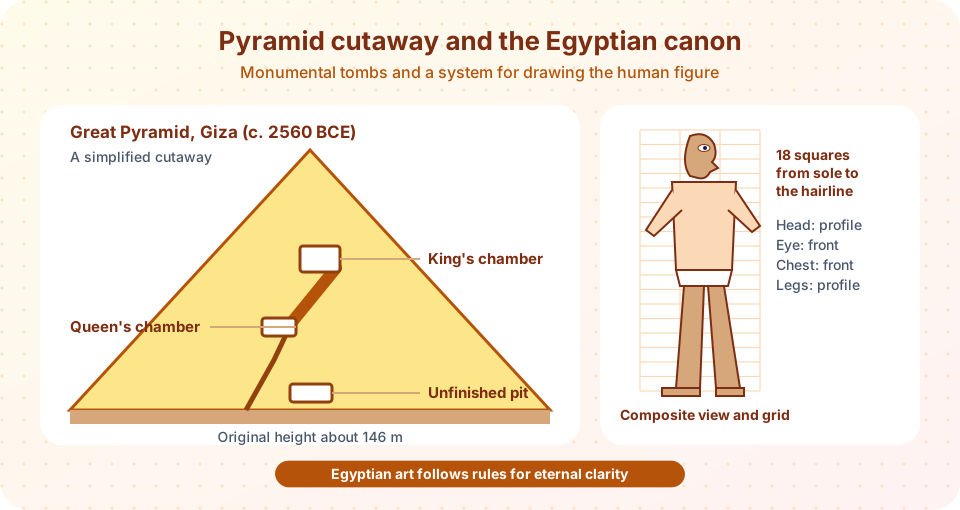
The earliest big stone building in the world is the Step Pyramid of Djoser at Saqqara (about 2670 BCE), designed, according to later tradition, by the architect and official Imhotep. It stacks six rectangular platforms, an enlargement of the flat-roofed tomb called the mastaba. At Giza, a generation or two later, kings of the Fourth Dynasty built smooth-sided pyramids: Khufu (the Great Pyramid, about 2560 BCE, originally about 146 meters tall), Khafre and Menkaure. The Great Pyramid is built from roughly 2.3 million blocks of limestone, with finer white limestone casing originally covering the outside, and was the tallest human-made structure in the world for nearly four thousand years.
Contrary to popular myth, the builders were not slaves in the movie sense. Excavations at workers' settlements near Giza have found bakeries, breweries and graves of laborers, which suggest a large organized workforce, much of it paid and fed by the state. The pyramid shape is usually linked to the sun cult: slanting rays of light falling from the clouds look like a ramp to heaven, and the shape recalls the sacred benben stone. Near Khafre's pyramid stands the Great Sphinx, carved from a natural outcrop of limestone, with a lion's body and a royal head.
Later kings abandoned pyramids as too visible to robbers and cut tombs into the rock of the Valley of the Kings, near modern Luxor. Most tombs were robbed anyway.
The canon and the composite view
If you look at an Egyptian wall painting or relief, certain rules repeat.
- Composite view. The head is shown in profile, but the eye is drawn as seen from the front. The shoulders and chest are frontal; the waist, hips and legs are in profile. This shows each part in its clearest and most complete form, so that nothing is hidden. Think of it as an identity card rather than a snapshot.
- The canon. Artists used a grid to lay out proportions. In the Old Kingdom the standing figure was set at 18 squares from the soles of the feet to the hairline; later periods used 21. This ensured that figures drawn by different people matched, and it helped teams work together.
- Hierarchic scale. The most important person is largest. The pharaoh towers over soldiers, and servants are small.
- Register composition. Scenes are arranged in horizontal bands, like pages of a story.
- Color code. Men are often painted reddish brown and women paler yellow; blue and green suggest the Nile and rebirth, and gold suggests the flesh of the gods.
The oldest clear display of these rules is the Palette of Narmer (about 3100 BCE), a ceremonial slab of siltstone that shows a king wearing the white crown of Upper Egypt striking an enemy, and on the other side the red crown of Lower Egypt. It is often read as a record of the unification of the two lands, though some scholars think it may mix myth and politics.
The system also allowed for individual character. Statues of Khafre in dark diorite show a calm king with the falcon god Horus sheltering his head. Menkaure and his queen stand side by side, her arm around him, in a rare image of a royal couple. And the Seated Scribe (about 2500 BCE), a painted limestone statue now in the Louvre, shows an official with a lined, alert face and crystal-and-copper eyes, an astonishing sense of life within the conventions.
Do not read composite view as a failure to draw "correctly." Egyptian artists could draw a foreshortened figure when they needed to; they chose not to because their goal was clarity and permanence.
The New Kingdom and Amarna
In the New Kingdom (about 1550 to 1070 BCE) Egypt was a wealthy empire. Queen-turned-king Hatshepsut built a terraced temple at Deir el-Bahri (about 1470 BCE), designed with her official Senenmut, where long reliefs recount a trading expedition to the land of Punt. Her statues often show her with a king's beard and kilt, which tells us how she managed the problem of a female king in a system built for men.
Then came a shock. The pharaoh Akhenaten (reigned about 1353 to 1336 BCE) rejected the old gods and made one, the sun disk Aten, supreme. He moved the capital to a new city, Akhetaten (modern Amarna), and artists adopted a startling new style: long faces, thin necks, curving bellies, wide hips and intimate, relaxed family scenes in which the royal couple play with their daughters under the rays of the sun. The painted limestone bust of Nefertiti (about 1345 BCE), found in 1912 in the workshop of the sculptor Thutmose, is the best-known example. It is in the Neues Museum in Berlin, and Egypt has asked for its return, one of the live arguments mentioned in chapter 8.
After Akhenaten died the old religion returned and the experiment was erased. His successor was the boy king Tutankhamun, whose short reign ended around 1327 BCE. His tomb, found largely intact by Howard Carter in 1922 in the Valley of the Kings, contained more than 5,000 objects, among them a gold funerary mask of about 10 kilograms. Its significance is not that Tutankhamun was an important king, which he was not, but that it shows what a typical royal burial must once have looked like before the robbers.
Books of the dead
Papyrus scrolls known as the Book of the Dead supplied spells for the journey to the afterlife. In the famous scene of the "weighing of the heart" (for example, in the papyrus of Hunefer, about 1275 BCE, in the British Museum), the god Anubis leads the dead person to a balance, where the heart is weighed against the feather of Ma'at while the god Thoth records the result and a monster, Ammit, waits to devour those who fail. The scene shows how pictures and text work together to guide the dead.
Language: hieroglyphs
Egyptian writing used pictorial signs. After the last inscription (394 CE) the knowledge of how to read hieroglyphs was lost for about fourteen centuries, until Jean-François Champollion announced his decipherment in 1822, using the Rosetta Stone, a slab found in 1799 that carries the same decree in hieroglyphic, demotic and Greek. The stone, dated 196 BCE, is now in the British Museum.
Common misconceptions
"Egyptians could not draw realistically." They chose conventions for meaning and clarity. In tomb scenes of animals and birds, observation can be astonishingly precise.
"Pyramids were built by slaves." Evidence suggests organized, fed and housed laborers, along with skilled craftsmen.
"Egyptian art never changed." There were shifts in each dynasty. Old Kingdom statues are solid and calm, Middle Kingdom faces show weight and care, New Kingdom work is richer and Amarna is a radical departure.
Try it
Check your understanding
Quick check · 5 questions
of 5 answered You scored / 5 · perfect!
-
1. What is the Egyptian composite view?
Egyptian artists combined profile and frontal views so that each part was clearly recognizable. -
2. What was a ka statue for?
The ka could live in the body or, if that decayed, in a statue. -
3. What was radically different about Amarna art under Akhenaten?
Akhenaten's reign (about 1353-1336 BCE) brought a new style, including the bust of Nefertiti, which faded after his death. -
4. Which pyramid is the oldest large stone structure in this lesson?
Djoser's Step Pyramid (about 2670 BCE) came before the smooth-sided pyramids at Giza. -
5. Who deciphered hieroglyphs in 1822, using the Rosetta Stone?
Champollion announced his decipherment in 1822, using the Rosetta Stone, found in 1799.
Summary
- Egyptian art served eternity: tombs, statues and paintings were working tools for the afterlife.
- Pyramids evolved from the Step Pyramid of Djoser (about 2670 BCE) to the Great Pyramid at Giza (about 2560 BCE).
- Rules such as the canon (18 squares in the Old Kingdom), composite view, hierarchic scale and registers gave clarity and consistency.
- Amarna (about 1353-1336 BCE) briefly broke the rules; Tutankhamun's tomb (found 1922) shows royal burial wealth.
- Hieroglyphs were deciphered in 1822 thanks to the Rosetta Stone.
Next: Greek Art
Track your progress
Create a free account to tick off lessons and pick up where you left off on any device.
of Art History lessons completed