


















Lesson 49 of 49 · Projects and Practice
Further study: where to go from here
Next steps after this art history course: how to look slowly in museums, what to read, which careers use art history, and how it connects to other tracks.
You now have a map of European art from the Baroque to today, a set of global traditions to explore, and the habits of an art historian: look closely, ask for evidence, use more than one lens and remember the frame. What next? This lesson suggests four paths: look, read, connect and make. It closes with a study-plan builder so you can turn good intentions into a schedule.
What you will learn
- How to practice slow looking in a museum or from a screen.
- What kinds of reading deepen the subject, and how to use older books critically.
- Which careers and further studies use art history.
- How art history connects to other subjects on this site.
Key terms
Slow looking: spending a long, deliberate time (ten minutes or more) with a single work to see more than a glance reveals.
Monograph: a scholarly book on a single artist, movement or topic.
Exhibition catalogue: a book published for an exhibition with essays and entries on each work, often the best source on a specific theme.
Curator: a specialist who researches, selects and interprets works for a museum.
Conservator: a specialist trained to examine, stabilize and repair works of art.
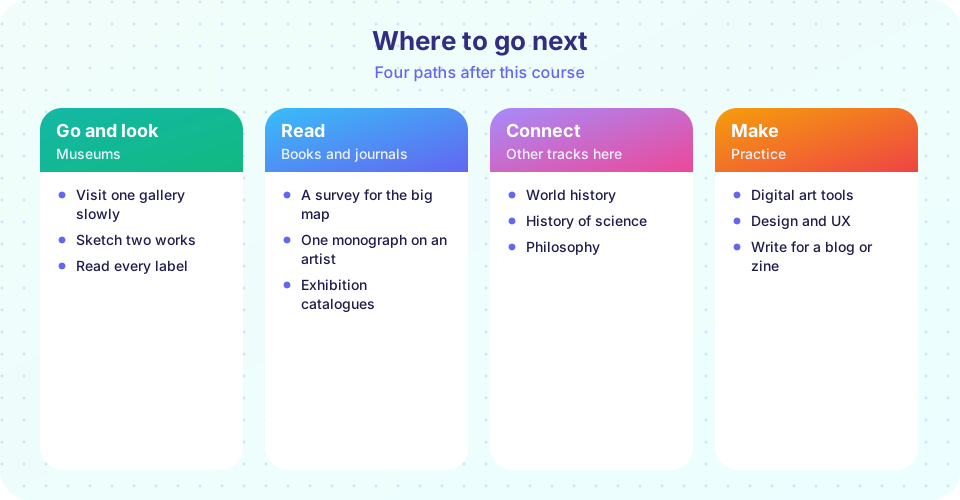
Path 1: go and look
Nothing replaces seeing a work in person. Scale, surface, texture and light, which a screen flattens, matter enormously. A canvas the size of a wall, like Guernica, or a small, jewel-like panel can feel nothing like its photograph.
A routine for a museum visit:
- Choose three works before you go, not thirty. Pick one you know, one you half-know and one you chose because it looked odd.
- Look for ten minutes each before reading the label. Write ten observations.
- Read the label and compare it with your notes. What did you miss? Which words are hedges ("attributed to", "c.")?
- Sketch one detail. Drawing forces attention, even if you draw badly.
- Ask the ten questions from the cheat sheet.
If you cannot visit in person, many museums publish high-resolution images and free collection databases. The Rijksmuseum, the Metropolitan Museum of Art, the National Gallery in London, the Art Institute of Chicago and the Louvre all have online collections, and many are free to reuse. Zoom in until you see brushstrokes and cracks, and always look for scale in the dimensions listed with each image.
Path 2: read
Reading gives the arguments that a single visit cannot. A good order:
- A one-volume survey to get the whole map. E. H. Gombrich's The Story of Art (first published in 1950) is a beloved introduction with a clear voice; later editions add material, but its focus is largely European, so treat it as one view. Newer global surveys give a wider picture.
- A book on how to look, such as John Berger's Ways of Seeing (1972), a short, provocative introduction to images and power.
- A monograph on one artist or movement that you loved in this course.
- Exhibition catalogues and museum essays for specific themes.
- Primary sources: letters, diaries and artist writings. Van Gogh's letters, for example, are widely available and readable.
Read older surveys critically. Check the publication date and ask who is absent: many classic textbooks give little or no space to women artists and to artists outside Europe and North America. A good habit is to read one old and one recent book on the same topic and compare.
Path 3: connect
Art history does not stand alone. Pairing it with other subjects deepens both. Tracks on this site that connect naturally include:
- World History: empires, trade, revolution and religion form the backdrop to every style in this course.
- History of Science: optics, pigments and the camera obscura shaped how artists saw.
- Philosophy: aesthetics asks what beauty and art are, and links with the questions of Conceptual art.
- Anthropology: helps you study art within the societies that made it, with care for cultural context.
- Literature: Romantic poems, Surrealist manifestos and the novels around the paintings.
- Music Theory: compare how composers and painters tackled form, rhythm and abstraction.
Path 4: make
Making something sharpens looking. You do not need to be a good artist.
- Copy a small part of a painting in pencil to learn how the artist built form.
- Photograph a scene with a single light source and compare it with Caravaggio.
- Try a Conceptual instruction piece and see how others interpret it.
- Practice digital tools in Photoshop, Illustrator, Figma or Blender, and apply composition and color ideas from this course to your own designs.
- Study visual communication in UX Design, where line, color, hierarchy and space meet real users.
Careers and further study
Art history opens routes in museums and galleries (curator, registrar, educator, conservator), publishing and journalism, auction houses and the art market, heritage and archaeology, art law and cultural policy (including provenance research and restitution), digital collections and archives, and teaching. Many careers combine art history with another skill such as languages, science (for conservation), law, data or design. A degree in art history, or a related field, is the usual route to curatorial and research work, while conservation requires specialist scientific and practical training.
Build a study plan
Press Run (or Ctrl + Enter) to see the result here.
Program input · what you'd type while the program runs
Type the answers before you press Run, one per line. Each time the program reads a line (with input()), it gets the next line from this box.
A note on staying curious
The habit that matters most after a course ends is returning to works you have already studied. A painting you analyzed in week one will show you new things in month six, because your eye and your questions will have changed. Keep a small notebook or file with one entry per work: date seen, what you noticed, and one question you could not answer. Over a year that record becomes a map of your own growing eye, and the unanswered questions point straight to your next book or exhibition.
Common misconceptions
"You need to be a good artist to study art history." Drawing helps looking, but art history is about seeing, research and argument.
"You can only learn it in a museum." Museums are ideal, but online collections and books can carry a lot of the work.
"The standard survey is the full story." Older surveys are partial; read widely and look for the missing voices.
"A career needs a PhD." Some roles (curator, professor) usually do, but many museum, education, publishing and market roles do not.
Try it
Open one online museum collection, pick a work from this course and do the ten-minute slow-looking exercise. Then run the study plan builder with your real weekly hours and write the plan in your calendar.
Check your understanding
Quick check · 4 questions
of 4 answered You scored / 4 · perfect!
-
1. What is slow looking?
Extended attention reveals details that quick glances miss. -
2. Why should you read older art surveys critically?
Check the date and ask who is missing. -
3. Which of these is an exhibition catalogue useful for?
Catalogues often hold the best scholarship on a theme. -
4. Which role specializes in examining and repairing artworks?
Conservators are trained in science and practical treatment.
Summary
- Four paths continue the course: go and look, read, connect to other subjects and make.
- Slow looking and critical reading are the two best habits.
- Art history links to world history, the history of science, philosophy, anthropology, literature, music and design.
- Careers span museums, publishing, law, the market, conservation and teaching.
- Plan your time: quality of attention beats quantity of works.
Track your progress
Create a free account to tick off lessons and pick up where you left off on any device.
of Art History lessons completed