


















Lesson 38 of 49 · Contemporary and Global Art
Global traditions and contemporary voices
A tour of long non-European art traditions, from Islamic geometry and Chinese ink to Benin bronzes and Papunya painting, with contemporary artists and a pattern maker.
For most of the 20th century, a European survey of art history stopped at Europe and the United States, with a few pages on "other" cultures labelled primitive or exotic. That was a limit of the survey, not of the world. Every region has had artists, workshops, patrons, critics and arguments about quality. This lesson sketches several major traditions, each in its own terms, then looks at contemporary artists who work across borders and at the questions about ownership, display and meaning that museums are now facing.
What you will learn
- How to read Islamic calligraphy and geometric ornament, and why "Islamic art" does not mean "no images".
- What makes Chinese ink landscape and Japanese woodblock prints distinctive.
- Why West African, Mesoamerican and Indigenous Australian works need careful, culture-specific reading.
- Which contemporary artists work between traditions, and what restitution debates are about.
Key terms
Calligraphy: decorative handwriting. In Islamic art it is among the most respected art forms, since the Arabic script carries the Quran.
Arabesque and geometric ornament: repeating patterns of curving vines (arabesque) and of polygons, stars and interlacing lines (geometric).
Ukiyo-e: "pictures of the floating world", Japanese woodblock prints of actors, beauties and landscapes, made from the 1600s to the 1800s.
Provenance: the history of ownership of an object. We return to it in Chapter 8.
Restitution: returning cultural objects to the communities or states they were taken from.
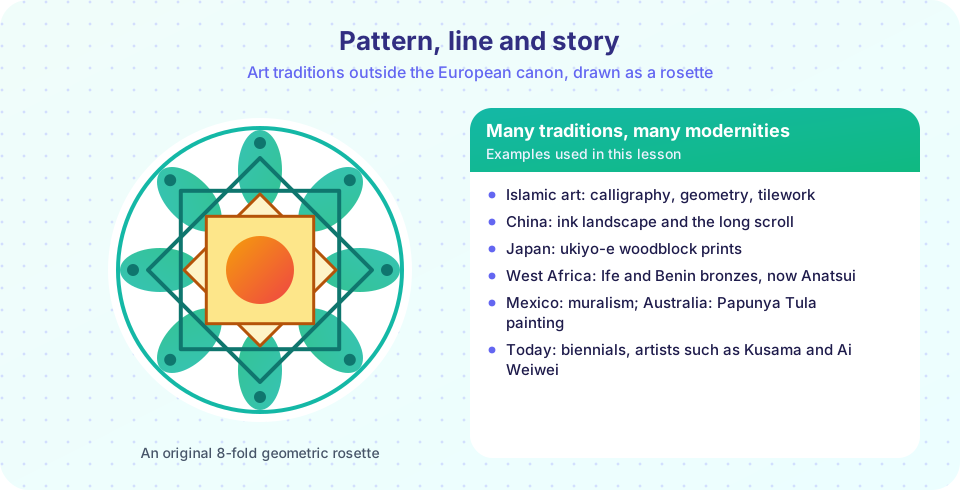
Islamic art: script, geometry and the figure
"Islamic art" covers a vast span of regions and centuries, from Spain to India, so it helps to name specific places and periods. Several features recur.
Calligraphy. Arabic script appears on buildings, books, ceramics and metalwork, in styles such as angular Kufic and flowing naskh and thuluth. In the Dome of the Rock in Jerusalem (completed in 691 to 692), long inscriptions run around the interior.
Geometry. Patterns build from circles divided into equal parts, joined by straight lines to make stars, polygons and interlace, which can repeat endlessly across a wall. They are drawn with compass and straightedge, and designers used shared geometric knowledge handed down in workshops and treatises. You can see them in the tilework and carved plaster of the Alhambra in Granada (Nasrid period, 13th and 14th centuries) and in Persian and Ottoman mosques. Some scholars have argued that certain medieval patterns show unusually sophisticated geometry; the detailed claims are debated.
The figure. A common misconception is that Islamic art forbids images of living beings. Religious spaces such as mosques generally avoid figures, but figurative painting flourished in Persian, Ottoman and Mughal manuscripts and courts, and in secular ceramics and metalwork. The Taj Mahal (begun 1632 in Agra, Mughal India) shows another strand: monumental architecture with inlaid stone, calligraphy, and gardens.
China and Japan: ink, scroll and woodblock
In Chinese art, calligraphy, poetry and painting were closely linked, and painting in ink on silk or paper was ranked highly by scholar-officials. Landscape painting (shanshui, "mountain-water") was not a picture of one place but a way to contemplate the order and scale of nature. In Travelers among Mountains and Streams (about 1000), attributed to Fan Kuan of the Northern Song dynasty, a huge mountain towers over tiny travelers on a mule train: a monumental image of nature that, to a Western eye, may remind you of Romantic scale. Painters often worked on long handscrolls that were unrolled a little at a time and viewed in private, quite unlike a framed picture on a wall.
In Edo-period Japan (1603 to 1868), a publishing industry produced ukiyo-e, woodblock prints sold to townspeople. A print was a team effort: a designer, a carver who cut the blocks, a printer who applied color and a publisher who financed it. Katsushika Hokusai (1760 to 1849) made Under the Wave off Kanagawa (about 1831), the famous "Great Wave", for his series Thirty-six Views of Mount Fuji, and Utagawa Hiroshige (1797 to 1858) made quiet series of travel views. After Japan opened to Western trade in the 1850s, these prints reached Paris and influenced Impressionists and Post-Impressionists, as you saw in Chapter 6. We take a closer look at the Great Wave in a project in Chapter 9.
West Africa, Mesoamerica and the Americas
Ife and Benin. In the city of Ife (in present-day Nigeria), artists made strikingly naturalistic heads in copper alloy, probably between the 12th and 15th centuries. In the Kingdom of Benin (Edo people, also in present-day Nigeria), court artists cast brass plaques and heads that recorded the history of the royal court. In 1897 a British military expedition attacked and burned Benin City and carried off thousands of objects, which ended up in museums in Britain, Germany, the United States and elsewhere. Since the 2010s many museums have discussed or carried out returns, and in 2022 Germany and Nigeria agreed on the transfer of ownership of Benin objects in German museums.
Mesoamerica. Maya cities of the Classic period (roughly 250 to 900 CE) produced carved stone stelae, painted vases and murals that combined portraits of rulers with hieroglyphic text. Their art is also a written record, which scholars have been able to read since the later 20th century.
Mexican muralism. After the Mexican Revolution (1910 to 1920), the government commissioned painters including Diego Rivera, Jose Clemente Orozco and David Alfaro Siqueiros to paint large public murals on historical and political themes. Their work influenced public art as far away as the United States, where Rivera painted the Detroit Industry Murals (1932 to 1933).
Indigenous Australian painting
The oldest continuing art traditions on earth are those of Aboriginal and Torres Strait Islander peoples, including rock art, body painting, carving and weaving. In 1971 at Papunya in Australia's Western Desert, men from several language groups began painting on boards with an art teacher, Geoffrey Bardon, which launched the Papunya Tula movement. They used acrylic paint for designs that relate to Tjukurrpa or Dreaming stories about land and law, adding dots and abstract symbols in part so that restricted knowledge would not be visible to outsiders. Later artists such as Emily Kame Kngwarreye (about 1910 to 1996) began painting in her late seventies and created a huge body of work in the last eight years of her life. Cultural protocols matter here: some images may only be seen by certain people, and exhibitions follow community guidance.
Contemporary artists between worlds
- El Anatsui (born 1944, Ghana, lives in Nigeria) makes monumental hanging sculptures from flattened bottle caps and copper wire that shimmer like cloth, referring to Ghanaian kente weaving, trade and consumption.
- Yayoi Kusama (born 1929, Japan) works in polka dots, mirrored "Infinity Rooms" and soft sculpture, connecting her personal experience with a universal visual language.
- Ai Weiwei (born 1957, China) uses sculpture, photography and installation to comment on politics; his Sunflower Seeds (2010) at Tate Modern consisted of about 100 million hand-painted porcelain seeds made by craftspeople in Jingdezhen.
- Kara Walker (born 1969, United States) makes silhouette cut-paper images of slavery and its legacy that are deliberately beautiful and disturbing.
- Yinka Shonibare (born 1962, Britain and Nigeria) clothes mannequins in "African" wax-print fabric that in fact has a tangled history linking Indonesia, the Netherlands and West Africa.
The 1989 Paris exhibition Magiciens de la Terre ("Magicians of the Earth"), by showing artists from around the world together, helped start a global conversation. It was also criticised for presenting some artists as exotic. Since then, biennials in cities from Havana and Sao Paulo to Gwangju and Dakar have changed where and by whom contemporary art is shown.
Press Run (or Ctrl + Enter) to see the result here.
Program input · what you'd type while the program runs
Type the answers before you press Run, one per line. Each time the program reads a line (with input()), it gets the next line from this box.
Reading across cultures responsibly
A few habits help when you look at work from a tradition you do not know:
- Start with the maker's context: who made it, for whom, for what use, in which language of forms.
- Avoid "primitive" and "exotic": these words judge a culture against a Western yardstick.
- Name the people and place, not just a continent.
- Ask who owns it and who displays it, and how it got there.
- Listen to the community's own scholars and artists whenever you can.
Common misconceptions
"Islamic art has no figures." Religious buildings usually avoid them, but figural art is common in books and court art.
"Aboriginal dot paintings are just decoration." They hold law, geography and ceremony, and some details are deliberately hidden from outsiders.
"Non-Western art was frozen in time until Europeans arrived." Every tradition changed and borrowed. Benin's brass casting, Chinese painting and Persian miniature painting all evolved through contact and invention.
"Museums have always owned these objects legitimately." Some were acquired by trade or gift; others by looting and force. Provenance research sorts which is which.
Try it
Set the pattern maker to n = 12, k = 5 and add a second layer rotation of 15 degrees. Then try n = 12, k = 4 and read the message about separate polygons. Why does gcd decide whether the star is one piece?
Check your understanding
Quick check · 5 questions
of 5 answered You scored / 5 · perfect!
-
1. Which statement about Islamic art is most accurate?
The picture is varied across regions and uses. -
2. What is ukiyo-e?
Ukiyo-e prints flourished in Edo-period Japan. -
3. What happened in Benin City in 1897?
The 1897 expedition looted objects that now sit in museums worldwide; restitution is an ongoing discussion. -
4. When does a star polygon {n/k} form one continuous star?
If n and k share a factor, the path closes early and the figure splits into several polygons. -
5. El Anatsui is best known for:
His shimmering works connect trade, consumption and West African textile traditions.
Summary
- Islamic art combines calligraphy, geometry and, outside religious buildings, figurative painting.
- Chinese ink landscape, Japanese woodblock printing, Benin and Ife metalwork, Maya carving, Mexican muralism and Papunya painting each have their own aims and histories.
- Contemporary artists such as El Anatsui, Kusama, Ai Weiwei, Walker and Shonibare work across traditions and question borders.
- Restitution debates ask who owns cultural objects and how to repair the history of acquisition.
- Responsible looking starts with the maker's context and avoids loaded words like "primitive".
Next: Chapter 7 review
Track your progress
Create a free account to tick off lessons and pick up where you left off on any device.
of Art History lessons completed