


















Lesson 46 of 49 · Projects and Practice
Practice: identification and comparison set
Practice the skills tested in art history exams: identify works from descriptions, place them in context, and compare two works, with a study game and spaced review.
Art history exams and quizzes usually come in two forms. In an identification question you are shown a work and must name it, date it and say why it matters. In a comparison question you are given two works and asked how they differ in form, purpose and meaning. Both are skills, and like any skills they improve with deliberate practice. This lesson gives you a method for each, worked examples, a game to train recall and a simple way to schedule your reviews.
What you will learn
- A four-move method for answering identification questions fast.
- How to structure a comparison so it argues something.
- How to use quick, repeated retrieval to remember works, names and dates.
- How to spot your own weak spots.
Key terms
Identification: naming a work (artist, title, date, place, medium) and explaining its significance in a few sentences.
Comparison: examining two works side by side to show what they share, how they differ and why.
Retrieval practice: strengthening memory by recalling information, not just rereading it.
Spaced repetition: reviewing information at increasing intervals, so you revisit items just before you would forget them.
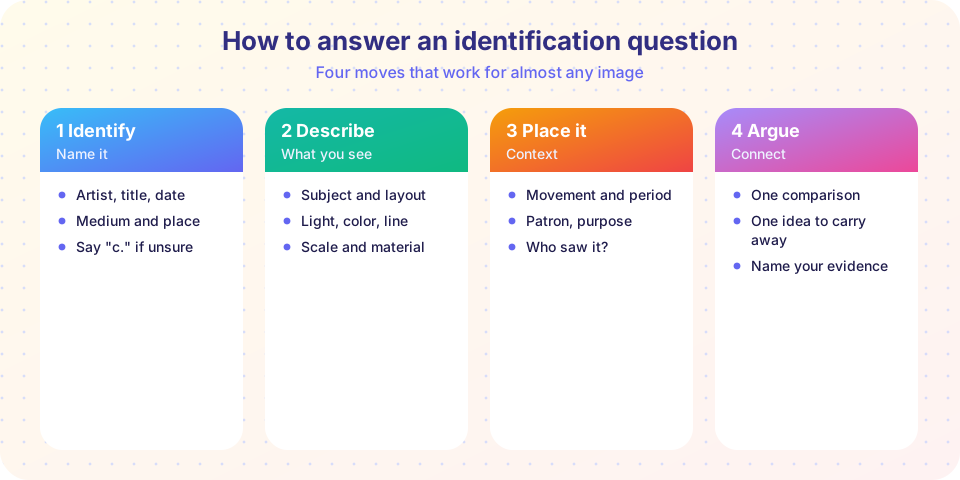
The four-move identification answer
- Identify. Give artist, title, date, medium and place. Use "c." when unsure and name the period if you cannot recall the artist; a correct period with a hedged date earns more than a wrong, confident one.
- Describe. Say what you see in two or three precise details: subject, composition, light, color, line, scale and material.
- Place it. Name the movement or period and one fact about the patron, purpose or setting.
- Argue. End with one connection: a comparison with another work, or an idea the work demonstrates.
Worked example 1
Prompt: a very large canvas showing three brothers with raised arms taking an oath before their father while women weep at the right.
"Jacques-Louis David, Oath of the Horatii, 1784, oil on canvas, France. The stage-like space, hard outlines and strong light stress a clear, almost sculptural group: the men's straight, tense arms contrast with the women's soft curves. It is a leading work of Neoclassicism, made for the royal administration at a moment when Enlightenment ideas of civic duty were spreading. It shows how art could preach sacrifice for the state, unlike the playful Rococo of a generation earlier."
Worked example 2
Prompt: a night sky of swirling blue and yellow strokes above a quiet village with a tall dark cypress.
"Vincent van Gogh, The Starry Night, 1889, oil on canvas, painted in Saint-Remy, France. Thick, rhythmic strokes and unnatural color express feeling more than description. It is a Post-Impressionist work that moves beyond Impressionism's interest in light toward emotion and symbol, and it helped shape later Expressionism."
Worked example 3
Prompt: a huge black-and-white canvas of a screaming woman, a gored horse and a fallen soldier, in fragmented forms.
"Pablo Picasso, Guernica, 1937, oil on canvas, Paris. Cubist fragmentation and a gray palette convey anguish after the bombing of a Basque town in the Spanish Civil War. It was made for the Spanish Republic's pavilion at the Paris World's Fair, and shows modern art used as political protest."
Notice that none of these is long. Each is a few sentences: name, look, place, link.
Comparison: a structure that argues
A weak comparison lists features of one work and then features of another. A strong comparison pairs the features under a point and then argues what the difference means. Use this skeleton:
| Move | What to write |
|---|---|
| Frame | One sentence naming both works and the question they answer in different ways |
| Point 1 | Form: line, color, space, light, side by side |
| Point 2 | Subject and purpose: what each is for, who saw it |
| Point 3 | Context: patron, place and period |
| Conclusion | What the contrast reveals about the two periods |
Worked comparison: Oath of the Horatii and The Swing
- Frame: Both were painted in France within about twenty years of each other, yet they offer opposite pictures of the good life.
- Form: David uses hard outlines, strong light, a shallow stage and sober colors. Fragonard uses soft, feathery brushwork, pastel pinks and greens, and a sweeping, asymmetrical curve of foliage.
- Subject and purpose: David shows a story of duty and sacrifice for a public audience. Fragonard shows a flirtation for a private patron.
- Context: Rococo served aristocratic salons; Neoclassicism responded to Enlightenment ideals and the approaching revolution.
- Conclusion: The pair shows how taste moved from pleasure toward civic virtue in a short time.
Comparison prompts to try yourself
- The Raft of the Medusa (1818 to 1819) and Guernica (1937): both turn a catastrophe into monumental art. How do they differ in color, composition and the role of the viewer?
- The Calling of Saint Matthew (about 1600) and The Night Watch (1642): both use light to organize a group. What does each light create?
- Wanderer above the Sea of Fog (about 1818) and Spiral Jetty (1970): both place a human being in front of a vast landscape. What does each artist ask you to do?
Train your recall
Reading again and again feels productive, but recalling is stronger. The game below asks for the movement behind a short description. Answer without looking at your notes, and treat every miss as information.
Schedule your reviews
Spaced repetition says: after you first learn something, review it soon, then again after a longer gap, then longer still. The classic simple version is the Leitner system. You keep cards in boxes; a correct answer moves a card to the next box (reviewed less often), a wrong answer sends it back to box 1.
Press Run (or Ctrl + Enter) to see the result here.
Program input · what you'd type while the program runs
Type the answers before you press Run, one per line. Each time the program reads a line (with input()), it gets the next line from this box.
Handling uncertainty in an answer
Sometimes you will not recognize the work at all. Do not leave the answer blank. Describe what you see precisely, name the features that point to a period, give a hedged date range, and say what would confirm your guess. A line such as "hard outlines, a shallow stage and a classical subject suggest Neoclassicism, c. 1780 to 1810, probably French" shows the method and often earns most of the credit. If you recognize the artist but not the title, say so honestly and describe the work. Examiners usually reward clear reasoning and honest hedging over a confident wrong answer.
Common misconceptions
"If I can recognize it, I know it." Recognizing a work is easier than recalling its name, date and meaning. Test recall.
"I must memorize every date." Know approximate dates and sequences. Hedge with "c." and anchor works to periods.
"A comparison means listing differences." A good comparison argues what the differences reveal.
"Cramming works as well as spaced practice." Spaced review gives much stronger long-term memory.
Try it
Play the game twice. Note the movements you miss, then use the scheduler's logic to decide when to review them. Write one comparison of your own from the three prompts, using the five-move skeleton, in under 200 words.
Check your understanding
Quick check · 5 questions
of 5 answered You scored / 5 · perfect!
-
1. What are the four moves of an identification answer?
Name it, say what you see, give context, and make one connection. -
2. Why use 'c.' with a date you are unsure of?
Circa shows that you know the date is approximate. -
3. What distinguishes a strong comparison from a weak one?
Point-by-point pairing plus an argument is the key. -
4. In the Leitner system, what happens when you get a card wrong?
Mistakes return a card to frequent review. -
5. Which study habit is most effective?
Retrieval practice and spacing improve long-term memory.
Summary
- Identification answers follow four moves: identify, describe, place, argue.
- A comparison pairs features under points and argues what the difference reveals.
- Retrieval practice and spaced repetition are better than rereading.
- Track your misses and revisit them on a schedule.
Track your progress
Create a free account to tick off lessons and pick up where you left off on any device.
of Art History lessons completed