


















Lesson 37 of 49 · Contemporary and Global Art
Postwar art: from Abstract Expressionism to Conceptual art
Follow postwar art from Pollock and Rothko through Warhol's Pop, Minimalism and Conceptual art to performance, Land art and feminist art, with two demos.
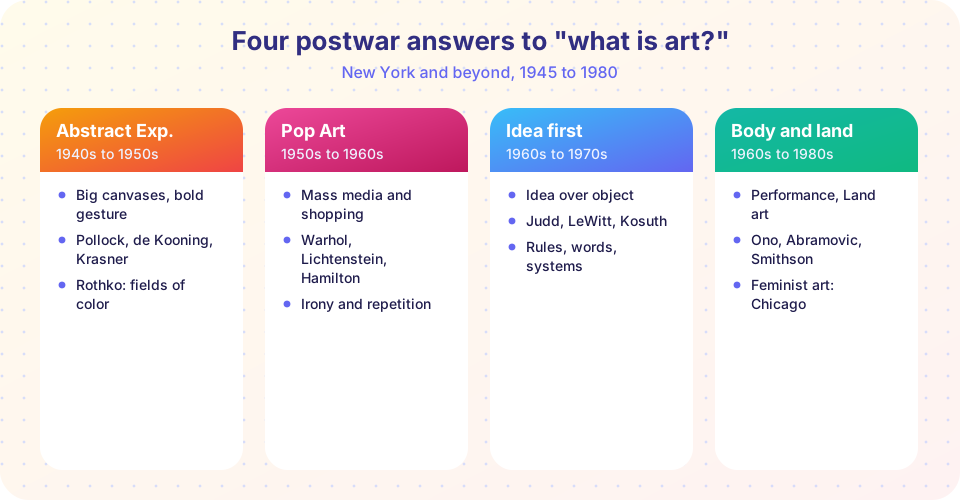
Between 1945 and 1980 art kept running into one question: what is left of art when you take away its traditional jobs? Abstract Expressionism removed the subject. Pop Art removed the line between art and advertising. Minimalism removed the artist's hand. Conceptual art removed the object. Performance and Land art moved art out of the frame and the gallery. Feminist artists asked whose bodies, labor and histories had been missing from museums all along. Each step is a bold experiment, and each makes sense once you see the one before it.
What you will learn
- How Abstract Expressionism made scale and gesture into subjects and why New York became a center of the art world.
- What Pop Art borrowed from mass culture and what it said about it.
- How Minimalist and Conceptual artists shifted attention from objects to ideas.
- How performance, Land art and feminist art extended art into the body, the land and politics.
Key terms
Abstract Expressionism: a postwar American movement of large, non-representational paintings emphasizing spontaneity, gesture or fields of color. Also called the New York School.
Pop Art: art that uses images from advertising, comics and consumer products, from the 1950s onward.
Minimalism: art reduced to simple geometric forms, often made of industrial materials, which asks viewers to attend to the object and the room.
Conceptual art: art in which the idea matters more than the finished object, sometimes consisting only of instructions or documents.
Performance art: art in which the artist's actions, often in front of an audience, are the work.
Abstract Expressionism: the scale of feeling
After the Second World War, New York began to rival Paris as the center of the art world, helped by artists who had fled Europe, a rich market and new museums. A group of American painters made huge abstract canvases. Jackson Pollock (1912 to 1956) laid canvases on the floor and poured and dripped enamel paint from above in rhythmic skeins, as in Autumn Rhythm (Number 30) (1950). The critic Harold Rosenberg called this "action painting": the canvas as an arena in which to act. A 1949 Life magazine article asked whether Pollock was the greatest living painter in the United States, making him a public figure.
Willem de Kooning (1904 to 1997) painted slashing, brutal figures such as Woman I (1950 to 1952). Mark Rothko (1903 to 1970) painted floating rectangles of color that aim for quiet, almost religious intensity; he wanted viewers to stand close and feel. Lee Krasner (1908 to 1984), Pollock's wife, made powerful gestural and collage paintings throughout her career and has been reassessed since the 1970s as a major artist in her own right. Helen Frankenthaler (1928 to 2011) poured thinned paint onto unprimed canvas in Mountains and Sea (1952), a "soak-stain" method that inspired color-field painters.
The critic Clement Greenberg championed this art as the highest point of modern painting, and some scholars argue that the US government and cultural foundations promoted Abstract Expressionism abroad as a sign of American freedom during the Cold War. Historians debate how strong that influence was, but the debate reminds us that art is never wholly separate from politics.
Pop Art: art meets the supermarket
By the mid-1950s, Britain and the United States were full of television, magazines, comics and packaged goods. In 1956 the British artist Richard Hamilton made a small collage of a modern living room with a bodybuilder and a lollipop; it is often named as an early work of Pop. Andy Warhol (1928 to 1987) began as a commercial illustrator, then in 1962 showed thirty-two canvases, one for each flavor of Campbell's soup, in Los Angeles. He used silkscreen printing to repeat images of celebrities such as Marilyn Monroe, producing pictures in his studio, the Factory, with assistants. Roy Lichtenstein (1923 to 1997) enlarged comic-strip panels and painted the printing dots by hand in works such as Whaam! (1963). British artist Pauline Boty (1938 to 1966) brought a feminist viewpoint to Pop, while Yayoi Kusama, a Japanese artist in New York in the 1960s, covered objects and rooms with repeated polka dots and soft protruding forms.
Is Pop a celebration of consumer culture or a critique of it? Warhol said little, which let viewers argue. Repetition may suggest the numbing power of mass production, or the glamour of a product. Good readings keep both possibilities open and look at the actual picture.
Press Run (or Ctrl + Enter) to see the result here.
Program input · what you'd type while the program runs
Type the answers before you press Run, one per line. Each time the program reads a line (with input()), it gets the next line from this box.
Minimalism and Conceptual art: from object to idea
In the 1960s a group of artists asked why a picture needs a story or a touch of the artist's hand. Donald Judd (1928 to 1994) made boxes of steel, aluminium and plexiglass, arranged in precise rows. Dan Flavin (1933 to 1996) used commercial fluorescent tubes to light a room with colored glow. Carl Andre arranged identical bricks and metal plates on the floor; a Tate purchase of his work, Equivalent VIII, caused a public row in 1976 about whether a pile of bricks could be art. Agnes Martin (1912 to 2004) made quiet grid paintings with faint hand-ruled lines that sit between Minimalism and spirituality. Minimal art asked viewers to be aware of themselves in a space with an object, not to look "into" a picture.
Conceptual art took the next step. In his 1967 essay "Paragraphs on Conceptual Art", Sol LeWitt (1928 to 2007) wrote that in this kind of art the idea is the most important part and the execution is a perfunctory affair. He wrote instructions for wall drawings that other people could carry out, so the same work could be drawn in many places. Joseph Kosuth's One and Three Chairs (1965) shows a real chair, a photograph of it and a dictionary definition of "chair", asking which is the real "chair" and what each tells us.
Because conceptual art can be reduced to text, it raised questions about ownership and the art market. Who owns an instruction? What happens when it is performed by someone else? Those questions are still debated in museums that collect "dematerialised" art.
The body, the land and the politics of seeing
Performance art. In Kyoto in 1964 Yoko Ono performed Cut Piece, sitting still while audience members cut away pieces of her clothing, a work about vulnerability and the viewer's role. Her book Grapefruit (1964) is a collection of instruction poems. In 1974 in Naples, Marina Abramovic stood still for six hours in Rhythm 0, with seventy-two objects, including a rose and a loaded pistol, on a table that visitors could use on her as they wished. Joseph Beuys (1921 to 1986) extended art into politics, calling his projects "social sculpture", and planted 7000 oak trees in Kassel from 1982.
Land art. Robert Smithson (1938 to 1973) built Spiral Jetty in April 1970 in the Great Salt Lake in Utah: a coil of basalt rock and earth about 450 meters long. Its color shifts as the lake's algae and water level change. Land art takes the work out of the museum and makes time, weather and travel part of seeing it.
Feminist art. In 1971 the art historian Linda Nochlin asked in an essay why there had been no "great" women artists, and answered that the question hides the institutional barriers that kept women out. Judy Chicago's The Dinner Party (1974 to 1979) is a triangular banquet table with thirty-nine place settings for historical and mythical women, now in the Brooklyn Museum. Critics have also noted that its imagery and guest list leave out many women of color, a reminder that feminist projects themselves need critical reading. The anonymous Guerrilla Girls, wearing gorilla masks, began in 1985 to publish posters with statistics on the lack of women and artists of color in museums. Faith Ringgold and Adrian Piper added Black feminist perspectives that challenged both the white feminist movement and the male-dominated art world.
Common misconceptions
"Pollock just splashed paint at random." His pouring was controlled and carefully balanced; he walked around and over the canvas and worked in layers.
"Pop Art is a joke." It is often witty, but it is also a serious study of how images shape desire. Warhol's work on death and disaster is rarely light.
"Conceptual art means no skill." The skill moves to ideas, rules, language and context, and some conceptual works are rigorous and quiet.
"Performance art can't be collected." Museums now collect photographs, scores, props and even re-performances, which raises hard questions about what is the 'work'.
Try it
Run the instruction drawing three times in a row with the same rule and compare. What stayed the same? What changed? Then run the Pop grid and change the palette lists to a set of your own: how many colorings can the same shape take before it stops feeling like "the same picture"?
Check your understanding
Quick check · 5 questions
of 5 answered You scored / 5 · perfect!
-
1. Who coined the term 'action painting'?
Harold Rosenberg used the term in 1952 to describe painting as an event. -
2. What did Warhol's silkscreen method allow?
It allowed multiple images of celebrities and products to be produced in a studio setting. -
3. What did Kosuth's One and Three Chairs present?
The work compares an object, an image and a definition. -
4. Where is Smithson's Spiral Jetty?
Built in 1970, it extends into the Great Salt Lake. -
5. Which statement about The Dinner Party is accurate?
Judy Chicago's work (1974 to 1979) is a triangular banquet table for 39 guests of honor.
Summary
- Abstract Expressionism made large-scale gesture and color the subject and helped move the art world's center to New York.
- Pop Art took images from advertising and comics and left open whether it celebrated or criticised them.
- Minimalism and Conceptual art shifted focus from the finished object to space, rules and ideas.
- Performance, Land art and feminist art extended art into the body, the landscape and the politics of who is seen.
Track your progress
Create a free account to tick off lessons and pick up where you left off on any device.
of Art History lessons completed