


















Lesson 25 of 49 · Baroque to Romanticism
Chapter 5 overview: Baroque to Romanticism
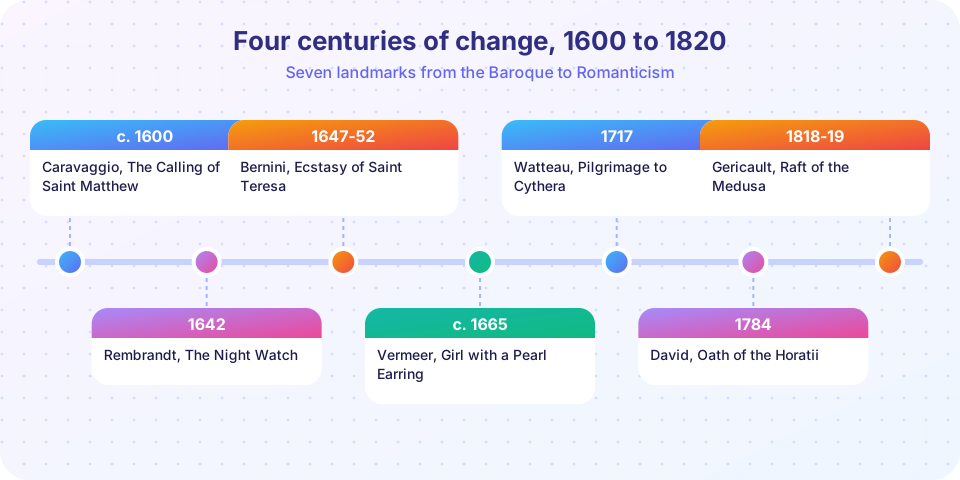
A map of European art from 1600 to 1850: Baroque drama, the Dutch Golden Age, Rococo and Neoclassicism, and the revolt of Romanticism.
Between about 1600 and 1850, European art changed direction again and again. Painters learned to stage light like theater directors, merchants in a small republic began buying pictures of their own kitchens, kings and revolutionaries used art as propaganda, and artists started to claim that feeling mattered more than rules. This chapter follows those changes in order, so you can see how each style answered the one before it.
The big picture
Art history likes labels, but a label is only a handle. Real artists lived through wars, plagues, trade booms and revolutions, and their pictures answer those pressures. Keep four questions in mind as you read the chapter:
- Who is paying? A pope, a king, a merchant guild and a private collector all want different pictures.
- What is the picture for? An altarpiece must move a congregation. A portrait must flatter a sitter. A history painting must teach a lesson.
- What can the artist do that earlier artists could not? New pigments, new lenses, new ideas about reason or feeling.
- What is the artist reacting against? Most styles begin as a complaint about the previous one.
Baroque: art that moves you
The Dutch Golden Age
Rococo and Neoclassicism
Romanticism
What each lesson covers
| Lesson | Focus | Key works |
|---|---|---|
| Baroque drama and the language of light | Counter-Reformation art, tenebrism, motion | Caravaggio, Artemisia Gentileschi, Bernini |
| The Dutch Golden Age | A market for pictures, genre and still life | Rembrandt, Vermeer, Hals, Leyster |
| Rococo and Neoclassicism | Pleasure against reason | Watteau, Fragonard, David, Kauffman |
| Romanticism | The sublime and political protest | Goya, Gericault, Friedrich, Turner |
| Chapter review | One-page recap and a long quiz | All of the above |
Three threads that run through the chapter
Light. In 1600 light is a spiritual tool. By 1665 it is something you can measure on a wall. By 1844 it dissolves a whole landscape into color. Following light is the quickest way to feel the century change.
The status of the artist. Early in the period, painters are craftsmen who take commissions. By the end, a Romantic painter can claim to be a visionary whose private feeling is the subject. Women artists such as Artemisia Gentileschi, Judith Leyster, Rachel Ruysch and Angelica Kauffman worked against heavy barriers, and their careers show how access to training and patrons shaped who got remembered.
Who looks. Baroque altarpieces were seen by crowds at worship. Dutch pictures hung in homes. Salon paintings were seen by thousands in Paris in the 1700s, when public exhibitions began to create something like an audience and a press for art criticism.
Dates in art history are often approximate. "c. 1600" means "circa", about that year, and many works were made over several years. Treat dates as a map, not a stopwatch.
How to use this chapter
Read each lesson once for the story, then open the images of the named works in a museum website (the Rijksmuseum, the Louvre, the National Gallery London and the Metropolitan Museum all publish high-resolution images free). Look for the features the lesson names. The interactive demos use original diagrams and simple models, not reproductions, so they are meant to be played with next to a real image.
A quick tour of the lessons
Expect each lesson to follow the same rhythm: a short story of the period, a close look at two or three works, an interactive demonstration, and a quiz. In the Baroque lesson, you will move the light in a dark room and see why one strong source makes drama. In the Dutch lesson you will build a floor in perspective and decode the symbols of a vanitas. In the Rococo and Neoclassicism lesson, you will sort traits between two styles that were almost neighbors. In the Romanticism lesson you will turn a dial that shows how scale creates the sublime.
By the end of the chapter, you should be able to look at an unfamiliar picture from this period and place it: roughly when, where and for whom it was made, which features give it away, and which other works it answers. You should also be able to say why the historians' labels exist and where they stop being useful.
Check your understanding
Quick check · 3 questions
of 3 answered You scored / 3 · perfect!
-
1. Which question helps you explain why a picture looks the way it does?
Patron and purpose shape subject, size and style, so they are the most useful first questions. -
2. Roughly which period does this chapter cover?
The chapter runs from the early Baroque around 1600 to the later Romantic painters in the mid-19th century. -
3. What does the abbreviation 'c.' before a date mean?
c. stands for circa, signalling an approximate date.
Summary
- The chapter moves from Baroque drama to Dutch realism, then Rococo and Neoclassicism, then Romanticism.
- Patron, purpose, available techniques and reaction against the past explain most stylistic changes.
- Three threads to follow: light, the status of the artist, and who looks.
- Dates are approximate; trust the sequence more than any single year.
Track your progress
Create a free account to tick off lessons and pick up where you left off on any device.
of Art History lessons completed