


















Lesson 21 of 49 · Medieval and Renaissance Art
The Early Renaissance in Florence: Perspective, Patrons and New Bodies
How Florence reinvented picturing in the 1400s: Giotto's solid figures, Brunelleschi's perspective and dome, Masaccio, Donatello, Botticelli and the Medici, with a perspective playground.
In the year 1401, the city of Florence held a competition. The wool merchants' guild wanted bronze doors for the baptistery opposite the cathedral, and young sculptors were invited to submit a bronze relief of the sacrifice of Isaac. The winner, Lorenzo Ghiberti, spent twenty-one years on the doors. The runner-up, Filippo Brunelleschi, is said to have been so disappointed that he left for Rome to study ancient ruins. When he came back, he designed a dome that no one thought could be built and a way of drawing space that changed European art for five hundred years.
Florence in the fifteenth century was a republic of bankers, cloth makers and guilds, and the most ambitious art city in Europe. Competition, wealth and a new interest in ancient Rome and Greece created conditions in which painters, sculptors and architects asked new questions: How can a flat surface show real space? How does the body work? What did the ancients know that we have forgotten? This lesson follows the answers from Giotto to Botticelli.
What you will learn
- Why Florence became the center of new art, and who paid for it.
- How linear perspective works and who developed it.
- What Giotto, Masaccio, Donatello and Botticelli each contributed.
- How the status of artists changed during the century.
Key terms
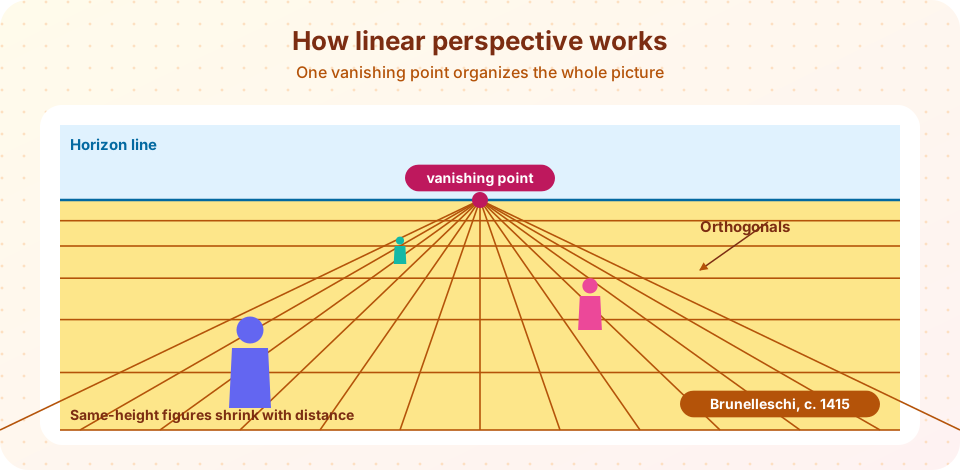
- Linear perspective: a system for showing three-dimensional space on a flat surface, using lines that converge at a vanishing point.
- Orthogonal: in perspective, a line that runs into the picture toward the vanishing point.
- Atmospheric perspective: making distant objects paler and bluer.
- Bottega: a workshop where a master and assistants produced art.
- Patron: a person or institution that commissions art.
- Humanism: the study of classical texts and a focus on human worth and achievement.
Why Florence?
Florence was rich. Its wool and silk industries and its bankers, notably the Medici family, who set up their bank in 1397 and ran the city's politics from the 1430s under Cosimo de' Medici, put huge sums into art. Guilds (the wool merchants, the cloth finishers) paid for sculptures, church decoration and public buildings, competing with each other. Wealthy families paid for chapels, altarpieces and portraits, partly out of piety and partly to display their position. A third force was humanism: scholars hunted for forgotten Latin and Greek manuscripts and admired the ancient world, and artists joined in by studying Roman ruins and statues. In 1348 the Black Death killed perhaps half of the city's population, which changed attitudes to life, death and religion.
Giotto: solid bodies and feeling
The sources of change reach back to Giotto di Bondone (about 1267 to 1337). Before him, Italian painting still followed Byzantine models: gold grounds, flat bodies, stiff gestures. In the Arena Chapel in Padua (about 1303 to 1305), painted for the banker Enrico Scrovegni, Giotto filled the walls with scenes from the lives of Mary and Christ in which the figures have weight, cast shadows and show feeling. In the Lamentation, mourning angels dive across the sky in grief and the figures crowd around Christ's body, turning their backs to the viewer. The space is shallow and the proportions are still simplified, but the drama is human. Later writers like Vasari saw Giotto as the person who "brought painting back to life."
Brunelleschi: perspective and the dome
Filippo Brunelleschi (1377 to 1446) was trained as a goldsmith and became the first great Renaissance architect. His achievements were two.
The dome. Florence Cathedral (Santa Maria del Fiore) had stood for generations with a huge octagonal opening where the dome should be, about 45 meters wide. No one knew how to build a vault that large without a vast wooden framework. Brunelleschi designed a double-shelled dome of brick, with a herringbone pattern in the brickwork that locked the courses and chains of stone and wood to hold it in. The main structure was complete in 1436, and it is still the largest masonry dome ever built.
Perspective. Around 1415, according to his biographer Antonio Manetti, Brunelleschi painted a small panel showing the Baptistery in Florence in accurate perspective, and invited viewers to look at it through a hole in the back while holding up a mirror in front. Their eye saw the painted image and the real scene seem to match. The panel is lost, so we depend on the account, but the idea spread. In 1435 the humanist Leon Battista Alberti wrote On Painting, explaining the method: imagine the picture as an open window, fix a viewpoint, draw the orthogonals to a single vanishing point, and space the cross-lines (the transversals) so that equal distances shrink with distance. The Try it section lets you play with it.
Perspective was more than a trick. It treated the picture as a view from one place at one moment, making the viewer an individual with a position, and it turned painting into a branch of mathematics and optics, which raised the status of painters. It also made it possible to place figures in a believable room, a street or a landscape.
Masaccio: the first Renaissance painter
Masaccio (1401 to about 1428) died in his twenties but changed painting. In the Holy Trinity fresco in Santa Maria Novella (about 1426 to 1428), a barrel-vaulted chapel in perfect perspective appears to open into the wall, with the Trinity above two kneeling donors. A skeleton on a tomb below carries an inscription that reminds the viewer, in effect, that they will be like it one day. In the Brancacci Chapel in Santa Maria del Carmine, Masaccio painted the Tribute Money with figures that stand firmly, light that comes from one direction and shadows that match, and the Expulsion from the Garden of Eden, in which Adam and Eve cry out in shame and sorrow with a raw realism that no one had shown before.
Sculpture: Ghiberti and Donatello
Ghiberti's second set of baptistery doors, made from 1425 to 1452, are called by tradition the Gates of Paradise, a name often credited to Michelangelo. Their ten gilded panels use perspective in shallow relief to show Old Testament scenes.
Donatello (about 1386 to 1466) brought the free-standing figure back to life. His bronze David (about 1440s), a nude youth with a sword and Goliath's severed head under his foot, is the first free-standing nude statue since antiquity, with a pose in contrapposto borrowed from the classical past. His Gattamelata (1445 to 1453) in Padua, a bronze equestrian monument to a mercenary general, revived the Roman tradition of honoring a hero on horseback, as in the statue of Marcus Aurelius.
Other voices
- Fra Angelico (about 1395 to 1455), a Dominican friar, painted luminous frescoes for the monastery of San Marco that combine simple devotion and elegant perspective.
- Piero della Francesca (about 1415 to 1492) wrote on mathematics and perspective; his calm, geometric paintings, like the Flagellation (about 1455 to 1460), are puzzles of space and light.
- Andrea Mantegna (about 1431 to 1506), working in northern Italy, painted the extreme foreshortening of a Lamentation over the Dead Christ (about 1480), seen from the feet.
- Sandro Botticelli (about 1445 to 1510) painted for the Medici circle. His Primavera (about 1480) and The Birth of Venus (about 1485) revive classical myths with graceful lines and, in the second, a rare nude goddess. The Birth of Venus is tempera on canvas and, instead of strong volume, it uses flowing outlines and gentle pattern. Scholars still debate the meaning: it may relate to Neoplatonic ideas about divine beauty, but no document settles it.
When you compare Giotto, Masaccio and Botticelli, ask how each treats space, body, light and feeling. Giotto gives bodies weight; Masaccio adds measured space and consistent light; Botticelli returns to line and elegance within a classical subject.
The status of the artist
At the start of the century an artist was a craftsman in a guild, working in a bottega and paid like a builder or goldsmith. By the end, a few were treated as intellectuals and even geniuses. Artists wrote theory (Alberti, Piero), studied anatomy and mathematics, signed their work and became friends of rulers. A bottega remained a business: Verrocchio's workshop, where Leonardo trained, produced paintings, sculpture and metalwork, and apprentices learned by copying, grinding colors and finishing the master's designs.
Common misconceptions
"Brunelleschi invented perspective from nothing." Artists and thinkers before him used partial methods, and Greek and Arab writers studied optics. Brunelleschi, Alberti and others created a consistent geometric system.
"Renaissance artists worked alone." Most worked in workshops with assistants and apprentices, and many works are collaborations.
"Perspective is the only correct way to show space." It is one system among many. Chinese hanging scrolls and Japanese prints use other solutions that suit their purposes equally well.
Try it
Check your understanding
Quick check · 5 questions
of 5 answered You scored / 5 · perfect!
-
1. What is linear perspective?
Developed in Florence in the early 1400s and described by Alberti in 1435. -
2. Which building project was completed by Brunelleschi in 1436?
He designed a double-shelled brick dome that did not need a full wooden framework. -
3. What did Masaccio's Holy Trinity show?
The fresco (about 1426-28) is a landmark of perspective and of memento mori imagery. -
4. Why was Donatello's bronze David important?
It revived the classical free-standing nude and contrapposto. -
5. Who helped fund Florentine art?
Guilds, families and church bodies all commissioned art.
Summary
- Florence was a wealthy republic where guilds, bankers like the Medici and humanist scholars drove new art.
- Giotto gave painted figures weight and feeling; Brunelleschi invented a workable perspective system and built the cathedral dome (1436); Alberti wrote it down (1435).
- Masaccio, Donatello and others made solid bodies in believable space; Botticelli favored graceful line and classical myth.
- Artists' status rose from craftsmen to thinkers, though most still worked in workshops.
- Perspective is one way of showing space, not the only correct one.
Next: The High Renaissance
Track your progress
Create a free account to tick off lessons and pick up where you left off on any device.
of Art History lessons completed