


















Lesson 43 of 49 · Methods, Museums and Projects
Chapter 8 review: methods, museums and evidence
Review attribution, provenance, scientific analysis, five interpretive lenses and museum ethics with a one-page picture, a sorting game and ten questions.
This chapter was about how we know. Anyone can say "this is a Rembrandt" or "this means freedom". A trained reader asks for the evidence, the lens and the context. The review below pulls the chapter together on a page. Study the picture and table, try the sorting game, and then take the long quiz.
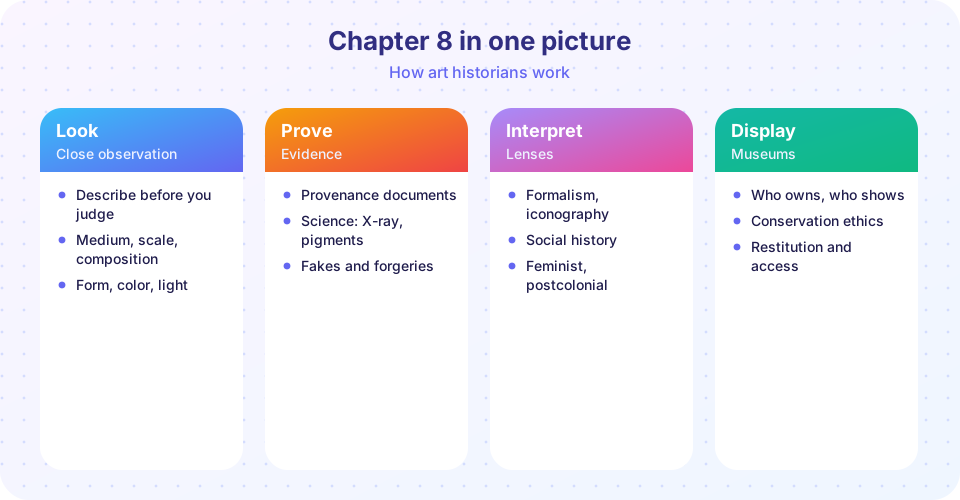
Recap table
| Skill | Key ideas | Examples |
|---|---|---|
| Look | Describe medium, scale, composition, color and light before interpreting | Formal analysis; Wolfflin's pairs |
| Attribute | Connoisseurship (Morelli), workshop vs master, label language | "By", "attributed to", "workshop of", "after" |
| Prove | Provenance, X-ray, infrared, dendrochronology, pigment dating | Van Meegeren, Beltracchi, 1933 to 1945 gaps |
| Interpret | Iconography, social history, feminist and postcolonial lenses | Panofsky, Baxandall, Nochlin, Said |
| Display | Museums shape meaning: hang, light, label | White cube, salon hang |
| Act ethically | Conservation, restitution, sponsorship | Parthenon Marbles, Benin objects, Washington Principles |
Five habits to remember
- Look first, read second. Describe what is physically there.
- Separate claim from evidence. Ask "how do we know?"
- Use more than one lens. Each lens has a blind spot.
- Check the chain. Provenance gaps deserve questions.
- Remember the frame. Display and ownership are part of the story.
Press Run (or Ctrl + Enter) to see the result here.
Program input · what you'd type while the program runs
Type the answers before you press Run, one per line. Each time the program reads a line (with input()), it gets the next line from this box.
How the lessons connect
The first lesson of the chapter dealt with evidence and the second with interpretation, but they are really two halves of one skill. Evidence without interpretation is a pile of facts: you may know the date of a panel from its tree rings and the owners from an invoice, yet still have no idea why the picture matters. Interpretation without evidence is opinion: it may be lively but it cannot be checked. Good art history keeps both in hand. When a historian says a painting "protests against war", you should be able to ask what visible features and what documents support that claim.
Museums add a third element: the frame. Where an object hangs, how it is labelled and whose name is on the gallery all affect what visitors think. The ethical questions about restitution, conservation and funding are not outside art history; they are part of the history of how works arrived and what has been done to them.
Compare and contrast prompts
- A museum label reading "attributed to" and one reading "workshop of": what do they signal, and what evidence might change each?
- Panofsky's three levels and a social-history approach: what does each see in a Dutch still life that the other might miss?
- The Parthenon Marbles dispute and the return of Benin objects: what do the two cases share, and how do their histories differ?
Common exam traps
- Believing that a scientific test can prove authenticity. It more often rules things out.
- Mixing up attribution (who made it), authentication (is it genuine) and provenance (who has owned it).
- Treating one lens as the correct one. Each has strengths and blind spots, and strong writing says so.
- Using vague language ("controversial", "problematic") without naming the specific issue.
A final worked check
Take a painting labelled "attributed to" a famous artist, with a provenance that has a gap from 1933 to 1945 and an X-ray that shows a different composition underneath. Walk through the chapter. The label says the museum is not certain. The gap invites research in archives about forced sales or seizure. The X-ray may support attribution (a confident underdrawing and changes of mind in a familiar style) or raise doubt (a stiff, copied outline). A formal analysis, an iconographic reading and a social-history question would each add something, and a postcolonial or feminist lens might ask who is missing from the story. A strong answer names the evidence, the lens and the limits of each.
Check your understanding
Quick check · 10 questions
of 10 answered You scored / 10 · perfect!
-
1. Why is a scientific test usually better at disproving than proving authenticity?
An anachronistic pigment is strong negative evidence; period materials alone are not proof. -
2. What does 'workshop of' on a label indicate?
It describes studio production. -
3. Which approach asks who paid, who saw and who was excluded?
Social history places the work in its economic and political setting. -
4. What did Panofsky's three levels begin with?
The first level is description before identification and interpretation. -
5. The 'white cube' is:
O'Doherty named it in 1976. -
6. Han van Meegeren's forgeries were undermined partly by:
Scientific analysis revealed materials Vermeer could not have used. -
7. Which sequence of years raises special provenance concerns?
Works could have been seized or sold under pressure during the Nazi era. -
8. Which museum opened to the public in 1793 in revolutionary France?
The Louvre was opened as a public museum in 1793. -
9. What is a pentimento?
X-rays and infrared often reveal these changes of mind. -
10. A sensible conservation principle is:
Minimal, reversible, documented treatment is the standard aim.
Summary
- Good art history separates description, evidence and interpretation.
- Attributions and provenance are living judgments built from documents, science and expertise.
- Five lenses, each with blind spots, help ask better questions.
- Museums shape meaning and face ethical choices about conservation, ownership and funding.
Track your progress
Create a free account to tick off lessons and pick up where you left off on any device.
of Art History lessons completed