


















Lesson 4 of 49 · Getting Started
The Big Timeline: Periods, Styles and Their Limits
A guided map of art history from Ice Age caves to the present, how periods got their names, why they are only tools, and what happened outside Europe.
Art history is long. The oldest known images are tens of thousands of years old, and the newest are being made today. To keep your bearings you need a map: a handful of big periods with rough dates, and a few landmark works pinned to each. This lesson gives you that map, then immediately warns you that every map simplifies. Periods are handy labels invented, often long after the fact, by people who wanted to make sense of a huge tangle of works. Treat them as scaffolding, not as walls.
You will meet the eight stretches that structure the rest of the course, learn how some of them got their names (several began as insults), see why the early periods are so much longer than the later ones, and get a first look at what was happening in other parts of the world at the same time.
What you will learn
- The eight big periods used in this course, with rough dates.
- One landmark work for each period.
- How periods were named and why those names are conventions.
- What was happening in other regions in the same centuries.
Key terms
- Period: a span of time grouped by shared features in art, such as Baroque or Medieval.
- Movement: a group of artists with shared aims, usually in a shorter span, such as Impressionism.
- Style: the recognizable look of a group, a place or an individual.
- Chronology: the ordering of events in time.
- Periodization: the act of cutting time into periods.
The eight stretches
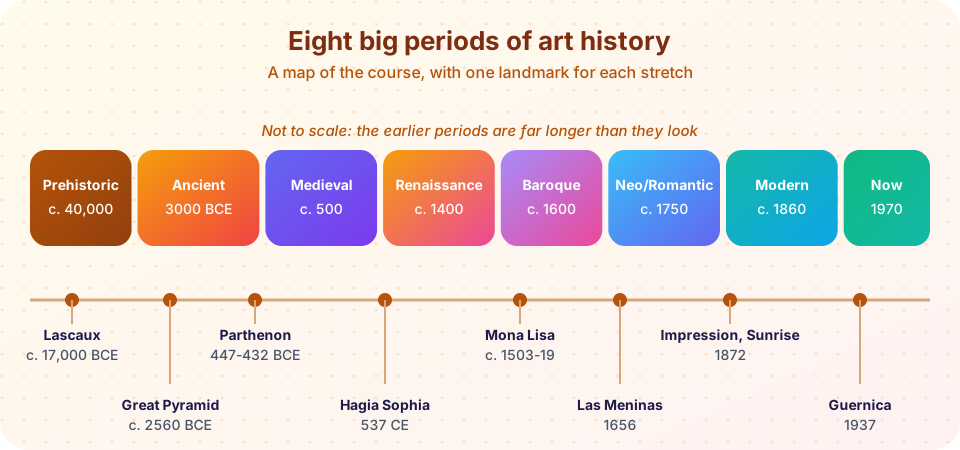
1. Prehistoric (about 40,000 to 3000 BCE). "Prehistoric" means before writing. It includes cave paintings such as those at Lascaux in France, usually dated to about 17,000 years ago, small carved figures such as the Venus of Willendorf (roughly 25,000 to 30,000 years old) and the great stone monuments of Neolithic Europe, among them Stonehenge, whose main phases fall in the third millennium BCE.
2. Ancient (about 3000 BCE to 476 CE). The first cities and states in Mesopotamia and Egypt, then Greece and Rome. The Great Pyramid at Giza (about 2560 BCE), the Parthenon in Athens (built 447 to 432 BCE) and the Colosseum in Rome (opened 80 CE) belong here. The end date, 476 CE, is the traditional date for the fall of the last western Roman emperor.
3. Medieval (about 500 to 1400). A long middle period of churches, monasteries, mosques and palaces, from the Byzantine Hagia Sophia (537) to the Gothic cathedrals of France and the illuminated manuscripts of many lands. The word comes from "middle age", a label invented by later Europeans.
4. Renaissance (about 1400 to 1600). A period when artists in Italy, and then elsewhere, revived classical ideas and developed linear perspective and realistic anatomy. Landmarks include Brunelleschi's dome in Florence (completed in the 1430s), Leonardo's Mona Lisa (begun about 1503) and Michelangelo's Sistine Chapel ceiling (1508 to 1512). In northern Europe, Jan van Eyck's oil paintings of the 1430s mark a parallel flowering.
5. Baroque and Rococo (about 1600 to 1750). Drama, movement and strong light and shadow: Caravaggio's paintings, Bernini's sculptures, Velázquez's Las Meninas (1656), and the glittering palaces and curving ornament of the late phase called Rococo.
6. Neoclassicism and Romanticism (about 1750 to 1850). Two partners and rivals: a calm return to Greek and Roman ideals (Jacques-Louis David) and a passionate focus on feeling, nature and the sublime (Eugène Delacroix, Caspar David Friedrich, J. M. W. Turner).
7. Modern (about 1860 to 1970). From Impressionism, named after Monet's Impression, Sunrise (painted 1872, shown in 1874), through Cubism, abstraction, Surrealism and Abstract Expressionism. Guernica (1937) sits here. Modernists repeatedly broke the rules of the past.
8. Contemporary (about 1970 to today). Art in an age of many media: photography, video, installation, performance and digital work, with global biennials and an art market that spans continents.
How periods got their names
Names often came later and sometimes began as slurs.
- Gothic was an insult. Renaissance writers such as Vasari called the pointed-arch architecture of the Middle Ages "Gothic", meaning barbarian, as if it were the work of the Goths who had destroyed Rome.
- Baroque was probably first used to mean irregular or exaggerated, perhaps from a word for an oddly shaped pearl. Only in the nineteenth century did it become a neutral label.
- Impressionism came from the critic Louis Leroy, who mocked a Monet title in a satirical review of an 1874 exhibition. The painters adopted the label.
- Renaissance means "rebirth". The idea that art was reborn after a "dark" Middle Ages comes from Vasari and was later made famous by the nineteenth-century historian Jacob Burckhardt. Modern scholars think the Middle Ages were far richer than that story admits.
Periods are not like geological layers. People did not wake up one morning in 1400 and start being Renaissance. Styles overlap, regions develop at different speeds and artists mix influences. When a lesson says "Baroque", read it as "a useful bundle of features, centered on roughly these dates and places".
Why the bars are not to scale
Look at the timeline picture again. The first bar covers about seven times the span of everything after 3000 BCE put together. If we drew the bars to scale, the Renaissance would be a hair and Contemporary art would vanish. Two reasons for the distortion:
- Our records are denser nearer to us. More works survive, and more is known about who made them. A single decade of the nineteenth century supports whole books.
- Change speeds up. Over tens of thousands of years of prehistory, styles changed slowly. In the last two centuries new movements have appeared every decade or so.
Use the plot in the Try it section to see the real proportions on a logarithmic scale, where each step along the axis multiplies the length by ten.
The same centuries, elsewhere
If you only follow the European labels, you can imagine that nothing else was going on. In fact each of these periods has parallels, which later chapters visit:
| Europe | Elsewhere, same time |
|---|---|
| Medieval (500-1400) | Tang and Song China (618-1279) paint monumental landscapes; Islamic courts build the Alhambra in Granada (mostly 13th and 14th centuries); Great Zimbabwe rises in southern Africa |
| Renaissance (1400-1600) | Ming China, Safavid Persia and the Mughal Empire develop refined painting; the Aztec and Inca build great cities such as Tenochtitlan and Machu Picchu; Benin's court casts brass plaques |
| Baroque (1600-1750) | Mughal miniatures and architecture (the Taj Mahal, finished about 1653); Edo-period Japan; the Dutch Golden Age at home and in trade networks |
| Neoclassical and Romantic (1750-1850) | Hokusai's Great Wave (about 1831); the art of Qing China; Haitian and Latin American revolutions inspire new images |
The Baroque and Mughal examples remind us that these traditions were not isolated. Silk, silver, ceramics and ideas traveled along trade routes, and European artists borrowed from Asian prints, Persian carpets and Islamic geometry as much as they borrowed from Greece.
Using the timeline in practice
A practical trick: attach every new work to a "peg" on the timeline using the three anchor facts from lesson one. For example, "Las Meninas: Spain, 1656, oil on canvas, Baroque." Within a few weeks of this habit you will recognize what is "before" and "after" many works without looking them up. Another trick is to learn two or three "pairs" that span a period boundary, such as Giotto (about 1305) and Masaccio (about 1425), and ask what changed between them. Chapter 4 makes that a game.
Common misconceptions
"Each period replaced the last one." Older styles often continued alongside new ones. Academic painters kept working in classical styles while Impressionists were rebelling.
"Progress means getting more realistic." Realism is one goal among many. A Byzantine mosaic aims for spiritual presence, and a Cubist still life aims to show several views at once.
"The Middle Ages were a dark age for art." Medieval artists made some of the most ambitious buildings and books in history, and their work shaped the Renaissance.
Try it
Press Run (or Ctrl + Enter) to see the result here.
Program input · what you'd type while the program runs
Type the answers before you press Run, one per line. Each time the program reads a line (with input()), it gets the next line from this box.
Check your understanding
Quick check · 5 questions
of 5 answered You scored / 5 · perfect!
-
1. Why is the 'Prehistoric' bar so long on a true-scale timeline?
Prehistory runs from about 40,000 BCE to 3000 BCE, around 37,000 years. All later periods together are roughly 5,000 years. -
2. Which period name began as a mocking review of a Monet painting?
The critic Louis Leroy mocked Monet's Impression, Sunrise in a review of an 1874 exhibition, and the painters adopted the word. -
3. What was Vasari's 'Gothic' meant to suggest?
Renaissance writers used 'Gothic' as a put-down for medieval architecture. Today it is a neutral label. -
4. Which statement about periods is best?
Periodization is a human tool. Styles overlap and the divisions of European history do not fit every culture. -
5. Which pair of works is correctly matched with its period?
Velazquez painted Las Meninas in 1656, in the Baroque era. The Parthenon is Ancient, Guernica is Modern and Hagia Sophia is Medieval (Byzantine).
Summary
- The course uses eight big periods: Prehistoric, Ancient, Medieval, Renaissance, Baroque, Neoclassical and Romantic, Modern, Contemporary.
- Names such as Gothic, Baroque and Impressionism began as insults or labels applied later.
- Periods are tools. They overlap, differ by region, and the earlier ones are much longer than the later ones.
- Other regions had rich parallel traditions, and routes of trade carried ideas between them.
- Pegging each work to who, when and medium builds a mental timeline quickly.
Next: Chapter 1 Review
Track your progress
Create a free account to tick off lessons and pick up where you left off on any device.
of Art History lessons completed