


















Lesson 15 of 49 · Ancient and Classical Art
Greek Art: Temples, Statues and Painted Vases
Follow Greek art from geometric vases to the Hellenistic Laocoon: the three orders, the Parthenon, contrapposto, painted statues and the Elgin Marbles debate.
Greek art begins with abstract patterns on pots and ends, a thousand years later, with statues that twist, scream and seem to move. In between is a story of rapid change that has fascinated artists ever since: the move from stiff, symmetrical figures to bodies that stand with the weight on one leg, and from simple columns to temples whose curves were refined to the last centimeter. Many later artists, from Renaissance sculptors to the designers of modern banks and government buildings, looked to Greece for models of order and beauty.
This lesson covers the main stages of Greek art from about 900 to 30 BCE: Geometric, Archaic, Classical and Hellenistic. It also asks questions that the ancient Greeks themselves asked, such as whether beauty is a matter of ideal proportion, and some that we ask today, such as who should own the Parthenon sculptures.
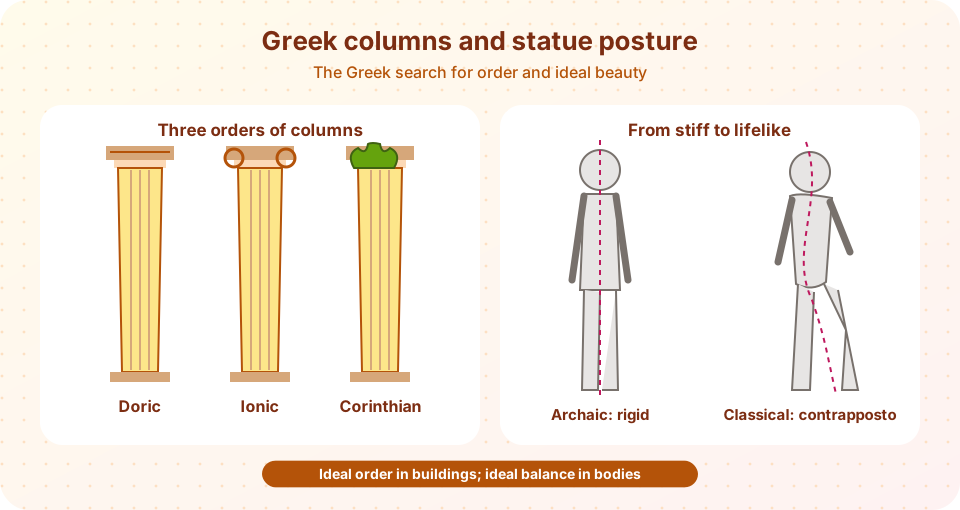
What you will learn
- The four main periods of Greek art and their characteristic works.
- The three orders of architecture and the main features of the Parthenon.
- How sculpture changed from the kouros to contrapposto to Hellenistic drama.
- How vase painting works, and why Greek marbles were not white.
Key terms
- Order: a system of column and entablature (the part above the columns): Doric, Ionic or Corinthian.
- Kouros (plural kouroi): an archaic standing nude male statue; the female version is kore.
- Contrapposto: a pose in which the weight rests on one leg, tilting hips and shoulders in opposite directions.
- Entasis: a slight swelling in the middle of a column.
- Black-figure and red-figure: two vase-painting techniques.
Four periods
| Period | Dates (approximate) | Hallmarks |
|---|---|---|
| Geometric | 900 to 700 BCE | Vases decorated with bands of triangles, meanders and stylized figures |
| Archaic | 700 to 480 BCE | Kouroi and korai, black-figure vases, early stone temples |
| Classical | 480 to 323 BCE | Idealized, balanced bodies; the Parthenon; red-figure vases |
| Hellenistic | 323 to 31 BCE | Drama, emotion, individual types, a wide spread of Greek culture |
The Classical period is often counted from the Greek victory over the Persians (480 to 479 BCE) to the death of Alexander the Great (323 BCE), whose conquests carried Greek culture across the Near East, Egypt and into Asia, beginning the Hellenistic age. The end of the Hellenistic period is often set at the Roman defeat of Cleopatra and Mark Antony at Actium in 31 BCE.
The Greek temple and its orders
A Greek temple was a house for a god's statue, not a space for crowds. Worshippers gathered outside at an altar. This allowed architects to focus on the outer look: a rectangle of columns, beams and a gabled roof. Three orders developed.
- Doric (earliest, mainland Greece and Italy): sturdy, fluted columns with no base and a plain, cushion-like capital. Its frieze alternates grooved triglyphs and sculpted metopes. Feels strong and masculine to the Greeks.
- Ionic (eastern Greece): slender columns on a base, with a capital decorated with scroll-like volutes, and a continuous frieze. Feels elegant.
- Corinthian (more common from the fourth century BCE and very popular with the Romans): a capital with acanthus leaves. A later Roman writer, Vitruvius, told a charming story that the sculptor Callimachus invented it after seeing a basket covered by a plant, but that is probably a legend.
The Parthenon on the Acropolis in Athens (built 447 to 432 BCE) is a Doric temple with Ionic touches, designed by the architects Iktinos and Kallikrates and decorated under the direction of the sculptor Pheidias. It housed a colossal gold-and-ivory statue of the goddess Athena (now lost). Its builders corrected optical illusions: the base curves gently upward, the columns lean slightly inward and swell (entasis), so that the temple looks perfectly straight and alive instead of sagging. Its sculpture includes 92 metopes, a continuous frieze that probably shows the Panathenaic procession and two pediments with scenes of the birth of Athena and her contest with Poseidon. It served as a temple, a treasury and later a Christian church and an Ottoman mosque. In 1687 a Venetian bombardment ignited gunpowder stored inside and blew out much of its center.
Sculpture: from kouros to contrapposto
Archaic. Early Greek sculptors learned from Egypt. A kouros, like the one dated about 600 BCE in the Metropolitan Museum of Art, stands with arms by the sides, left foot forward, rigid and frontal. The face wears the "Archaic smile", a slight upward curl of the lips that suggests life. The figure stands for a youth, perhaps an athlete or a grave marker.
Early Classical. Around 480 BCE the Kritios Boy broke the pattern: his weight shifts onto one leg and his head turns slightly. This is the first well-known appearance of contrapposto ("counterpoise"), where hips and shoulders tilt in opposite directions. The idea spread, and the result is a figure that seems relaxed and lifelike.
High Classical. Sculptors sought ideal proportion. Polykleitos wrote a treatise called the Canon, now lost, and made a statue, the Doryphoros ("Spear-Bearer," about 440 BCE), to illustrate it. We know it from Roman marble copies, since the bronze original is lost. Myron's Discobolus ("Discus Thrower," about 450 BCE) freezes an athlete at the moment before release, again known from copies. Pheidias led the work on the Parthenon and made the colossal Athena. Their figures are calm, balanced and idealized: no wrinkles, no anger.
Late Classical. In the fourth century BCE Praxiteles made the Aphrodite of Knidos, the first major statue of a nude woman, and carved softer, more sensuous forms. Lysippos, court sculptor to Alexander, used a slimmer, more elongated proportion and turned figures so that they must be seen from several sides.
Hellenistic. After Alexander, artists explored emotion, age, pain and variety. The Winged Victory of Samothrace (about 190 BCE), now in the Louvre, shows the goddess Nike alighting on the prow of a ship, her wet drapery whipped by wind. The Laocoön and His Sons, carved on Rhodes and found in Rome in 1506, shows a Trojan priest and his sons crushed by sea serpents, an explosion of twisting muscle and agony. Michelangelo, who was present at its unearthing, was deeply influenced by it.
A quick test for period: look at the face. Archaic faces smile slightly; Classical faces are calm and ideal; Hellenistic faces can show pain, age and character.
Painted vases
Greek pottery was made for wine, water and oil and for ceremonies and burials. Its painted scenes, of myth, sport, banquets and daily life, are our best view of Greek painting, since nearly all wall and panel painting is lost. In black-figure (about 700 to 500 BCE) figures are painted in black slip on the red clay, and details are scratched through the black. Exekias, painting in Athens around 540 to 530 BCE, made a famous amphora of Achilles and Ajax playing a board game, with remarkable detail and tension. About 530 BCE the Athenians invented red-figure, where the background is painted black and the figures are left in red clay, with details drawn in fine lines, which gave painters more freedom to show foreshortening and expressive faces. Many vases are signed, so we know names such as Exekias, Euphronios and the potters who made the vases.
Greek sculpture was painted
Because ancient marbles now look white, people assumed the Greeks preferred white. In fact statues and temple sculpture were often painted in strong colors, with colored eyes, lips, clothing and patterns. Traces of pigment survive and have been studied with ultraviolet light and microscopes, and modern reconstructions show vivid results. The idea of a pure white antiquity is largely a later invention, powerfully promoted in the eighteenth century by Winckelmann, who admired the white copies he knew. When you imagine Greek temples, think color.
The Parthenon sculptures: a continuing argument
In the early 1800s Lord Elgin, the British ambassador to the Ottoman Empire, removed large parts of the Parthenon sculptures with a permission whose exact scope is argued, and sold them to the British government in 1816. They are in the British Museum, while other parts stay in Athens, where the Acropolis Museum opened in 2009 with a gallery designed to hold them. Greece has long asked for their return. The British Museum has argued that its collection shows world cultures together and that Elgin acted legally under Ottoman authority; critics say the sculptures were taken from an occupied country and should be reunited. We return to such cases in chapter 8.
Common misconceptions
"Greek art was all about realism." Classical Greek sculpture aimed at an ideal, a perfect, calm body, rather than portraits of real individuals. True portraiture grew in the Hellenistic and Roman periods.
"The Parthenon is a perfect rectangle." It is full of subtle curves, designed to look straight to the human eye.
"We have the originals." Many famous Greek statues, including the Doryphoros and Discobolus, survive only in Roman copies.
Try it
Check your understanding
Quick check · 6 questions
of 6 answered You scored / 6 · perfect!
-
1. What is contrapposto?
The Kritios Boy (about 480 BCE) is an early example. It makes figures look relaxed and lifelike. -
2. Which order has scroll-like volutes on its capital?
The Ionic capital has volutes. Doric is plain, and Corinthian has acanthus leaves. -
3. Why do we know the Doryphoros mostly from Roman copies?
Many Greek bronzes were melted down; Roman copies preserve their designs. -
4. How does red-figure differ from black-figure?
Invented in Athens around 530 BCE, red-figure allowed freer drawing of details. -
5. Which statement about Greek statues is best supported by evidence?
Traces of pigment survive and modern studies reconstruct colorful originals. -
6. Who designed the Parthenon with Pheidias supervising the sculpture?
Iktinos and Kallikrates were the architects; Pheidias supervised the sculpture.
Summary
- Greek art runs from Geometric (900-700 BCE) through Archaic, Classical (480-323 BCE) and Hellenistic (323-31 BCE).
- Temples used the Doric, Ionic and Corinthian orders; the Parthenon (447-432 BCE) refined every line to look perfect.
- Sculpture moved from the stiff kouros to contrapposto to Hellenistic drama; many masterpieces survive only as Roman copies.
- Vases, in black-figure and red-figure, carry stories and signatures.
- Statues and temples were painted; the white antiquity is a later idea.
- The ownership of the Parthenon sculptures is still contested.
Next: Roman Art
Track your progress
Create a free account to tick off lessons and pick up where you left off on any device.
of Art History lessons completed