


















Lesson 13 of 49 · Ancient and Classical Art
Prehistoric and Near Eastern Art: Caves, Figurines and the First Cities
Explore Ice Age cave painting, the Venus of Willendorf, standing stones and the first cities of Mesopotamia, from the ziggurat of Ur to the Ishtar Gate, with a hand-stencil studio.
Imagine a cave in southwestern France, about 17,000 years ago. A person lights a small lamp burning animal fat and climbs deep into the rock, then spends hours painting a herd of bulls and horses on the wall, using minerals ground to a powder and perhaps blown through a hollow bone. No one will see the result for tens of thousands of years. Why did they do it? Nobody knows for certain, and that uncertainty is the heart of studying prehistoric art: the objects survive, but the voices that explained them do not.
This lesson covers the earliest art we can recognize and the first cities of Mesopotamia, the land between the Tigris and Euphrates rivers in modern Iraq, where art took on new jobs. It is a good place to practice the key habit of this course: separating what we can observe from what we infer.
What you will learn
- What survives of Ice Age painting, carving and monuments, and how it is dated.
- Why the purposes of prehistoric art are debated.
- How the first cities of Mesopotamia used art for religion, rule and record.
- Key monuments: Lascaux, the Venus of Willendorf, Stonehenge, the Ziggurat of Ur, the Ishtar Gate.
Key terms
- Prehistoric: before written records.
- Paleolithic: the Old Stone Age, ending around 11,000 years ago. Neolithic: the New Stone Age, with farming and villages.
- Ochre: an earth pigment ranging from yellow to red, used for tens of thousands of years.
- Megalith: a large stone used in a monument.
- Cuneiform: wedge-shaped writing pressed into clay, developed in Mesopotamia.
Cave paintings
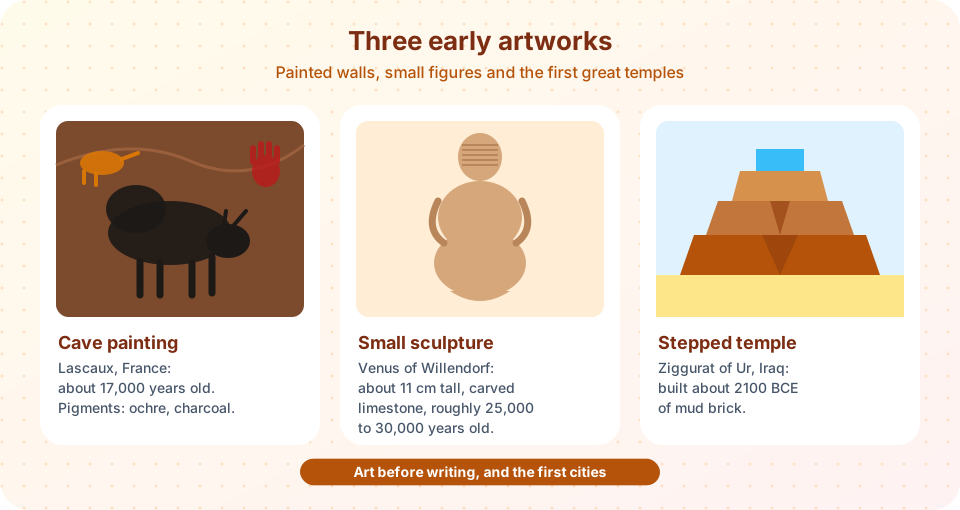
The most famous examples are in Europe. Lascaux, in the Dordogne region of France, was found in 1940 by four teenagers following a dog. Its walls carry hundreds of painted and engraved animals, including a chamber with giant bulls, called the Hall of the Bulls, some more than 5 meters long. The dates usually given are about 17,000 years ago. Chauvet Cave, discovered in 1994 in the Ardèche region, has lions, rhinos, horses and bears, and radiocarbon dates suggest paintings made around 30,000 to 36,000 years ago. Both are tied to Europe, but cave painting is not limited to it. Researchers have reported painted animals in caves on the Indonesian island of Sulawesi that may be about 45,000 years old, and hand stencils appear in Argentina, Australia and Borneo.
These images are not crude. The artists used the natural bulges of the rock to give animals volume, drew shoulders and heads in strong, flowing outlines and sometimes suggested motion with overlapping legs. Pigments were minerals: red and yellow ochre, black from charcoal or manganese. Hand stencils were made by placing a hand on the wall and blowing pigment around it.
Why did they paint? Researchers have proposed several answers:
- Hunting magic: painting animals might ensure success. But the animals painted are not always the ones most eaten, which weakens this theory.
- Ritual and shamanism: the deep, difficult chambers may have been spaces for ceremony, and some scholars link images to altered states of mind.
- Storytelling and teaching: the paintings could record myths or pass on knowledge of animal behavior.
- Marking territory or identity: groups may have signaled belonging.
No theory explains everything. A careful historian says that the evidence supports several uses and that we cannot recover the meaning. It is also worth noting the caution about conservation: breathing visitors damaged Lascaux, which was closed to the public in 1963. Visitors now see replicas.
Small sculpture
The Venus of Willendorf, found in 1908 in Austria, is an 11-centimeter limestone figure of a woman with exaggerated breasts, belly and hips and no visible face, only rows of curls on the head. Estimates of its age range from about 25,000 to 30,000 years. The nickname "Venus" is a modern joke and a poor one, since it has nothing to do with the Roman goddess. Interpretations range from fertility symbol to self-portrait by a woman looking down at her own body to a figure of status or protection. Again, the honest answer is that we do not know.
An even older example is the Lion-man of Hohlenstein-Stadel in Germany, a mammoth-ivory figure about 31 centimeters tall with a human body and a lion's head, dated to about 40,000 years ago. It shows that early humans could imagine beings that do not exist, which is a milestone in symbolic thinking. Small portable carvings, such as animal figures, flutes of bone and ivory, and beads, also show that making beautiful things was an ordinary part of life.
Monuments before metal
When people began to farm and settle, they started to build. Göbekli Tepe, in southeastern Turkey, has enormous T-shaped limestone pillars carved with animals, set in circles. It is dated to about 9500 BCE, before agriculture is thought to have been established there, which has forced scholars to rethink the order of events. Stonehenge in England took shape over many centuries; its large sarsen stones were raised around 2500 BCE. Its purpose is debated, but alignments with the midsummer sunrise and midwinter sunset suggest that the movement of the sun mattered. These monuments show that large groups could organize labor, share beliefs and plan over long periods long before cities and writing.
The first cities: Mesopotamia
Around 3500 BCE, farming villages along the rivers of southern Mesopotamia grew into cities such as Uruk and Ur, ruled by kings and organized around temples. Here we meet art with new jobs, and here writing begins: cuneiform signs, first used for accounts.
The ziggurat is the signature building: a massive stepped platform of mud brick topped by a shrine, meant to bring the gods close to the city. The Ziggurat of Ur, built around 2100 BCE by the king Ur-Nammu for the moon god Nanna, still stands in part in modern Iraq. Its staircases rise from a large rectangular base. Mud brick is humble, so Mesopotamian builders faced their monuments with baked brick and decorated them, though most of that has disappeared.
Sculpture and relief served kings and gods. The Standard of Ur (about 2600 BCE) is a small wooden box covered in mosaic of shell, red limestone and lapis lazuli. One side shows war, with chariots and prisoners, and the other shows peace, with a banquet and gifts. Its figures are arranged in horizontal bands called registers, so that the story reads like a comic strip, with the king larger than anyone else, a method of showing rank by scale that also appears in Egypt. Cylinder seals, small stone cylinders carved with scenes, were rolled across wet clay to sign documents, a bit like a stamp and a signature in one.
The Babylonian king Hammurabi (reigned about 1792 to 1750 BCE) set up a tall black stone stele inscribed with his laws. At the top, carved in relief, the king stands before the seated sun god Shamash, who is shown handing him a symbol of rule. The picture says that justice comes from a god, and the text says it applies to everyone, at least in principle. It is now in the Louvre.
The Assyrians (centered on northern Iraq, ninth to seventh centuries BCE) lined their palaces with long alabaster reliefs of hunts and battles, and guarded the doors with colossal human-headed winged bulls and lions, called lamassu, carved with five legs so that they appear to stand when seen from the front and to walk when seen from the side. The Babylonians under Nebuchadnezzar II built the Ishtar Gate (about 575 BCE) faced with glazed bricks of deep blue, decorated with golden bulls and dragons, a reconstruction of which stands in the Pergamon Museum in Berlin.
A way to remember Mesopotamian art: it is public. Reliefs, gates and stelae were made to be seen by crowds and to say, in pictures, who ruled and why.
Whose heritage?
Many Mesopotamian objects left their country in the nineteenth and twentieth centuries through excavations, purchases and sometimes theft, and now sit in museums in Europe and the United States. In 2003, after the invasion of Iraq, thousands of objects were looted from the Iraq Museum in Baghdad, and many have since been recovered. These stories link the study of ancient art to present-day arguments about ownership, protection and who gets to tell the story, topics that chapter 8 revisits.
Common misconceptions
"Cave artists were primitive." They were modern humans with the same brains as us, using the tools they had. Their paintings show careful observation and technique.
"We know why they painted." We have theories, not proof. Be wary of confident explanations.
"The Venus of Willendorf is a goddess." The goddess label is a guess. The figure may have had many meanings, or none that we can identify.
"Mesopotamian art is just Egyptian art in another place." Their styles, materials and ideas differ. Mesopotamian builders used mud brick because stone was scarce; Egyptians had abundant limestone and granite.
Try it
Check your understanding
Quick check · 5 questions
of 5 answered You scored / 5 · perfect!
-
1. Which statement about the purposes of cave painting is best supported?
Scholars suggest hunting magic, ritual, storytelling and identity. The evidence supports several uses without proving one. -
2. What was the main building type of early Mesopotamian cities?
The Ziggurat of Ur (about 2100 BCE) is the best-known example. -
3. What do registers do on the Standard of Ur?
Registers organize a narrative in horizontal strips, a device used in many ancient cultures. -
4. Why does the Venus of Willendorf nickname mislead?
'Venus' is a modern label. Interpretations remain speculative. -
5. What did Hammurabi's stele combine?
The stele carries inscribed laws and, above, a relief of Hammurabi before the sun god Shamash.
Summary
- The oldest known art includes cave paintings (Lascaux about 17,000 years ago, Chauvet older), small figures such as the Venus of Willendorf and the Lion-man, and early monuments such as Göbekli Tepe and Stonehenge.
- Purposes are debated, and a good historian separates evidence from guesses.
- In Mesopotamia, cities, writing and kingship produced ziggurats, registers, cylinder seals, law stelae, lamassu and glazed-brick gates.
- Mud brick and a scarcity of stone shaped Mesopotamian architecture.
- The ownership and protection of ancient objects is a live question.
Next: Egyptian Art
Track your progress
Create a free account to tick off lessons and pick up where you left off on any device.
of Art History lessons completed