


















Lesson 11 of 49 · Looking at Art
Chapter 2 Review: Looking at Art
Review chapter 2 of the art history course: the elements of art, composition, media and techniques, and formal analysis, with a five-step routine, flashcards and a ten-question quiz.
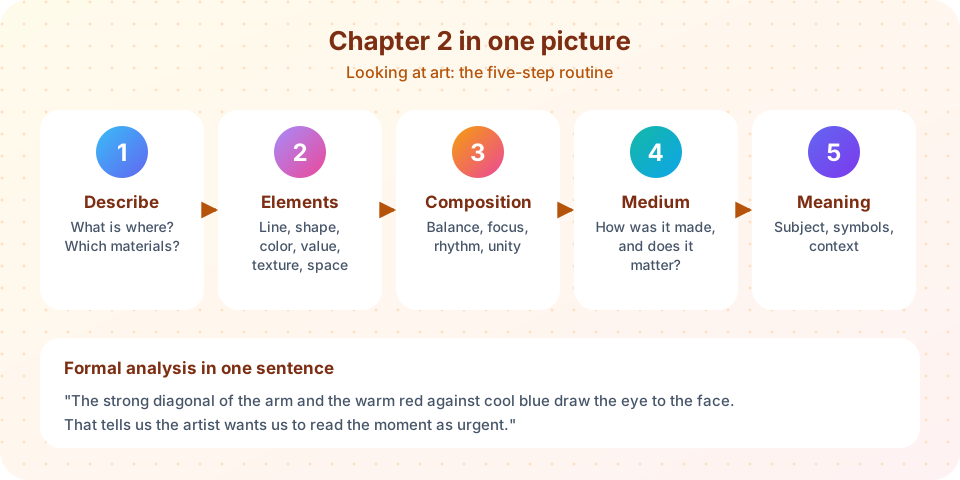
Chapter 2 gave you the working vocabulary of art history. You can name what you see (elements), describe how it is arranged (composition), explain how it was made (media) and move from description to interpretation (formal analysis and iconography). This review compresses the chapter into a single routine and then tests you on it.
Recap
| Lesson | Big idea | Words to know |
|---|---|---|
| The Elements of Art | Line, shape, color, value, texture and space are the ingredients | hue, saturation, value, chiaroscuro, positive and negative space |
| Composition and the Principles of Design | Arrangement creates balance, emphasis, rhythm, scale and unity | symmetry, focal point, hierarchic scale, golden ratio (with caution) |
| Media and Techniques | Material and technique shape the look and meaning | fresco, tempera, oil, glaze, lost wax, matrix |
| Formal Analysis and Iconography | Three levels: describe, identify, interpret | attribute, Panofsky, iconology, intentional fallacy |
The five-step routine
- Describe what is there in plain words.
- Name the elements: which line, color, value and space choices stand out?
- Read the composition: balance, focal point, movement.
- Consider the medium: what is it made of, and how did that shape the result?
- Interpret: identify subjects and symbols, then ask what the work suggests, saying how sure you are.
Try the routine on three very different things this week: a famous painting, a poster and a building. The same five steps work on all of them.
Worked example: Géricault's Raft of the Medusa
Here is the five-step routine applied to one painting you met in this chapter.
- Describe. A huge oil painting (about 5 by 7 meters) of survivors on a crude raft in a stormy sea. Some figures lie dead or dying in the foreground; others, higher up, wave cloths toward a tiny ship on the horizon. The sky is dark and the sea heavy.
- Elements. The palette is earthy: browns, olive and gray, lit by pale flesh tones. Strong value contrast, a form of chiaroscuro, picks out bodies against the dark. Lines are mostly diagonal. The texture of the sea and the cloth is rough and painterly.
- Composition. Two pyramids of figures rise on the raft, one toward the mast and one toward the tallest, waving man. A strong diagonal runs from the dead at the lower left to the signaling survivor at the upper right, carrying your eye from despair to hope.
- Medium. Oil on canvas, which allowed Géricault to work over months on a very large scale, with deep, dark shadows and detailed anatomy. He prepared by studying corpses and by interviewing survivors of the real shipwreck.
- Interpret. The painting depicts a real 1816 French naval disaster that became a political scandal. The composition turns a news event into a drama of survival and also a criticism of the people who failed the survivors. The subject (iconography) is a contemporary event rather than a myth, and that choice was part of its meaning.
Notice that every claim in steps two to four can be checked by looking. Only step five needs outside knowledge, and it says where that knowledge came from.
Common slips in formal analysis
- Naming without explaining. "The painting uses diagonals" is a start. "The diagonal carries the eye from the dying to the waving man" is an analysis.
- Mixing up hue and value. A pale yellow and a pale blue are close in value even though they differ in hue.
- Calling every symbol a secret. Check the date, the region and the sources before assuming a fixed meaning.
- Ignoring the medium. The material often explains the scale, the finish and the cost.
- Confusing "realistic" with "better". Egyptian, Byzantine and modern abstract work follow other goals.
Try it
Check your understanding
Quick check · 10 questions
of 10 answered You scored / 10 · perfect!
-
1. A picture has a bright red figure small against a large pale gray area, and the two feel balanced. Which type of balance is this?
Unlike elements balance by visual weight, which is asymmetrical balance. -
2. Which pair of terms describes saturation and value correctly?
Hue is the color family, saturation the intensity and value the lightness. -
3. Why do Egyptian pharaohs often appear larger than attendants?
Hierarchic scale communicates status, not realistic size. -
4. Which medium has paint locked into damp plaster?
In fresco the pigment is absorbed as lime plaster dries. -
5. Which statement about the golden ratio is the most careful?
Dalí used it deliberately in some works, but many claims about earlier works are not well supported. -
6. Which sentence best follows the 'feature, evidence, effect' pattern?
It names a feature, shows where it appears and states the effect. -
7. In the Arnolfini Portrait debate, what is secure at level one?
The visible facts are secure. Whether it shows a wedding and whether objects are symbols is disputed. -
8. Why can a bronze figure stretch out limbs more freely than marble?
Hollow bronze can be thin-walled and still strong. -
9. What is the best response to a symbol you think you recognize?
Symbols change with tradition and period, so they need supporting evidence. -
10. Which of these is a print technique in which ink is pressed into lines cut or etched into a plate?
Engraving and etching are intaglio processes. Woodcut is relief.
Summary
- Elements, composition, media and analysis form one routine: describe, name the elements, read the composition, consider the medium, interpret.
- Be precise: use feature, evidence, effect.
- Symbols and meanings need evidence from date, place and sources.
- Chapter 3 applies this toolkit to the first great traditions of art, from Ice Age caves to Rome.
Track your progress
Create a free account to tick off lessons and pick up where you left off on any device.
of Art History lessons completed