


















Lesson 22 of 49 · Medieval and Renaissance Art
The High Renaissance: Leonardo, Raphael, Michelangelo and Venice
Meet the High Renaissance masters: Leonardo's Last Supper and Mona Lisa, Raphael's School of Athens, Michelangelo's David and Sistine ceiling, and Titian's Venetian color.
Around 1500 a handful of artists, working within a few years and a few hundred kilometers of each other, produced some of the most famous images in Western history. Leonardo da Vinci painted the Last Supper and the Mona Lisa. Michelangelo carved the David and painted the Sistine Chapel ceiling. Raphael covered the walls of the pope's private rooms with pictures that look as if the right answer to every question of composition had been found. In Venice, Titian made color itself into a way of thinking.
Art historians call this brief peak the High Renaissance, from roughly 1490 to 1527, the year imperial troops sacked Rome. It is the moment when the discoveries of the early Renaissance (perspective, anatomy, the classical ideal) were fused into a confident, harmonious style. This lesson looks at the four great figures, at what they share, and at the ways they differ.
What you will learn
- What "High Renaissance" means and the qualities these artists share.
- Key works by Leonardo, Raphael and Michelangelo, with dates and facts.
- How Venice developed a different tradition built on color.
- Why the Renaissance ideal ended and what came next.
Key terms
- Sfumato: soft, smoky blending of tones without hard outlines.
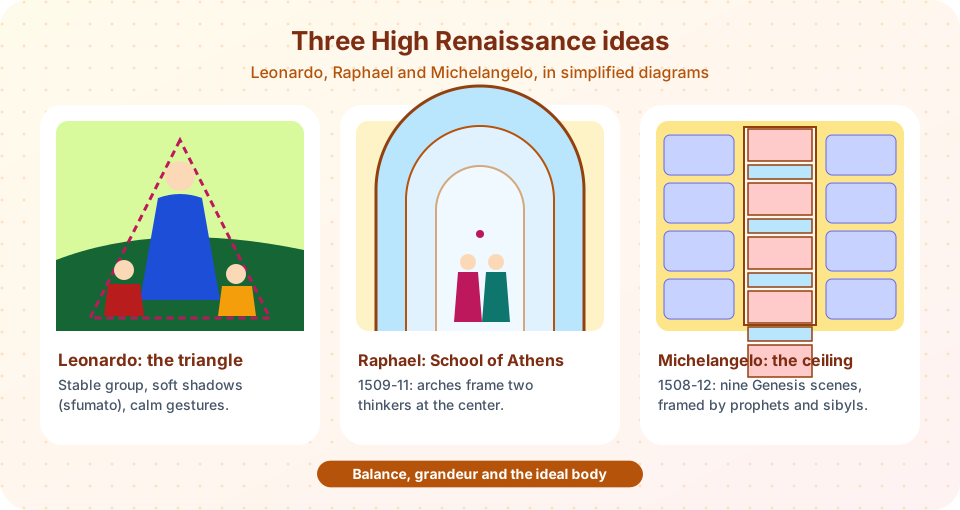
- Pyramidal composition: arranging figures in a triangle for stability.
- Disegno and colorito: "drawing" (design, line) and "color": the two qualities debated by Florentine and Venetian artists.
- Fresco: painting on wet plaster, used for the Sistine ceiling.
- Terribilità: a word for Michelangelo's awe-inspiring, sometimes frightening intensity.
What defines the High Renaissance
- Balance and harmony. Compositions feel stable, with figures grouped in triangles or arranged around a central axis.
- Idealized bodies. Artists combine close study of nature with an ideal of perfect form, taken from classical art.
- Mastery. Perspective, anatomy and foreshortening are no longer problems to solve but tools to use.
- Monumentality. Figures are large and noble, even in small works.
- Patronage in Rome. Popes such as Julius II (pope 1503 to 1513) and Leo X (pope 1513 to 1521) used art to make the Vatican the new center of Christian Europe.
Leonardo da Vinci (1452 to 1519)
Leonardo was born in the town of Vinci near Florence and trained in the workshop of Verrocchio. He was a painter, engineer, anatomist and thinker, and his notebooks, filled with drawings of dissections, water, plants and machines, contain thousands of pages. He believed that a painter must understand nature by observation, and he asked what muscles lay under skin and how light falls on a cheek.
The Last Supper (about 1495 to 1498) fills a wall of the refectory of Santa Maria delle Grazie in Milan. It shows the moment when Christ announces that one of the twelve will betray him. The apostles react in four groups of three, with gestures and expressions that tell the story at once; the perspective lines converge on Christ's head. Leonardo experimented with oil and tempera on dry plaster, not true fresco, because he wanted to work slowly. The technique failed, and the paint started to flake within his lifetime; the painting has been restored repeatedly, most recently in a long campaign finished in 1999.
The Mona Lisa (begun about 1503) is probably a portrait of Lisa Gherardini, the wife of the Florentine merchant Francesco del Giocondo (hence its Italian name, La Gioconda). It is small, about 77 by 53 centimeters, painted in oil on a poplar panel. Its power comes from sfumato: soft transitions around the eyes and mouth that make the expression seem to shift as you look. The pose, a half-length figure turned slightly with hands folded, became the model for portraits for centuries. Leonardo kept it with him until his death in France in 1519, and it entered the French royal collection. In 1911 it was stolen from the Louvre by a worker named Vincenzo Peruggia and recovered in 1913, an episode that made it a global celebrity.
Leonardo finished few paintings; fewer than twenty are generally attributed to him. He left many unfinished, and many of his ideas, such as flying machines, remained on paper.
Raphael (1483 to 1520)
Raphael Sanzio was born in Urbino, trained under Perugino, spent time in Florence and was called to Rome in 1508. Over the next twelve years, he became the most successful painter in Rome, running a huge workshop and designing paintings, tapestries and buildings until his death at 37.
His masterpiece is the School of Athens (about 1509 to 1511), painted in the pope's library in the Vatican (the Stanza della Segnatura). In a huge barrel-vaulted hall that echoes Roman architecture, philosophers and scientists gather. At the center are two men: Plato points up toward the realm of ideas, while Aristotle holds out his hand flat toward the earth. Tradition says Plato has Leonardo's features. Other figures include Pythagoras writing, Euclid or Archimedes demonstrating with compasses, and Heraclitus in front, said to be modeled on Michelangelo. Raphael appears himself at the right edge, looking at us. The architecture and the clustering of figures create a harmony that has made the painting a symbol of the Renaissance dream that all knowledge can be gathered in one place. He also painted gentle Madonnas, such as the Sistine Madonna (about 1512), with its two bored-looking cherubs.
Michelangelo Buonarroti (1475 to 1564)
Michelangelo considered himself a sculptor first, a painter reluctantly and an architect and poet as well.
The Pietà (1498 to 1499), in Saint Peter's Basilica in Rome, shows the Virgin Mary holding the dead Christ, made when he was in his early twenties. It is the only work he signed; the signature runs across the band on Mary's chest.
David (1501 to 1504) is a marble figure 5.17 meters tall, carved from a single block of Carrara marble that other sculptors had begun and abandoned. It shows the young hero before the battle, tense, looking at an enemy, rather than after the victory as earlier artists (such as Donatello) had shown. It was placed outside the Palazzo della Signoria as a symbol of the Florentine Republic, and moved indoors to the Accademia in 1873.
The Sistine Chapel ceiling (1508 to 1512) was commissioned by Julius II. Michelangelo worked on scaffolding for about four years, painting in fresco more than 300 figures. The central strip has nine scenes from the Book of Genesis, from the separation of light from darkness to the Drunkenness of Noah, including the famous Creation of Adam in which God's finger nearly touches Adam's. Around them sit prophets and sibyls (prophetic women of the ancient world) on painted thrones, and nude young men, called ignudi, hold garlands. A cleaning from 1980 to 1994 revealed unexpectedly bright colors and sparked a debate about whether the earlier dark surface was dirt or Michelangelo's own shading.
He returned to the Sistine Chapel in 1536 to 1541 to paint the Last Judgment on the end wall, a swirling, darker work shaped by the religious turmoil of the Reformation and the Sack of Rome. Late in life he designed the dome of Saint Peter's, though it was finished after his death in 1564.
A quick way to tell the three apart: Leonardo is mysterious and scientific, with soft shadow. Raphael is harmonious and clear. Michelangelo is powerful and muscular.
Venice: color and light
While Florence and Rome valued disegno (drawing and design), Venice, a trading city built on water and surrounded by shimmering light, prized colorito. Venetian painters used oil paint on canvas, which suited the damp climate and allowed large works, and built forms with layers of color instead of outlines.
Giovanni Bellini (about 1430 to 1516) painted tender Madonnas and landscapes bathed in warm light. Giorgione (about 1477 to 1510) made mysterious pictures like The Tempest whose meaning is still debated. Titian (about 1488 to 1576) towered over them. His Assumption of the Virgin (1516 to 1518) in the Frari church in Venice is a huge altarpiece with glowing red robes and a swirl of angels. His nude Venus of Urbino (1538) is relaxed and direct. Over a long career he became loose and free with the brush, and his late paintings dissolve forms into shimmering touches, an approach that influenced Rubens, Velázquez and later the Impressionists.
Women and the Renaissance workshop
Almost all of the famous names of the High Renaissance are men, because training and commissions were limited for women, who were often barred from drawing nude models and from joining workshops. Some still succeeded: Sofonisba Anguissola (about 1532 to 1625), from Cremona, became a court painter to the king of Spain, and Properzia de' Rossi (about 1490 to 1530), from Bologna, carved in marble. Their stories remind us that the canon reflects who was allowed to take part.
The end of the ideal
In 1527 imperial troops sacked Rome. The Reformation, begun in 1517, was splitting Christianity and shaking the confidence of the period. Younger artists such as Pontormo and Parmigianino began to twist and elongate figures, as in Parmigianino's Madonna with the Long Neck (about 1535 to 1540), deliberately rejecting the calm perfection of the masters. Later writers called this next phase Mannerism, a term that began as a criticism.
Common misconceptions
"Michelangelo painted the Sistine ceiling lying on his back." He painted standing on a scaffold, craning upward, as documents and his own comic poem describe.
"The Mona Lisa is famous only because it is the best painting." Its fame also owes to its history of imitation, writing, the 1911 theft and modern publicity.
"Leonardo was an unfinished genius who accomplished little." He finished a handful of works that changed painting, and his studies of nature fed his art even where they never became finished objects.
Try it
Press Run (or Ctrl + Enter) to see the result here.
Program input · what you'd type while the program runs
Type the answers before you press Run, one per line. Each time the program reads a line (with input()), it gets the next line from this box.
Check your understanding
Quick check · 5 questions
of 5 answered You scored / 5 · perfect!
-
1. What is sfumato?
Leonardo used it, especially around the eyes and mouth of the Mona Lisa. -
2. Where is Raphael's School of Athens, and who commissioned the room?
It is in the Stanza della Segnatura, painted about 1509-1511. -
3. What moment of the David story did Michelangelo choose?
Michelangelo's David (1501-04) stands ready, unlike Donatello's earlier victorious David. -
4. How did Venetian painters differ from Florentine ones?
Disegno (design) and colorito (color) were the two poles of debate. -
5. Why did Leonardo's Last Supper deteriorate?
The experimental technique did not bond well and began flaking within his lifetime.
Summary
- The High Renaissance (about 1490-1527) combined perspective, anatomy and the classical ideal into balanced, monumental art.
- Leonardo: the Last Supper (about 1495-98) and the Mona Lisa (begun about 1503), sfumato and scientific observation.
- Raphael: the School of Athens (about 1509-11), harmony and clarity.
- Michelangelo: David (1501-04), the Sistine ceiling (1508-12) and the Last Judgment (1536-41), power and anatomy.
- Venice favored color and oil on canvas, with Bellini, Giorgione and Titian.
- The Sack of Rome (1527) and the Reformation ended the calm ideal, leading to Mannerism.
Next: The Northern Renaissance
Track your progress
Create a free account to tick off lessons and pick up where you left off on any device.
of Art History lessons completed