


















Lesson 26 of 49 · Baroque to Romanticism
Baroque drama and the language of light
Why Baroque art feels so dramatic: the Counter-Reformation, Caravaggio's tenebrism, Artemisia Gentileschi, Bernini and Rubens, with a light simulator.
Stand in front of a Baroque painting and something happens to your body before you think a single thought. A hand reaches out of the dark. A figure twists mid-motion. A beam of light cuts a room in two. Baroque artists, working roughly from 1600 to 1750, wanted to move you, and they discovered that light, diagonal lines and caught-in-the-act gestures were the quickest way to do it.
This lesson explains where that style came from, how its most famous tool (strong light against deep shadow) works, and why the same century produced both Caravaggio's gritty street faces and Bernini's glowing marble ecstasy.
What you will learn
- Why the Catholic Church wanted emotionally powerful art after the Reformation.
- How tenebrism and chiaroscuro work, and how they differ.
- How Caravaggio, Artemisia Gentileschi, Rubens and Bernini each used drama in a different way.
- How to read a Baroque composition: diagonals, cropped figures, a frozen "decisive moment".
Key terms
Baroque: the style of European art and architecture from about 1600 to 1750, marked by drama, movement, rich color and strong light. The word probably comes from a Portuguese word for an irregular pearl, and it began as an insult.
Chiaroscuro: Italian for "light-dark"; the modelling of forms through gradual contrasts of light and shade.
Tenebrism: an extreme chiaroscuro in which most of the picture falls into darkness and a few areas are brightly lit. From Italian tenebroso, "murky".
Counter-Reformation: the Catholic Church's response to Protestantism in the 1500s and 1600s, including reforms to religious art.
Naturalism: painting people and things as they appear, without idealizing them.
Why the Church wanted drama
In 1517 Martin Luther began the movement that split Western Christianity. Many Protestants distrusted religious images, and some churches were stripped bare. The Catholic Church answered at the Council of Trent (1545 to 1563). In its final session it said that images in churches should teach the faith clearly and move believers to devotion, and it warned against anything confusing or indecent.
The effect was practical. A Catholic altarpiece had to be legible from the back of a crowded church and strong enough to make an ordinary person feel the presence of a saint. Rome, which the popes were rebuilding with new churches and chapels, became the laboratory for that idea. Jesuit churches in particular, such as the Gesu in Rome, were designed as theaters for sermons, with painted ceilings that appear to open into heaven.
Notice that "Baroque" is not only a Catholic style. Protestant Dutch painters also benefited from the new interest in light, and Lutheran German courts built Baroque palaces. But the bold, emotional version we start with grew in Catholic Rome.
Caravaggio: the light that changed painting
Michelangelo Merisi, called Caravaggio (1571 to 1610), came to Rome in his twenties and quickly became famous. His commission for the Contarelli Chapel in the church of San Luigi dei Francesi, finished around 1599 to 1600, includes The Calling of Saint Matthew. A tax collector sits counting money at a table with his companions. Christ, half hidden at the right, points. A shaft of light enters from above the figure of Christ and lands on Matthew's face.
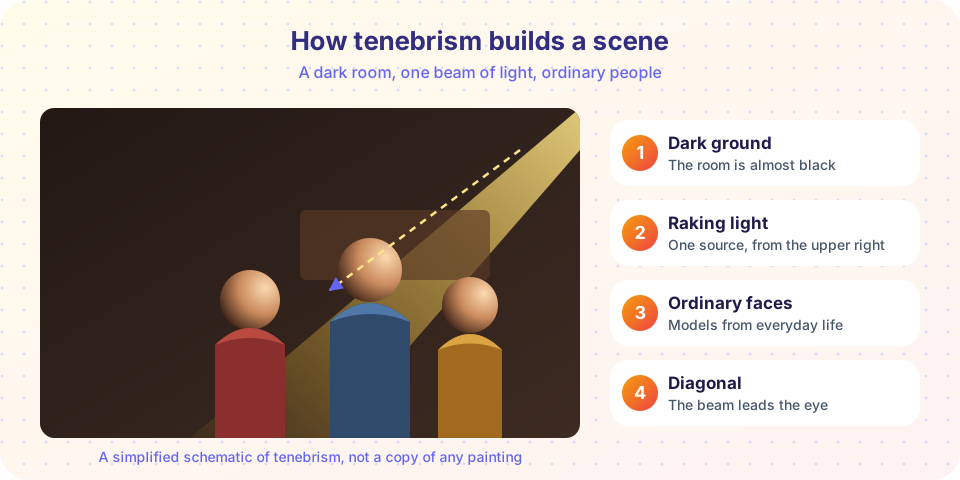
Study the schematic and you can name the four ingredients of Caravaggio's method:
- A dark ground. No landscape, no sky, no deep architecture. The darkness removes distractions.
- A raking light. One source from the side or above, so faces split into bright and shadowed halves.
- Ordinary faces. Caravaggio used living models, often from Rome's streets, instead of idealized types. Saints can have dirty feet.
- A strong diagonal. The eye follows the beam of light and the pointing hands.
His contemporaries argued about this. Some admired the honesty and power; others thought sacred subjects deserved noble beauty. Caravaggio was also volatile. In 1606 he killed a man named Ranuccio Tomassoni in a brawl, fled Rome under a death sentence, and spent his last years in Naples, Malta and Sicily before dying in 1610 at about 38. Artists across Europe, from Spain to the Dutch Republic, still copied his light. They are called Caravaggisti.
Light as a measurable idea
You do not need to be a physicist to understand why tenebrism feels theatrical. Light from a single small source (a candle, a window) gets weaker quickly as you move away from it: roughly with the inverse of the distance squared. So a single source naturally gives a bright centre and a fast fall into dark. Even daylight, by contrast, spreads gently and leaves everything readable. Painters could choose, and Baroque painters chose the dramatic option.
Press Run (or Ctrl + Enter) to see the result here.
Program input · what you'd type while the program runs
Type the answers before you press Run, one per line. Each time the program reads a line (with input()), it gets the next line from this box.
Artemisia Gentileschi: drama with a personal edge
Artemisia Gentileschi (1593 to about 1656) trained in her father Orazio's Roman workshop, and she absorbed Caravaggio's lesson thoroughly. In 1612 a trial took place in Rome after her father accused the painter Agostino Tassi of raping her. The trial records survive. Whether or not you read her paintings through that event, her Judith Slaying Holofernes (versions c. 1612 to 1613 in Naples and c. 1620 in Florence) is a masterclass in Baroque staging: two women work with muscular determination, blood arcs across the bedsheet, and a strong light isolates the action against a black background.
Artemisia became the first woman admitted to the Accademia delle Arti del Disegno in Florence, and she worked for patrons in Florence, Rome, Naples and, briefly, London. Her paintings show women as active, intelligent and physically capable, which makes them important evidence in later discussions about gender and art, a theme we meet again in the methods chapter.
Bernini and Rubens: drama in marble and in flesh
Gian Lorenzo Bernini (1598 to 1680) took the same idea into sculpture and architecture. In the Cornaro Chapel of Santa Maria della Vittoria in Rome, The Ecstasy of Saint Teresa (1647 to 1652) shows the Spanish mystic swooning as an angel prepares to pierce her heart with a golden arrow. Bernini hid a window above the group so that real daylight pours down onto gilded bronze rays, and he carved the marble drapery so it seems to tremble. Members of the Cornaro family look on from sculpted theater boxes at the sides. The chapel makes the visitor a witness.
Peter Paul Rubens (1577 to 1640), based in Antwerp, brought Baroque motion to northern Europe. His Descent from the Cross (1612 to 1614) for Antwerp Cathedral lowers Christ's pale body down a diagonal of white cloth while living figures strain to catch it. Rubens ran a large workshop of assistants and painted altarpieces, portraits, mythologies and landscapes, as well as working as a diplomat for the Spanish Habsburgs.
| Artist | Medium | Baroque tool |
|---|---|---|
| Caravaggio | Oil on canvas | Tenebrism, street models |
| Artemisia Gentileschi | Oil on canvas | Tenebrism, tense physical action |
| Bernini | Marble, bronze, architecture | Hidden light, theatrical staging |
| Rubens | Oil on panel and canvas | Diagonals, swelling flesh, color |
Illusion on ceilings
Baroque artists also loved quadratura, painted architecture that merges with real architecture. Andrea Pozzo's ceiling in the church of Sant'Ignazio in Rome (1685 to 1694) seems to open upward through columns into a sky full of figures. A marked spot on the floor tells you where to stand: from there the perspective works perfectly, and from elsewhere the architecture appears to lean. The trick was not to fool you permanently but to astonish you.
Common misconceptions
"Baroque means ornate and fussy." Baroque often means bold and dramatic, not simply decorative. Caravaggio's pictures are austere: bare walls, few props. Fussy pastel decoration belongs more to the Rococo of the next century.
"Caravaggio invented dark paintings." Painters had shaded forms for centuries and Leonardo's soft shadows (sfumato) are older. Caravaggio pushed contrast to an extreme and applied it to everyday faces, which is what felt new.
"Baroque equals Catholic." The style spread through Protestant courts and the Dutch Republic too, in different forms.
Try it
Use the light simulator above to turn the ambient slider all the way up, then all the way down. Notice at which point the picture stops feeling theatrical. Then run the brightness model and change the width of the spotlight. A narrower beam raises the contrast ratio and the drama.
Check your understanding
Quick check · 5 questions
of 5 answered You scored / 5 · perfect!
-
1. What did the Council of Trent say about religious images?
The Catholic Church wanted clear, emotionally effective sacred images in answer to Protestant criticism. -
2. Which term describes an extreme form of chiaroscuro with most of the picture in darkness?
Tenebrism leaves large areas in deep shadow and lights only a few key areas. -
3. Which artist designed the Cornaro Chapel with its hidden window?
Gian Lorenzo Bernini created The Ecstasy of Saint Teresa and its theatrical lighting. -
4. Why does a single small light source create more drama than daylight?
Light from a small source weakens quickly with distance, so there is a bright centre and fast fall into shadow. -
5. Which statement about Artemisia Gentileschi is accurate?
She trained in Rome, worked in Florence and Naples, and became the first woman admitted to the Florentine Accademia.
Summary
- Baroque art grew in Counter-Reformation Rome, where images had to teach and move viewers.
- Tenebrism and chiaroscuro use contrast to focus attention and create drama; Caravaggio made them famous with ordinary models.
- Artemisia Gentileschi, Bernini and Rubens each adapted drama to their own medium and subjects.
- Illusionistic ceilings (quadratura) extended painted space into real architecture.
- Baroque is bold and theatrical, not simply ornate.
Next: The Dutch Golden Age
Track your progress
Create a free account to tick off lessons and pick up where you left off on any device.
of Art History lessons completed