


















Lesson 16 of 49 · Ancient and Classical Art
Roman Art: Portraits, Concrete and the Art of Empire
Explore Roman art as imperial communication: realistic portraits, the arch and concrete, the Colosseum, the Pantheon, Pompeii's wall paintings and the shift toward late antiquity.
The Romans began as a city on the Tiber and ended up ruling lands from Britain to Syria. That empire needed ways to communicate: to tell people in a hundred provinces who was in charge, to build roads, baths, aqueducts and amphitheaters that made distant towns feel Roman, and to turn the ruler's face into something every subject recognized. Roman art is the visual side of that effort. It borrowed freely from Greece and Etruria, but it also invented: concrete and the dome, the realistic portrait and a mass-communication style on coins and monuments.
In this lesson you will see how Roman artists used portraits and reliefs to carry messages, how Roman engineers made space itself an art form, what Pompeii preserved and how art changed as the empire entered late antiquity.
What you will learn
- How the Roman portrait changed from the Republic to the Empire.
- How concrete, the arch and the dome let builders make huge interior spaces.
- What the Colosseum, the Pantheon and Trajan's Column were for.
- What Pompeii's wall paintings and mosaics tell us about ordinary Roman taste.
Key terms
- Verism: extreme realism in portraiture, showing wrinkles and flaws, typical of the Roman Republic.
- Concrete: a mix of lime mortar, volcanic ash and rubble that hardens, even underwater.
- Vault and dome: arched ceilings; a barrel vault is a long arch, a dome is a rotated arch.
- Voussoir: a wedge-shaped stone in an arch. The keystone is the top one.
- Fresco and mosaic: wall painting on wet plaster, and pictures made of small cubes (tesserae).
Portraits: faces for the family and the state
In the Roman Republic (509 to 27 BCE) leading families kept wax masks of their ancestors and carried them in funeral processions. Sculpted portraits of older men, often with deep wrinkles, sagging cheeks and a stern gaze, show verism: a taste for truth that was also a claim to experience and seriousness. Facing death and the proud tradition of the family, a Roman did not want to look young.
With Augustus (ruled 27 BCE to 14 CE) the imperial portrait changed. As you saw in chapter 1, the statue from Prima Porta presents the emperor as a handsome, ageless, god-favored leader, with Greek classical proportions and the pose of the Doryphoros. His face was multiplied across the empire in statues and on coins; scholars have counted hundreds of surviving copies of a few standard types. Later emperors adapted the formula: Flavian emperors like Vespasian (ruled 69 to 79 CE) returned to a blunt realism, Hadrian (117 to 138 CE) wore a Greek-style beard, and Marcus Aurelius (161 to 180 CE) was shown in a bronze equestrian statue that survived the Middle Ages because people mistook it for Constantine, the first Christian emperor. It was moved to the Capitoline Hill in Rome in 1538.
Portraits of ordinary people also flourished. Freed slaves and their families paid for relief portraits of couples on their tombs. In Roman Egypt, painted wooden panel portraits of the dead, called Fayum portraits, attached to mummies, show strikingly individual faces in wax (encaustic) or tempera paint.
Concrete, arches and domes
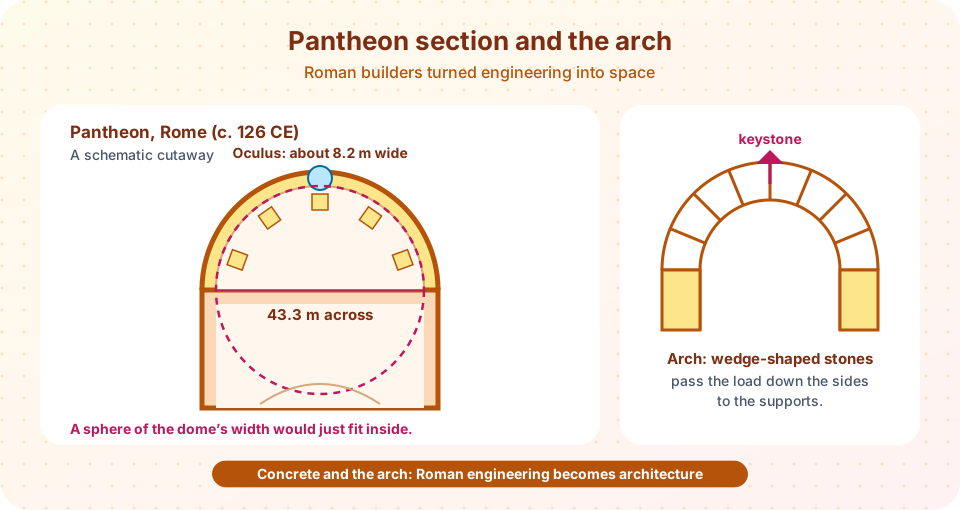
The Romans did not invent the arch, but they used it at a scale and in quantities nobody had before. An arch works because a curved row of wedge-shaped stones, called voussoirs, presses against each other and carries the weight sideways and down to the supports. A barrel vault is a long tunnel of arches, and a groin vault crosses two of them.
The real revolution was concrete (opus caementicium), a mix of lime, water, a volcanic sand called pozzolana and chunks of stone or brick. It could be poured into wooden forms and hardened even underwater. Workers faced the walls with brick or stone, so a Roman building often looks like brick but is a concrete core. Concrete freed architects from stone blocks and allowed enormous interiors. Recent research has proposed that the lime clasts in Roman concrete helped it self-heal tiny cracks, a topic under active study.
The Colosseum
The Flavian Amphitheater, or Colosseum, in Rome was begun by Vespasian about 72 CE and opened by his son Titus in 80 CE. It is an oval with four stories of arches, partly of travertine stone and partly of concrete and brick, with seating for roughly 50,000 spectators and a system of vaulted corridors that let crowds enter and leave quickly. It hosted gladiator contests, animal hunts and spectacles. Its facade uses the three Greek orders as decoration, Doric at ground level, Ionic above, then Corinthian, an example of how Romans took Greek forms and applied them to Roman structures.
The Pantheon
The Pantheon, rebuilt under Hadrian about 118 to 128 CE, is a temple to all the gods. A porch of granite columns leads into a round hall under a concrete dome 43.3 meters across, whose top is open: the oculus, about 8.2 meters wide, is the only source of light. The height from floor to oculus equals the diameter, so a perfect sphere would fit in the room, an idea you can test in the Try it section. To lighten the weight, the builders used coffers (sunken panels) in the dome and used lighter aggregates, such as volcanic stone and pumice, near the top. It remained the world's largest dome for more than a thousand years, and its concrete dome is still the world's largest unreinforced one. It survived because it was turned into a Christian church in 609 CE.
Roads, aqueducts, baths
Roman engineers carried water over valleys on arched bridges, such as the Pont du Gard in southern France (first century CE), built of precisely cut stone without mortar. Public baths like the huge ones built by Caracalla (about 216 CE) combined engineering, mosaic floors and sculpture. These structures are art by other means: they show a state that cared about shared comfort and about looking powerful.
Relief and the story of conquest
Roman sculptors used relief for narrative. The Ara Pacis (Altar of Peace, 13 to 9 BCE) commemorates Augustus's return and the peace he brought, with a procession of his family and officials, shown with the individual, informal look of real people, and with graceful floral scrolls. The Arch of Titus (about 81 CE) shows soldiers carrying treasures, including a seven-branched menorah, from the Temple in Jerusalem, destroyed in 70 CE. Trajan's Column (113 CE), met in lesson one, wraps its story in a spiral. These works used pictures to teach citizens about Roman victories, and they are one of the main sources for Roman armor and tactics.
Pompeii and everyday art
In 79 CE the eruption of Vesuvius buried Pompeii and Herculaneum under ash, preserving buildings, wall paintings, mosaics and even graffiti. We see the taste of wealthy and middle-class Romans: walls painted with imitation marble, painted columns and open vistas; mosaics of fish, cats and masks; garden scenes with birds. In the nineteenth century the German scholar August Mau divided Pompeian wall painting into four "styles", still used today: marble imitation, architectural illusion, delicate ornament on flat panels and a crowded fantasy style. Painting in Pompeii shows how much Romans liked an illusion of space, and the delight in trompe l'oeil.
From empire to late antiquity
In the third century CE the empire faced civil war, plague and invasion. Portraits became more tense and then more abstract. By the early fourth century, under Constantine (ruled 306 to 337 CE), the style on the Arch of Constantine (315 CE) shows stocky figures, frontal poses and rows of faces that look back to hierarchy rather than to Greek naturalism. Constantine's support for Christianity led to the first great churches, such as Old Saint Peter's in Rome, which adapted the Roman basilica, a public hall, to Christian worship. This is the doorway to chapter 4: Christian art grew out of Roman art, and the Byzantine Empire in the East carried it on for another thousand years. The traditional end date of the western empire is 476 CE.
If you want a short way to remember Roman art: realism for people, engineering for space, narrative for power.
Common misconceptions
"Romans just copied the Greeks." They copied and adapted Greek models, but they also created new things: concrete architecture, the veristic portrait and narrative reliefs on columns and arches.
"Concrete is a modern invention." Romans used it from the second century BCE, and some of their structures still stand.
"Gladiators fought to the death in every match." Historians believe many fights ended without a death, since trained fighters were expensive. Matches were spectacles with rules and referees.
Try it
Press Run (or Ctrl + Enter) to see the result here.
Program input · what you'd type while the program runs
Type the answers before you press Run, one per line. Each time the program reads a line (with input()), it gets the next line from this box.
Check your understanding
Quick check · 5 questions
of 5 answered You scored / 5 · perfect!
-
1. What is verism in Roman portraiture?
Republican portraits of older men showed signs of age as marks of experience and seriousness. -
2. Why was Roman concrete so important to architecture?
Concrete freed architects from stone blocks and allowed vast interior spaces. -
3. What is special about the proportions of the Pantheon's interior?
The interior is 43.3 meters across and about the same in height. -
4. What did Pompeii preserve?
Ash preserved everyday Roman life in unusual detail. -
5. How is the portrait of Augustus different from Republican verism?
Augustus adopted Greek classical proportions to project calm, youth and divine favor.
Summary
- Roman art served an empire: portraits, reliefs, coins and buildings carried messages across provinces.
- Portraits moved from Republican verism to Augustan idealism, then to many later variations.
- Concrete, the arch, the vault and the dome made monumental interiors: the Colosseum (80 CE) and the Pantheon (about 126 CE).
- Narrative reliefs (Ara Pacis, Arch of Titus, Trajan's Column) told stories of power.
- Pompeii shows everyday taste; Constantine's era led toward Christian and Byzantine art.
Next: Chapter 3 Review
Track your progress
Create a free account to tick off lessons and pick up where you left off on any device.
of Art History lessons completed