


















Lesson 45 of 49 · Projects and Practice
Project: build your own art timeline
Choose a theme, collect eight to twelve works, record the facts, and build an interactive timeline that reveals patterns, gaps and your own selection bias.
A timeline is more than a list of dates. Once you choose works around a theme and place them on a line, patterns jump out: bursts of activity, long silences, repeated ideas in different centuries. In this project you will build your own timeline in three stages: choose a theme, collect and record the data, then look for patterns and ask what your selection leaves out. The code tools give you a working timeline builder and a small analysis script you can adapt.
What you will learn
- How to choose a theme that creates a meaningful, not random, set of works.
- What facts to record for each work so your timeline can be checked.
- How to read a timeline for patterns, gaps and bias.
- How to present the finished project clearly.
Key terms
Theme: the question that ties your works together, such as "How do artists use light?" or "How does art protest?"
Data record: the facts about each work: title, artist, date, place, medium and a one-line reason it matters.
Selection bias: a distortion that arises because you chose some works and left others out.
Terminus: a start or end date. A work dated "c. 1600" has an uncertain terminus, so record the uncertainty.
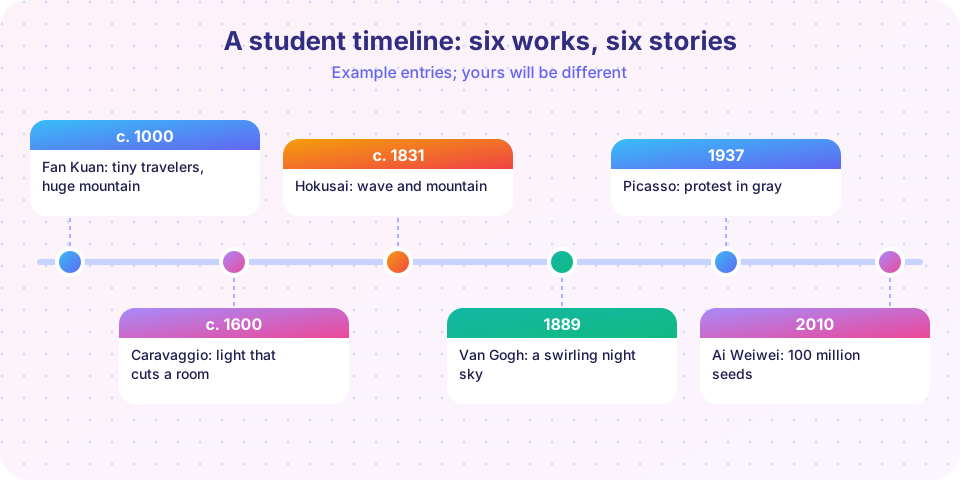
Step 1: choose a theme
The best themes are questions, not categories. "Baroque painting" is a category and will quickly turn into a list. "How do artists make light feel dramatic?" is a question, and every work you choose must answer it. Some starting questions:
- Light: Caravaggio (about 1600), Vermeer's The Milkmaid (about 1657 to 1658), Turner's Rain, Steam and Speed (1844), Monet's Impression, Sunrise (1872), Dan Flavin's fluorescent-tube installations (from the 1960s), James Turrell's Roden Crater (begun in 1977).
- Protest and witness: Goya's The Third of May 1808 (1814), Delacroix's Liberty Leading the People (1830), Picasso's Guernica (1937), the Guerrilla Girls' posters (from 1985), Ai Weiwei's Sunflower Seeds (2010).
- Women artists: Artemisia Gentileschi's Judith Slaying Holofernes (about 1612 to 1613), Judith Leyster's self-portrait (about 1630), Elisabeth Louise Vigee Le Brun's Marie Antoinette and Her Children (1787), Berthe Morisot's The Cradle (1872), Mary Cassatt's The Child's Bath (1893), Hilma af Klint's Paintings for the Temple (from 1906), Frida Kahlo's The Two Fridas (1939), Judy Chicago's The Dinner Party (1974 to 1979).
- Nature and the sublime: Fan Kuan's Travelers among Mountains and Streams (about 1000), Hokusai's Great Wave (about 1831), Friedrich's Wanderer above the Sea of Fog (about 1818), Smithson's Spiral Jetty (1970).
Aim for eight to twelve works. Fewer than eight gives no pattern; more than twelve gets hard to explain well.
Step 2: record the facts
For each work, create one record. Keep it consistent so you can compare them:
| Field | Example | Notes |
|---|---|---|
| Title | The Cradle | Use the title museums use |
| Artist | Berthe Morisot | Add life dates if helpful |
| Date | 1872 | Write "c." if approximate |
| Place made | France | Country or city |
| Medium | Oil on canvas | As on the museum page |
| Why it matters | Intimate view of motherhood by a founding Impressionist | One sentence, your own words |
| Source | Museum website | So you can check later |
Use museum websites and scholarly books for facts. Write the "why it matters" line in your own words: it will be the heart of your presentation.
Step 3: build and explore
The tool below is an interactive timeline builder. Add works with a title and a year, and it places them on a line in date order. Use the buttons to load an example theme, then replace the entries with your own.
Step 4: read the patterns
Once your works sit on a line, ask:
- Clusters. Do several works fall within a few decades? What was happening then?
- Gaps. What happened in the long empty stretches? Is it that nothing relevant was made, or that your sources did not show it?
- Geography. Are all the works from one region? If so, is that because of your theme, or because of the books and websites you used first?
- Voices. Whose work is missing? Is every maker from the same background?
- Echoes. Do later works answer earlier ones, as Smithson's Spiral Jetty might be linked with the ancient practice of marking land?
Try the analysis script below. It takes your records, reports spans and gaps, and counts works by region and century so you can see the shape of your own selection.
Press Run (or Ctrl + Enter) to see the result here.
Program input · what you'd type while the program runs
Type the answers before you press Run, one per line. Each time the program reads a line (with input()), it gets the next line from this box.
Step 5: present
A strong presentation has four parts: a one-sentence theme, the timeline itself, a short paragraph on each work (your own words), and a final "what I noticed and what I left out" paragraph. The last paragraph is the sign of a careful historian.
Extending the project
Once the first version works, try one of three extensions. Add a second line for events outside art (a war, a discovery, an invention) and see whether the clusters line up. Add a geography column and map your works by place. Or swap in works chosen by a friend with a different theme, and compare how the two timelines tell different stories of the same centuries. Each extension trains the same skill: noticing that a pattern is a product of both the evidence and your choices.
Common misconceptions
"A timeline shows what happened." It shows what you chose to include. Another student's timeline on the same theme could look quite different.
"Dates are exact." Many dates are approximate or span years. Write "c." when unsure and note your source.
"Gaps mean nothing was made." Gaps often reflect what survived, what was collected or what scholars have studied.
Try it
Load the "Women artists" set, then add three works from outside Europe and the United States. How does the line change? Write one sentence on what your new works show that the original set did not.
Presenting your project
Once your timeline is built, think about its audience. A classmate, a teacher or a museum visitor will see a line of dots and short labels, so the labels have to do the work. Aim for each entry to answer three questions in a sentence or two: what is it, why is it here, and what does it connect to? Avoid listing facts that do not support your theme. If you cannot explain why a work belongs, either drop it or rethink the theme.
A good final reflection is short and honest. It might say: "My timeline on light moves from religious drama in 1600 to a pure experience of light in the 1970s. It is weighted toward Europe because I started with the museums I knew, so a next step is to add works from Japan, Iran and West Africa." That paragraph shows that you understand that every selection is a choice, and it points to the work still to do.
Check your understanding
Quick check · 4 questions
of 4 answered You scored / 4 · perfect!
-
1. What makes a good theme for a timeline project?
A question creates a reason to include or exclude works. -
2. How many works are recommended?
Eight to twelve is enough for patterns but small enough to explain well. -
3. What does a long gap on your timeline most likely tell you?
Gaps can come from selection, survival or study. -
4. Why record a source for each work?
Sources make a project verifiable.
Summary
- A timeline project starts from a question and uses eight to twelve consistently recorded works.
- Reading clusters, gaps, geography and voices shows patterns and bias.
- Your selection shapes the story; naming what you left out is part of good practice.
- Present with a theme, the timeline, short entries in your own words and a final reflection.
Track your progress
Create a free account to tick off lessons and pick up where you left off on any device.
of Art History lessons completed