


















Lesson 23 of 49 · Medieval and Renaissance Art
The Northern Renaissance: Van Eyck, Dürer, Holbein and Bruegel
How artists in the Netherlands and Germany made their own Renaissance: oil glazes, hidden detail, printmaking with Dürer, Holbein's anamorphic skull and Bruegel's peasants, with two demos.
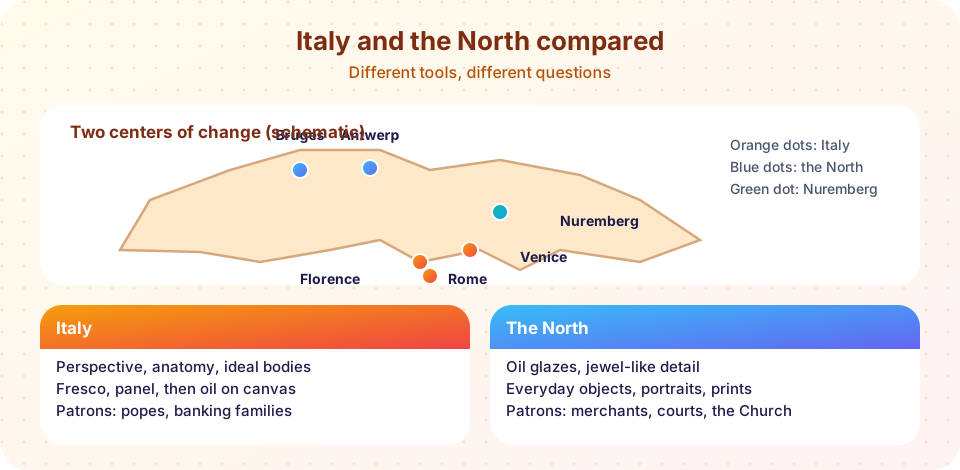
While Florentine artists were working out perspective and anatomy, painters north of the Alps were doing something different. In the wealthy trading cities of Flanders, like Bruges and Antwerp, they were perfecting oil paint to capture the sparkle of a jewel, the weave of a carpet and the reflection of a window in a pupil. They were less interested in a mathematical system and more in the rich surface of the visible world. Further east, in the German city of Nuremberg, a goldsmith's son named Albrecht Dürer discovered that printing could make an image travel across Europe.
The Northern Renaissance shares goals with the Italian one: close observation, individual portraits, a new status for the artist. But its tools, patrons and results differ, and by the end of the sixteenth century its legacy, in portraiture, landscape and scenes of everyday life, shaped much of European painting. This lesson tours its main figures and ideas.
What you will learn
- How Netherlandish painters used oil glazes and detail, and what "disguised symbolism" means.
- How printmaking spread images, with Dürer as the master.
- Key works by Van Eyck, Bosch, Holbein, Grünewald and Bruegel.
- How the Reformation changed art in northern Europe.
Key terms
- Glaze: a thin, transparent layer of oil paint over a dry layer, giving depth and glow.
- Altarpiece: a painting or carving placed behind or above a church altar, often with hinged panels.
- Woodcut and engraving: two print techniques (relief and intaglio).
- Anamorphosis: an image deliberately distorted so that it looks correct only from a particular angle.
- Reformation: the sixteenth-century movement that began with Martin Luther (1517) and divided Western Christianity.
The Netherlandish painters
In the early fifteenth century, the Burgundian Netherlands was one of Europe's richest regions, with powerful dukes, banking and cloth trade, and a growing middle class that wanted portraits and private devotional pictures. Here painters developed oil painting into a precise art.
Robert Campin (about 1375 to 1444) painted the Mérode Altarpiece (about 1427 to 1432), in which the Annunciation takes place in an ordinary middle-class room with a mousetrap and a lit candle. Everyday objects carry religious meaning. The idea that familiar things can also be symbols is called disguised symbolism, a term popularized by Panofsky, though scholars now debate how consistently it applies.
Jan van Eyck (about 1390 to 1441) was the court painter to Philip the Good, duke of Burgundy, and the most famous of them. His Ghent Altarpiece (finished 1432), made with his brother Hubert according to the inscription, is a huge folding polyptych (many-panel) work with nearly life-size nude Adam and Eve, an adoration of the lamb and hundreds of precisely painted plants and faces. His oil technique used thin, transparent glazes built up over a smooth white ground, so that colors glow from within, and reflections on armor and jewels seem to shimmer. The Arnolfini Portrait (1434), which you met in chapter 2, shows the same extreme detail, including the tiny convex mirror that reflects the whole room. Van Eyck did not invent oil paint, but he made it the tool of choice for painters of detail and light.
Rogier van der Weyden (about 1399 to 1464) painted emotion. His Deposition (about 1435 to 1438) shows mourners in tight, tearful poses, with the Virgin collapsing in a pose that echoes Christ's body, an image designed to move viewers to share the grief.
These works were often small and portable, painted for private devotion or as portraits, and they were collected by Italian bankers. In 1483 an altarpiece by Hugo van der Goes arrived in Florence and astonished local painters with its realism.
Bosch: fantasy and warning
Hieronymus Bosch (about 1450 to 1516) lived in the Dutch town of 's-Hertogenbosch. His Garden of Earthly Delights (about 1490 to 1510), now in the Prado in Madrid, is a triptych. The left panel shows Eden, the center is a crowded garden of naked figures, giant fruit and strange animals, and the right is a nightmarish hell with musical instruments used as torture devices. Scholars disagree about its meaning: a warning against lust, a satire, a reflection on human folly, an alchemical allegory or something else. What is certain is that it combines moral teaching with inventive imagery, and that it drew viewers in with details to hunt for.
Dürer and the power of print
Albrecht Dürer (1471 to 1528) of Nuremberg trained with his goldsmith father, then with a painter and a printmaker. He traveled to Italy twice (1494 to 1495 and 1505 to 1507), where he absorbed ideas about proportion and perspective. He was among the first artists to see himself as a thinker, and he wrote books on measurement and the human body.
Dürer's real genius was in printmaking. In 1498 he published a series of woodcuts of the Apocalypse, giving the Book of Revelation a terrifying new energy. His engravings, such as Knight, Death and the Devil (1513), Saint Jerome in His Study (1514) and the mysterious Melencolia I (1514), are packed with fine, controlled line. A print could be made in hundreds of impressions and carried across Europe, and Dürer's monogram, AD, became a trademark. When an Italian engraver copied his monogram, he complained to the authorities in Venice, one of the earliest recorded cases of artistic copyright.
His woodcut Rhinoceros (1515) is based only on a written description and a sketch of an animal sent to Lisbon; it shows plates like armor and a small horn on the back, details that are not accurate, but it became the standard image of the animal in Europe for centuries. His watercolor Young Hare (1502) and his 1500 self-portrait, in which he presents himself in a frontal, Christ-like pose, show his range.
Holbein, Grünewald and Bruegel
Hans Holbein the Younger (about 1497 to 1543) moved from Basel to England, where he painted court portraits, including Henry VIII. His double portrait The Ambassadors (1533) shows two richly dressed Frenchmen with instruments and books that show their learning, and, at the bottom, a strange stretched shape that appears from the side as a skull, an example of anamorphosis and a reminder of death. You can experiment with this effect in the Try it section.
Matthias Grünewald (about 1470 to 1528) painted the Isenheim Altarpiece (about 1512 to 1516) for a hospital run by monks who cared for people with painful skin diseases. Its central Crucifixion shows Christ covered with sores, so that patients could see their suffering shared.
Pieter Bruegel the Elder (about 1525 to 1569) lived in Antwerp and Brussels. He painted crowded, witty pictures of proverbs (Netherlandish Proverbs, 1559), landscapes with figures shown from far away, like the Tower of Babel (1563), and peasants dancing, feasting and working, such as the Peasant Wedding (about 1567). His Hunters in the Snow (1565) shows a winter village scene viewed from a hill, with bare trees, skaters and tired hunters, painted during a period of unusually cold winters in Europe often called the Little Ice Age. Because he treated the country people seriously and with an eye for detail, he is considered a founder of the tradition of landscape and genre painting.
Printing, reform and a changing market
Several changes in the sixteenth century reshaped northern art. Johannes Gutenberg's movable-type press (about 1450 in Mainz) made books and prints cheaper and spread ideas faster. In 1517 Martin Luther's challenge to the Church began the Reformation. Reformers argued that religious images could distract from God, and in 1566 waves of image-breaking (the Beeldenstorm) swept the Netherlands, destroying much church art. As a result, many northern artists turned from altarpieces to portraits, landscapes, still lifes and scenes of daily life, sold on an open market to merchants and townspeople. That shift sets up the Dutch Golden Age, the subject of chapter 5.
A simple contrast to remember: Italian painters often asked "how does space work?" while northern painters often asked "how does light fall on this surface?" Both ended up asking "what is a person?"
Common misconceptions
"The Northern Renaissance copied Italy." Its own roots in Gothic illumination, goldsmithing and Netherlandish oil painting created a distinct art, and exchange went both ways.
"Every object in a Van Eyck is a coded symbol." Some are, but scholars warn against over-reading. A dog may be just a dog.
"Prints are minor art." Dürer's engravings were among the most prized art of their day.
Try it
Check your understanding
Quick check · 5 questions
of 5 answered You scored / 5 · perfect!
-
1. What is a glaze in oil painting?
Netherlandish painters built up layered glazes to make colors glow. -
2. Why were prints important for artists like Dürer?
Prints spread images across Europe and built an artist's reputation, with Dürer's AD monogram as a trademark. -
3. What is anamorphosis in Holbein's The Ambassadors?
The distorted form appears as a skull when viewed from the side, a reminder of death. -
4. What did the Reformation do to northern art?
Image-breaking and new beliefs reduced church art and opened the market for secular subjects. -
5. Which painting shows a winter village scene viewed from a hill, painted in 1565?
Hunters in the Snow (1565) by Pieter Bruegel the Elder.
Summary
- Netherlandish painters such as Van Eyck perfected oil glazes and extreme detail; Campin and Van der Weyden added everyday settings and strong emotion.
- Bosch painted fantastic, hard-to-interpret moral visions.
- Dürer made printmaking a major art and a business, traveling to Italy and writing on proportion.
- Holbein, Grünewald and Bruegel brought portraits, suffering and everyday life into focus.
- The printing press and the Reformation (1517) changed what and for whom northern artists painted, preparing the Dutch Golden Age.
Next: Chapter 4 Review
Track your progress
Create a free account to tick off lessons and pick up where you left off on any device.
of Art History lessons completed