


















Lesson 39 of 49 · Contemporary and Global Art
Chapter 7 review: contemporary and global art
Review postwar art, Pop, Conceptual and performance art, and global traditions from Islamic geometry to Papunya painting, with a game and ten-question quiz.
This chapter made two moves at once: it followed the postwar avant-garde to the limits of what counts as art, and it widened the map to long traditions the older story overlooked. The review brings both together. Look at the picture, read the table, play the clue game and take the quiz. A good test of understanding is whether you can explain why a work belongs in its context: why a soup can appeared in the early 1960s, or why a geometric wall pattern grows from a circle.
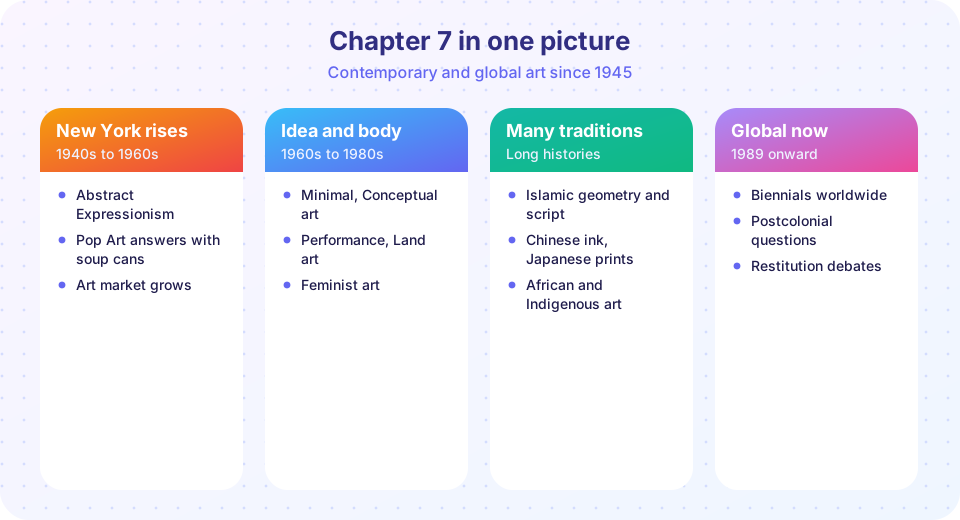
Recap table
| Topic | Key idea | Names and works |
|---|---|---|
| Abstract Expressionism | Scale, gesture and color as subject; New York as a center | Pollock (Autumn Rhythm), Rothko, de Kooning, Krasner, Frankenthaler |
| Pop Art | Mass media and shopping as subject; irony and repetition | Warhol (Campbell's Soup Cans), Lichtenstein (Whaam!), Hamilton, Boty |
| Minimalism and Conceptual art | The object simplifies; the idea takes over | Judd, Flavin, Martin, LeWitt, Kosuth |
| Performance, Land, feminist art | Body, landscape and politics | Ono, Abramovic, Beuys, Smithson (Spiral Jetty), Chicago, Guerrilla Girls |
| Islamic art | Script, geometry, figures in books and courts | Dome of the Rock, Alhambra, Taj Mahal |
| East Asia | Ink landscape; woodblock prints | Fan Kuan, Hokusai, Hiroshige |
| Africa, Americas, Australia | Court bronzes, murals, Dreaming paintings | Ife, Benin, Rivera, Papunya Tula, Kngwarreye |
| Contemporary global | Biennials, postcolonial critique, restitution | El Anatsui, Kusama, Ai Weiwei, Walker, Shonibare |
Five patterns to remember
- Each postwar move removes something: the subject, the artist's hand, the object, the gallery wall.
- Context makes meaning. The same bricks in a pile can be building material or art depending on where and why.
- No tradition is "outside" history. Islamic geometry, Chinese ink and West African bronze developed through their own long conversations.
- Ownership is a living question. Where objects are kept, and how they got there, matters.
- Be specific. Prefer "Yoruba" or "Edo" or "Western Desert" to a continent, and name artists.
Press Run (or Ctrl + Enter) to see the result here.
Program input · what you'd type while the program runs
Type the answers before you press Run, one per line. Each time the program reads a line (with input()), it gets the next line from this box.
How the lessons connect
The two halves of this chapter can look unrelated, but they ask the same question: who decides what counts as art, and on what grounds? In New York in the 1950s and 1960s, artists and critics argued over whether a drip painting, a soup can or a written instruction could be art. At the same time, scholars and curators were realizing that the older story of art had not even asked whether Islamic geometry, Chinese ink landscape, West African bronzes or Indigenous Australian painting belonged in the conversation. Both movements widen the definition and both challenge institutions.
The link is also practical. A museum that shows Warhol next to an Ife head, or Pollock next to a Papunya Tula painting, has to decide what the two have in common and what they do not. Good curators avoid saying "they are the same" and aim instead for comparison that respects each work's own context. That is the habit this chapter asks you to carry forward.
Compare and contrast prompts
- Pollock's Autumn Rhythm and a Papunya Tula painting: both are large, abstract-looking surfaces. What does each mean to its makers?
- Warhol's Campbell's Soup Cans and El Anatsui's bottle-cap hangings: both use the materials of consumption. What different stories do they tell?
- Smithson's Spiral Jetty and an Islamic geometric wall: both use pattern and repetition, but for very different ends.
Common exam traps
- Calling Pop Art simply "a joke". Read Warhol's disaster pictures before deciding.
- Using "primitive" or "tribal" for non-Western art. Name the specific culture, period and maker where known.
- Assuming museums own their collections without questions. Ask how objects arrived there.
- Treating Conceptual art as having no skill. The skill is in the idea, language and context.
Check your understanding
Quick check · 10 questions
of 10 answered You scored / 10 · perfect!
-
1. What does 'action painting' emphasize?
Harold Rosenberg described Pollock's method this way. -
2. What did Pop Art mainly borrow from?
Warhol, Lichtenstein and Hamilton used mass-media imagery. -
3. In Conceptual art, what often matters most?
LeWitt and Kosuth argued the idea comes first. -
4. Spiral Jetty is a work of:
Smithson built it in the Great Salt Lake in 1970. -
5. What was the Guerrilla Girls' main project?
They began in 1985 and used gorilla masks to stay anonymous. -
6. Which statement about Islamic geometric patterns is accurate?
Designers used compass-and-straightedge constructions based on circles. -
7. What does Tjukurrpa refer to?
Papunya Tula painters used the term for stories connecting people, land and law. -
8. What happened to Benin objects in 1897?
Thousands of objects were taken, and many are now being discussed for return. -
9. Which artist made Sunflower Seeds?
Ai Weiwei's 2010 Tate Modern installation used about 100 million porcelain seeds. -
10. Why should we be careful with the term 'non-Western'?
Naming specific cultures and regions is more accurate.
Summary
- Postwar Western art kept removing assumptions: subject, hand, object and gallery.
- Context, rules and ideas became part of artworks, as in Conceptual, Performance and Land art.
- Long global traditions have their own logic and history and are not footnotes to Europe.
- Restitution and provenance questions are central to museums today.
Track your progress
Create a free account to tick off lessons and pick up where you left off on any device.
of Art History lessons completed