


















Lesson 33 of 49 · Impressionism to Modernism
Post-Impressionism and Expressionism: structure, feeling, color
Seurat, Cezanne, Van Gogh and Gauguin extended Impressionism; Munch, the Fauves and German Expressionists put feeling first. With a dot and color lab.
By the 1880s some of the artists who had started with Impressionism felt it was not enough. Light and color were wonderful, but where was structure? Where was meaning? Where was the painter's own feeling? A new generation took different paths. Seurat turned color into a science, Cezanne rebuilt solid form out of patches of paint, Van Gogh poured emotion into every stroke, and Gauguin simplified shapes into flat symbolic color. Their work led straight into Expressionism, in which color and distortion were used to show inner states, not outward appearance.
What you will learn
- How the four main Post-Impressionists differ from each other and from Impressionism.
- What Fauvism and German Expressionism had in common and where they differed.
- Why "expressive" color is a choice, not a mistake.
- Which of these artists' reputations need critical rereading today.
Key terms
Post-Impressionism: a label coined by the critic Roger Fry for the London exhibition "Manet and the Post-Impressionists" (1910). It groups artists who built on Impressionism but moved beyond it.
Pointillism: painting with small distinct dots of pure color, which blend in the viewer's eye. Also called divisionism.
Fauvism: a short-lived movement (about 1905 to 1908) known for intense, non-natural color. Fauves means "wild beasts".
Expressionism: art that distorts shape and color to express emotion or inner experience.
Impasto: thick paint that stands up from the canvas and shows brush or knife marks.
Four routes beyond Impressionism
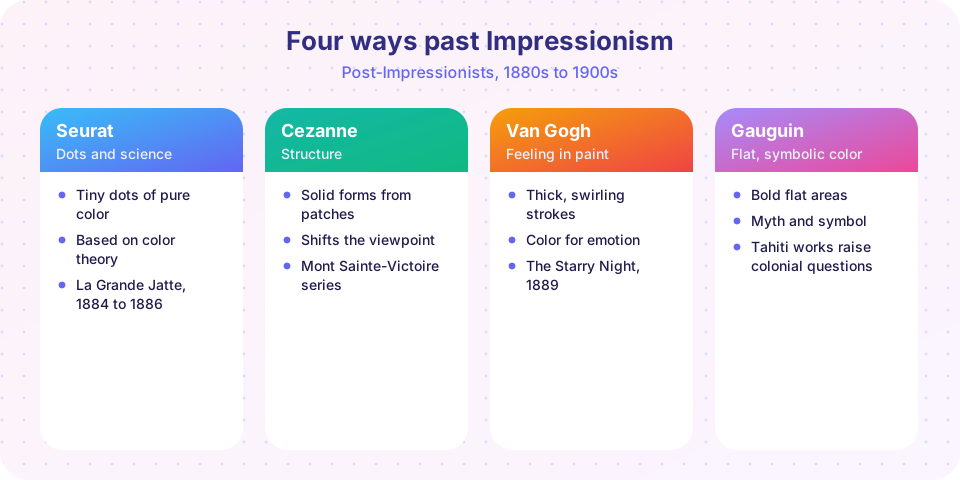
Georges Seurat (1859 to 1891) treated painting as a systematic experiment. He studied color theory by Chevreul and others and applied tiny dots of pure color to the canvas. His masterpiece A Sunday Afternoon on the Island of La Grande Jatte (1884 to 1886), about two by three meters, shows Parisians relaxing on a river island. The figures are formal and almost frozen, like figures in an Egyptian frieze, and the surface vibrates with dots of orange, blue and green. With his friend Paul Signac, he founded Neo-Impressionism.
Paul Cezanne (1839 to 1906) lived in Aix-en-Provence in the south of France. He wanted Impressionist color but also the solidity of old master painting. He built objects from many small, parallel patches of color that describe both light and the planes of form, and he let the viewpoint shift slightly within a picture. He painted Mont Sainte-Victoire again and again. His still lifes of apples have tabletops that tilt and bottles that lean, because he painted what he saw as he moved his head. Later painters, from Matisse to Picasso, studied him closely, and his approach helped open the way to Cubism.
Vincent van Gogh (1853 to 1890) was Dutch and came to painting in his late twenties, after working as an art dealer, teacher and missionary. In Paris (1886 to 1888) he met the Impressionists and the Japanese prints that his brother Theo, a dealer, collected. In Arles in the south of France (1888) he painted Sunflowers and The Night Cafe, using color to say something about mood: he described the cafe's reds and greens as a place where one could go mad. The Starry Night (1889) was painted from memory and imagination during his stay in the asylum at Saint-Remy, using thick, rhythmic strokes for a swirling sky above a quiet village. He died in July 1890 at 37. He sold very few paintings in his lifetime, and his fame grew after his death, helped by his brother's widow, Jo van Gogh-Bonger, who promoted his work and published his letters. Those letters are a remarkable record of an artist thinking about color, work and doubt. Today scholars warn against reducing his art to a tale of madness; he was a determined, widely read professional who worked methodically.
Paul Gauguin (1848 to 1903) left a banking career and a family to paint. In Brittany he developed a flat, bold style with strong outlines (called Synthetism). From 1891 he lived in Tahiti, producing pictures of Polynesian people and myths such as Where Do We Come From? What Are We? Where Are We Going? (1897 to 1898). His color is deliberately unnatural, and symbols matter more than appearance. But his Tahitian work is also rightly criticized today: he held colonial attitudes, idealized a culture he did not understand, and had relationships with teenage girls. A good modern reading appreciates his pictorial innovations while naming those problems.
Expressionism: when feeling leads
The word "Expressionism" is used loosely for art that distorts for emotional effect. It appears in several places at once.
Edvard Munch (1863 to 1944), the Norwegian painter, made The Scream (1893, with several versions) to express a moment of anxiety: a figure on a bridge, hands to the head, under a swirling red sky, with two people walking calmly behind. Munch described the experience in his own diary, and the image became a modern icon of anxiety.
The Fauves exhibited at the Salon d'Automne in Paris in 1905. The critic Louis Vauxcelles saw a Renaissance-style sculpture in the middle of the room, surrounded by explosively colored paintings, and joked that it was like a Donatello among wild beasts. Henri Matisse (1869 to 1954), Andre Derain and Maurice de Vlaminck used pure, unmixed color, often straight from the tube, for faces, trees and skies. Matisse's Woman with a Hat (1905) gave her green and violet planes in the face. These were not mistakes: color had been freed from description.
Die Brucke ("The Bridge") formed in Dresden in 1905 with Ernst Ludwig Kirchner, Erich Heckel and Karl Schmidt-Rottluff. Their harsh colors, angular forms and city street scenes express modern tension. Der Blaue Reiter ("The Blue Rider") began in Munich in 1911 around Wassily Kandinsky, Franz Marc, Gabriele Munter and August Macke, and was more spiritual, exploring color and eventually abstraction. Käthe Kollwitz (1867 to 1945) brought an Expressionist power to prints and drawings about poverty and war, while the young Egon Schiele (1890 to 1918) of Vienna made raw, angular figures.
Color as feeling: a plot
Painters often reach for complementary pairs to make strong emotional effects. Van Gogh wrote about using red against green in the cafe and blue against orange in his night scenes. The Python demo draws a hue wheel and marks three complementary pairs, then compares them numerically.
Press Run (or Ctrl + Enter) to see the result here.
Program input · what you'd type while the program runs
Type the answers before you press Run, one per line. Each time the program reads a line (with input()), it gets the next line from this box.
Common misconceptions
"Van Gogh painted only when mad." He had episodes of severe illness, but his greatest works were made during stable stretches, and his letters show careful planning and technique.
"Expressionist color is random." It is chosen. Kirchner's pink street or Matisse's green shadow follow a design logic that serves the mood.
"Gauguin is just a heroic escapee from the West." His Tahitian work is also bound up with colonial power and personal exploitation. Current museum labels often say so.
Try it
Slide the dot size above up gradually: at what size do you stop recognizing the tree? Then shift the hue by 60 to 120 degrees and ask yourself whether the picture says something different about the place.
Check your understanding
Quick check · 5 questions
of 5 answered You scored / 5 · perfect!
-
1. Who painted A Sunday Afternoon on the Island of La Grande Jatte?
Georges Seurat painted it between 1884 and 1886 using tiny dots of pure color. -
2. What is Cezanne most associated with?
His constructive brushstroke and Mont Sainte-Victoire series influenced Cubism. -
3. What does 'Fauves' mean?
A critic's joke about the wildly colored paintings at the 1905 Salon d'Automne. -
4. Which group formed in Dresden in 1905?
Kirchner, Heckel and Schmidt-Rottluff founded Die Brucke in Dresden. -
5. Why is Gauguin's Tahitian work discussed critically today?
Scholars point to his colonial viewpoint and his relationships with young girls.
Summary
- Post-Impressionists extended Impressionism in four directions: Seurat's science, Cezanne's structure, Van Gogh's feeling and Gauguin's symbol.
- Fauvism and German Expressionism freed color and form from description to express feeling.
- Expressive distortion is a deliberate design choice.
- Modern scholarship rereads Gauguin and corrects myths about Van Gogh.
Track your progress
Create a free account to tick off lessons and pick up where you left off on any device.
of Art History lessons completed