


















Lesson 49 of 49 · Projects and Practice
Further study: where to go next in aerodynamics
A roadmap beyond this course: which subjects deepen aerodynamics, how they connect, project ideas to build skills, and a self-assessment of what you can now do.
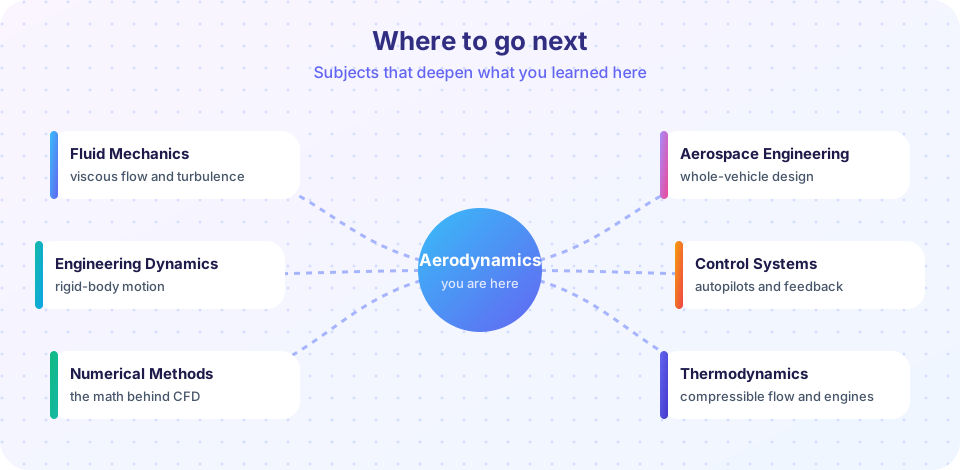
You have covered finite wings, compressible and supersonic flow, stability and control, and the ideas of computational aerodynamics, with projects that put them together. Aerodynamics itself is a doorway: behind it are viscous flow theory, vehicle design, flight dynamics, control and numerical methods. This page maps where each of those continues, suggests projects to build real skill, and ends with a checklist of what you should now be able to do.
What you will learn
- Which subjects extend each part of this course.
- Project ideas that build skills quickly.
- How to judge what you can already do.
Where each part leads
- Boundary layers, turbulence and viscous flow lead to Fluid Mechanics: the Navier-Stokes equations, pipe and channel flow, dimensional analysis and similarity. This is the natural next step if the CFD and turbulence lessons made you curious.
- Whole-vehicle design continues in Aerospace Engineering: aircraft performance, structures, propulsion, orbital mechanics and mission design, putting aerodynamics in context.
- Stability and dynamics grows into flight dynamics. The foundations are in Engineering Dynamics: rigid-body motion, rotation and vibration.
- Autopilots and feedback are the subject of Control Systems: transfer functions, stability margins and feedback design, which explains how a yaw damper or autopilot is built.
- Solving equations on computers is covered by Numerical Methods and Differential Equations, the mathematics underneath every CFD code.
- High-speed and propulsion flows rely on Engineering Thermodynamics: gas properties, cycles and compressible flow through engines.
- Loads on the airframe continue in Structural Engineering, where aerodynamic forces meet bending, shear and fatigue.
Project ideas
- Build and test a glide-ratio model. Make a foam or balsa glider with a measured wing area and mass, measure glide distance from a known height and compare it with your polar model. Expect
CD0to differ from the assumption. - A vortex-lattice code. Extend the lifting-line solver to a swept or tapered wing by replacing the line with a grid of horseshoe vortices; compare lift distributions.
- A shock-expansion airfoil calculator. Compute lift and wave drag of a diamond airfoil at several Mach numbers and angles of attack.
- A six-degrees-of-freedom flight simulator of a simple aircraft using the aerodynamic derivatives from Chapter 7; see the phugoid and short period appear.
- A finite-volume solver for the 1D Euler equations (the shock tube), with an upwind flux. It is the smallest real CFD code and a rite of passage.
What you can do now
Self-check. If you can do these things, you have absorbed the course:
- Estimate induced drag, stall speed and best-glide performance from a wing's geometry.
- Compute properties across normal and oblique shocks and through expansion fans.
- Compute the neutral point, static margin and trim elevator angle of an airplane.
- Estimate the phugoid period and short-period behavior.
- Choose a CFD method and wall spacing, and design a grid-convergence check.
Key terms
Flight dynamics: the study of aircraft motion under aerodynamic, thrust and gravity forces.
Vortex lattice: a method that models a wing as a grid of horseshoe vortices.
Shock tube: a classic test problem for compressible CFD codes.
Try it
A tiny helper that recommends a next subject from your interest. It is just a lookup table; change the entries to match your own plan.
Press Run (or Ctrl + Enter) to see the console output here.
No output.
Check your understanding
Quick check · 3 questions
of 3 answered You scored / 3 · perfect!
-
1. Which subject would you study to learn how autopilots and yaw dampers are designed?
Feedback design, transfer functions and stability margins are control-systems topics. -
2. Which project is the 'smallest real CFD code'?
It contains the essential ingredients: discretization, fluxes, time stepping and shocks. -
3. Why compare a physical glider test with your polar model?
Differences between model and experiment show which assumptions need improvement.
Summary
- Aerodynamics connects to fluid mechanics, aerospace design, dynamics, control, numerical methods, thermodynamics and structures.
- Projects (a measured glider, a vortex lattice, a shock-expansion calculator, a flight simulator, a shock-tube solver) build real skill.
- Use the self-check list to see what you can already do.
Track your progress
Create a free account to tick off lessons and pick up where you left off on any device.
of Aerodynamics lessons completed