


















Lesson 11 of 49 · Airfoils and Lift
Airfoil geometry
Learn the parts of an airfoil (chord, camber line, thickness, leading edge radius) and how to decode and generate NACA four-digit sections with live code.
An airfoil is a shape designed so that air flowing past it produces a lot of lift for little drag. Its geometry is described by a few numbers, and once you know them you can read an airfoil's name and sketch its shape without seeing it. In this lesson you will meet the vocabulary, decode the famous NACA four-digit family, and generate real airfoils with a few lines of code.
What you will learn
- The parts of an airfoil: chord, camber line, thickness, leading and trailing edges.
- How to decode a NACA four-digit code such as 4412.
- How the camber line and thickness distribution build the shape.
- How camber, thickness and angle of attack influence lift qualitatively.
Key terms
Chord line (c): the straight line joining the leading edge and the trailing edge; its length is the chord.
Mean camber line: the curve halfway between the upper and lower surfaces.
Thickness (t): the distance between upper and lower surfaces, usually quoted as a fraction of the chord.
Leading-edge radius: the radius of the circle that fits the nose of the airfoil.
Angle of attack (α): the angle between the chord line and the free-stream direction.
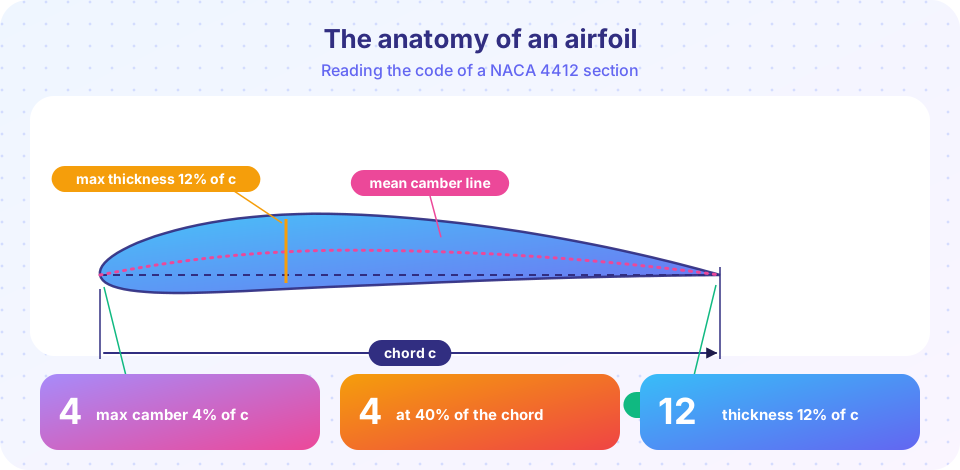
The vocabulary
Look at the picture and name the parts.
- The front point of the airfoil is the leading edge (LE); the sharp rear point is the trailing edge (TE).
- The straight line between them is the chord line, and its length is the chord
c. All other lengths are normalized byc, so airfoil shapes are quoted in terms ofx/candy/c. - The mean camber line is the curve that runs halfway between the upper and lower surfaces. It measures how asymmetric the airfoil is. A symmetric airfoil has a straight camber line that coincides with the chord.
- The thickness distribution is how far apart the upper and lower surfaces are, measured perpendicular to the camber line. The maximum thickness (about 12% for typical light-aircraft sections) occurs at roughly 30% of the chord.
- The leading-edge radius controls how the flow handles the nose. A blunt nose is gentler at high angle of attack but causes more drag at high speed.
NACA four-digit airfoils
In the 1930s the US National Advisory Committee for Aeronautics (NACA, the predecessor of NASA) published families of airfoils defined by simple formulas. The four-digit family is named by digits MPTT:
- M: maximum camber, in percent of chord.
- P: position of maximum camber, in tenths of chord.
- TT: maximum thickness, in percent of chord.
So NACA 4412 has 4% camber at 40% chord and 12% thickness. NACA 0012 has zero camber (M = 0, P = 0) and is symmetric with 12% thickness: it is used for helicopter blades and aerobatic wings.
The formulas
With x measured along the chord from 0 to 1 and m = M/100, p = P/10, t = TT/100:
Thickness distribution (the half-thickness at each x):
yt = 5 t ( 0.2969 √x − 0.1260 x − 0.3516 x² + 0.2843 x³ − 0.1036 x⁴ )
(the last coefficient 0.1036 gives a trailing edge that is slightly open; 0.1015 closes it exactly)
Camber line:
yc = (m / p²) (2 p x − x²)                     for 0 ≤ x < p
yc = (m / (1 − p)²) (1 − 2p + 2 p x − x²)      for p ≤ x ≤ 1
The upper and lower surfaces are the camber line offset by ±yt along the normal to the camber line. For thin airfoils, a vertical offset is accurate enough for plotting. Three further facts help:
- The leading-edge radius of a four-digit airfoil is
r = 1.1019 t² c; for 12% thickness it is about 1.6% of the chord. - A symmetric airfoil has zero lift at zero angle of attack. A cambered airfoil has lift at zero angle of attack.
- Later NACA families (five-digit, 6-series) shift the position of maximum thickness aft to keep the flow laminar for longer.
How shape affects lift
Qualitatively:
- Angle of attack raises lift almost linearly until stall (next lessons).
- Camber shifts the whole lift curve upward: a cambered airfoil produces lift at α = 0. This is why most low-speed airplane wings are cambered.
- Thickness matters mainly for strength (a thicker spar holds more fuel and carries bending loads) and for the maximum lift near stall. Thick airfoils usually stall more gently; very thin ones stall abruptly at the leading edge.
Common misconceptions
"The angle of attack is the angle between the wing and the ground." It is the angle between the chord line and the relative wind. In a climb or descent the relative wind is tilted, but α is still measured from it.
"Thicker means more lift." At normal angles of attack, thickness has little effect on the lift slope. It does change the maximum lift and the drag.
"Pitch angle and angle of attack are the same." Pitch is the angle of the aircraft relative to the horizon, while α is relative to the air.
Try it
Press Run (or Ctrl + Enter) to see the result here.
Program input · what you'd type while the program runs
Type the answers before you press Run, one per line. Each time the program reads a line (with input()), it gets the next line from this box.
Check your understanding
Quick check · 5 questions
of 5 answered You scored / 5 · perfect!
-
1. What does the NACA code 2412 mean?
The digits are maximum camber (percent), its position (tenths of chord) and maximum thickness (percent). -
2. Which airfoil is symmetric?
Zero camber digits (00) mean the camber line is the chord line, so the airfoil is symmetric. -
3. The angle of attack is measured between:
It is the angle between the chord and the oncoming flow, not the horizon. -
4. Compared with a symmetric airfoil, a cambered airfoil at zero angle of attack:
Camber turns the flow and shifts the lift curve upward, so lift is positive at α = 0. -
5. The leading-edge radius of a 12% thick NACA four-digit airfoil is about:
r = 1.1019 t² c = 1.1019 × 0.0144 ≈ 0.0159 c.
Summary
- An airfoil is described by its chord, camber line, thickness distribution and leading-edge radius.
- NACA MPTT: camber %, its position in tenths, thickness %.
- Camber shifts the lift curve upward; angle of attack is measured from the relative wind.
- You can plot any four-digit airfoil from the formulas.
Next: Pressure and lift
Track your progress
Create a free account to tick off lessons and pick up where you left off on any device.
of Aerodynamics lessons completed