


















Lesson 36 of 49 · Stability and Control
Chapter 7 review: stability and control
Review static and dynamic stability, the neutral point, trim, CG limits and the longitudinal and lateral modes with a one-page summary and a ten-question quiz.
Stability and control let an airplane fly itself and obey the pilot. This page collects the main results from the chapter. Test them with the calculator and the quiz, which mixes all three lessons.
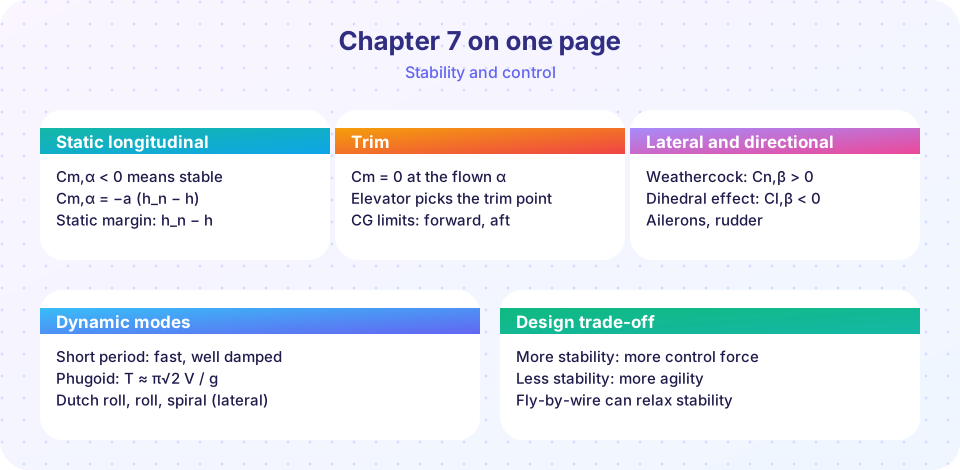
The chapter in a table
| Topic | Key result | What to remember |
|---|---|---|
| Static longitudinal | Cm,α = a (h − h_n) < 0 |
CG ahead of the neutral point |
| Static margin | K_n = h_n − h |
5% to 20% chord is typical |
| Neutral point | Lift-slope-weighted mean of wing and tail ACs | Tail pulls it aft |
| Trim | Cm = 0; δe shifts the curve |
Slower flight means more up elevator |
| CG limits | Forward: elevator authority. Aft: stability | Set by the loading chart |
| Lateral | Cn,β > 0, Cl,β < 0 |
Weathercock and dihedral effects |
| Short period | ωₙ² ≈ −Mα + Zα Mq |
Fast, well damped |
| Phugoid | T ≈ π√2 V/g, ζ ≈ 1/(√2 L/D) |
Slow, lightly damped |
Try it
A compact stability analyzer that takes the airplane geometry and returns the neutral point, static margin, Cm,α and the verdict. Change the tail area and arm and see what changes.
Press Run (or Ctrl + Enter) to see the result here.
Program input · what you'd type while the program runs
Type the answers before you press Run, one per line. Each time the program reads a line (with input()), it gets the next line from this box.
Check your understanding
Quick check · 10 questions
of 10 answered You scored / 10 · perfect!
-
1. Which sign of Cm,α indicates static longitudinal stability?
A nose-up disturbance must produce a nose-down moment. -
2. Moving the CG aft does what to the static margin?
K_n = h_n − h shrinks as h grows. -
3. The neutral point is the average of the wing and tail aerodynamic centers weighted by
h_n = (a_w h_ac + a_t' h_t)/(a_w + a_t'). -
4. To fly slower at the same CG, a stable airplane needs
Higher CL requires a larger nose-up tail moment: the trim curve slopes up toward lower speed. -
5. Which limit usually sets the forward CG bound?
A far-forward CG demands more nose-up control than the elevator can supply at low speed. -
6. What does a trim tab accomplish?
It sets the surface's floating position so the hinge moment is zero. -
7. The short-period mode is typically
Periods of one to three seconds with damping ratio 0.3 to 0.8. -
8. Estimate the Lanchester phugoid damping ratio for L/D = 10.
ζ = 1/(√2 · 10) = 0.0707. -
9. Which mode do yaw dampers mainly improve?
They add yaw damping, reducing the Dutch roll oscillation. -
10. A positive Cn,β means
Weathercock stability: yaw away from the wind produces a restoring moment.
Summary
- Static stability:
Cm,α = a (h − h_n) < 0; the margin ish_n − h. - The elevator sets trim; the CG envelope is bounded by control authority (forward) and stability (aft).
- Short period: fast and damped; phugoid: slow, damping depends on
L/D. - Lateral modes: roll subsidence, spiral and Dutch roll; yaw dampers help.
Track your progress
Create a free account to tick off lessons and pick up where you left off on any device.
of Aerodynamics lessons completed