


















Lesson 10 of 49 · Airfoils and Lift
Chapter 3 overview: Airfoils and lift
A clear overview of how wings make lift, with three equivalent views (pressure difference, momentum change, circulation), common myths, and a map of chapter 3.
A fully loaded airliner weighs hundreds of tonnes, and the only thing holding it up is air flowing over its wings. How can thin air carry that much? This chapter answers the question carefully, because the lift of a wing is one of the most misexplained ideas in science. We will keep to explanations that agree with each other and with measurement.
What you will learn
- Three equivalent explanations of lift and how they connect.
- Why the popular "equal transit time" story is wrong.
- A first numerical estimate of lift from momentum.
- The plan for the rest of the chapter.
Key terms
Camber: the curvature of an airfoil; a cambered airfoil is asymmetric between top and bottom.
Angle of attack (α): the angle between the chord line and the oncoming flow.
Circulation (Γ): the net rotation of the flow around the wing, measured in m²/s.
Downwash: the downward velocity given to the air by the wing.
Stagnation point: the point where the flow comes to rest on the body.
Three views, one lift
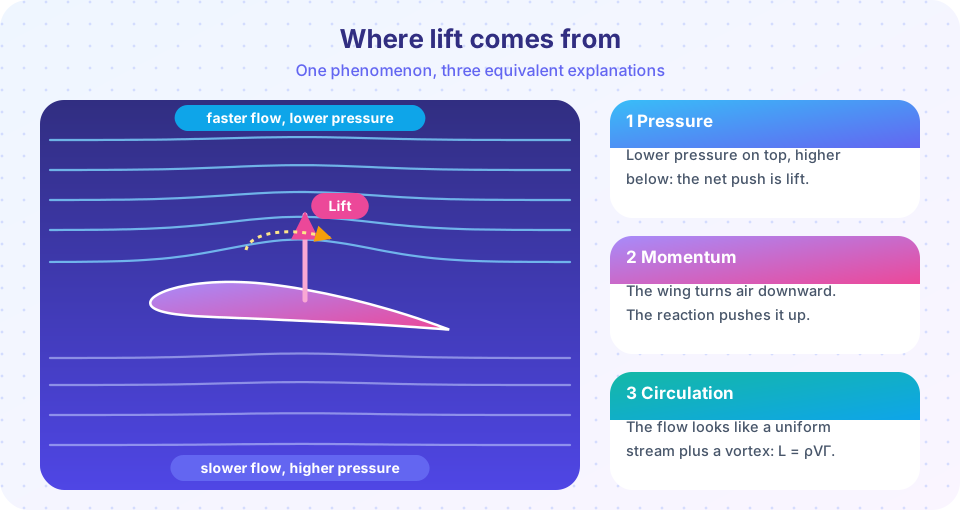
A wing at a small angle of attack, or with camber, bends the flow. Looked at from three angles, this single event gives three consistent descriptions.
- The pressure view
- The momentum view
- The circulation view
One cause behind all three
The pressure view. The surface of the wing feels pressure from the air. The pressure on the top is lower than the free-stream value and on the bottom it is higher, so the net push is upward. The next lesson draws this as a graph. This view tells you where the force acts.
The momentum view. The wing leaves the air behind it moving downward (downwash). By Newton's second law, the force on the air is the rate of change of its momentum, and by the third law the air pushes back up on the wing with equal force. This view tells you how much lift is possible.
The circulation view. Add a spinning flow (a vortex) around the wing section to a uniform stream. The flow speeds up on top and slows below, and the Kutta–Joukowski theorem says the lift per unit span is L' = ρ V Γ. This view gives the mathematics that lead to thin-airfoil theory.
None of these is "the real" cause and the others "just" descriptions. They are complete descriptions of the same flow, and each is exact if used consistently. Problems arise when people mix half of one with half of another.
A momentum estimate
For a wing of span b, a good first approximation is that it influences a cylinder of air of diameter b, so the mass flowing through it per second is ṁ = ρ V (π b² / 4). If the wing leaves that air with a downward velocity w far behind it, then
L = ṁ w = ρ V (π b² / 4) w
For an elliptically loaded wing (Chapter 5) this relation is exact. The Try it block below puts a light aircraft through it and finds the downwash it must generate.
Common misconceptions
"The air over the top must travel farther and so must go faster to meet the air below at the trailing edge." This "equal transit time" story is false. Measurements and calculations show the air over the top arrives at the trailing edge before the air from below. Flat plates and thin symmetric wings at an angle also lift, even though both surfaces have the same length.
"Bernoulli explains lift, Newton is wrong" (or the reverse). Both Bernoulli's equation and Newton's laws are satisfied by the real flow. They are two accounts of the same thing, and neither gives the full answer without knowing the flow pattern (the shape and angle of attack decide it).
"A wing needs a curved top to lift." Camber helps but is not required. A flat sheet of plywood at a small positive angle of attack lifts, and an aerobatic aircraft flies upside down with a symmetric section.
What the chapter covers
- Airfoil geometry: the vocabulary and the NACA four-digit family.
- Pressure and lift: the pressure coefficient and circulation.
- Thin-airfoil theory: the formula
cl = 2π(α − α0). - Stall and high lift: the limit of the straight-line region, and flaps.
- Chapter 3 review.
Try it
Press Run (or Ctrl + Enter) to see the result here.
Program input · what you'd type while the program runs
Type the answers before you press Run, one per line. Each time the program reads a line (with input()), it gets the next line from this box.
Check your understanding
Quick check · 5 questions
of 5 answered You scored / 5 · perfect!
-
1. Which statement about the 'equal transit time' explanation is true?
There is no physical reason for the two air parcels to meet again at the trailing edge, and measurements show the top flow arrives earlier. -
2. In the momentum view, lift is the reaction to:
The wing changes the downward momentum of the air, and the reaction force lifts the wing. -
3. The Kutta–Joukowski theorem states that lift per unit span equals:
L' = ρ V Γ links lift to the circulation Γ and the free-stream speed V. -
4. A flat plate at a small angle of attack:
Tilting the plate turns the flow downward, so lift appears even without camber. -
5. If speed halves while the weight stays the same, the air that the wing processes per second halves, so the downwash must:
L = ṁ w with ṁ proportional to V, so w must double to keep L the same.
Summary
- Lift has three equivalent descriptions: pressure difference, downward momentum change, and circulation.
- The "equal transit time" story is wrong; camber is not required for lift.
- A first estimate is
L = ρV(πb²/4)·w. - The next lessons build the tools: geometry, Cp, thin-airfoil theory, and stall.
Next: Airfoil geometry
Track your progress
Create a free account to tick off lessons and pick up where you left off on any device.
of Aerodynamics lessons completed