


















Lesson 48 of 49 · Projects and Practice
Aerodynamics cheat sheet
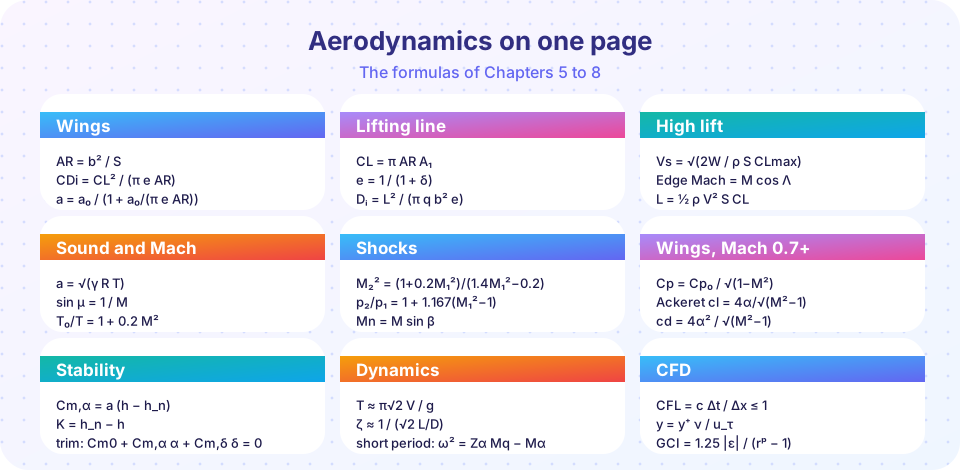
One-page aerodynamics cheat sheet: formulas for wings, shocks, stability and CFD, standard constants, a tool chooser and a Python toolbox of the key functions.
When you solve a real problem you rarely need a derivation; you need the right formula, the right constants and a reminder of when each one applies. This page is that one-page summary of Chapters 5 to 8: a poster of formulas, a table of constants, a decision guide for choosing the right method, and a small Python toolbox you can copy into your own work.
What you will learn
- Where to find the key formulas and constants quickly.
- How to choose the method that matches the question.
- How to wrap the formulas in reusable code.
Constants and standard values
| Quantity | Value |
|---|---|
Gravity g |
9.81 m/s² |
Sea-level density ρ₀ |
1.225 kg/m³ |
| Sea-level pressure | 101,325 Pa |
| Sea-level temperature | 288.15 K (15 °C) |
| Speed of sound at sea level | 340.3 m/s |
| Speed of sound at 11 km (216.65 K) | 295.1 m/s |
Air gas constant R |
287.05 J/(kg K) |
Heat capacity ratio γ (air) |
1.4 |
| Kinematic viscosity at sea level | about 1.46 × 10⁻⁵ m²/s |
| Thin-airfoil lift slope | 2π per radian (about 0.110 per degree) |
Which tool for which question?
| Question | Tool | Chapter |
|---|---|---|
| How much induced drag does this wing have? | CDi = CL²/(π e AR) |
5 |
| How should lift be distributed along the span? | Lifting-line (Glauert) | 5 |
| Will a swept wing delay shocks? | M cos Λ |
5, 6 |
| How slowly can it land? | Vs = √(2W/(ρ S CLmax)) |
5 |
| Is this flow compressible? | M = V/a, check M > 0.3 |
6 |
| What happens across a shock? | Normal and oblique shock relations | 6 |
| Lift and wave drag at Mach 2? | Ackeret or shock-expansion | 6 |
| Is the airplane stable? | Neutral point and static margin | 7 |
| Where can the CG go? | CG envelope | 7 |
| How does it respond to a gust? | Short period and phugoid | 7 |
| Quick pressure distribution at low speed? | Panel method | 8 |
| Is my simulation grid good enough? | Grid convergence and GCI | 8 |
Common mistakes to avoid
Mixing degrees and radians: lift slopes are per radian unless stated; convert before multiplying.
Forgetting the square: CDi ∝ CL², q ∝ V², stall speed ∝ 1/√CLmax.
Using static properties where stagnation properties belong (and the reverse) in shock and isentropic calculations.
Trusting a solution without a grid study or a limiting-case check.
Key terms
Dynamic pressure q: ½ρV², the scale for aerodynamic forces.
Coefficient: force or moment divided by q S (or q S c̄ for moments).
Stagnation property: the value after isentropic deceleration to rest.
Try it
A toolbox of the key functions of the course in one place. Run it to see sample outputs and copy the functions into your own scripts.
Press Run (or Ctrl + Enter) to see the result here.
Program input · what you'd type while the program runs
Type the answers before you press Run, one per line. Each time the program reads a line (with input()), it gets the next line from this box.
Check your understanding
Quick check · 4 questions
of 4 answered You scored / 4 · perfect!
-
1. What is the speed of sound at sea level in standard air?
a = √(1.4 · 287.05 · 288.15) ≈ 340.3 m/s. -
2. In which units should lift-curve slopes be used in formulas like a = a₀/(1 + a₀/(π e AR))?
The 2π thin-airfoil value is per radian; mixing units gives wrong numbers. -
3. A question asks how a swept wing's leading edge sees the flow. Which formula applies?
The component across the leading edge is V cos Λ. -
4. To check that a CFD answer does not depend on the mesh you should
A grid study with at least three meshes quantifies discretization error.
Summary
- The poster and tables collect the formulas, constants and tools of Chapters 5 to 8.
- Watch units (radians!), squares and stagnation-versus-static values.
- The toolbox gives reusable functions for common calculations.
Next: Further study
Track your progress
Create a free account to tick off lessons and pick up where you left off on any device.
of Aerodynamics lessons completed