


















Lesson 27 of 49 · Compressible and Supersonic Flow
Chapter 6 overview: compressible and supersonic flow
A visual map of compressible flow: Mach regimes, shock waves, expansion fans, transonic drag rise and supersonic wings, with a quick Mach number calculator.
Up to now you could treat air as if its density never changed. For an airplane at 60 m/s that is an excellent approximation: the density varies by less than two percent around the airframe. Push the speed up and the approximation fails. Air starts to behave like a compressible gas, pressure disturbances can no longer escape ahead of the aircraft, and new phenomena appear: shock waves, wave drag, sonic booms. This chapter introduces the physics you need to understand them.
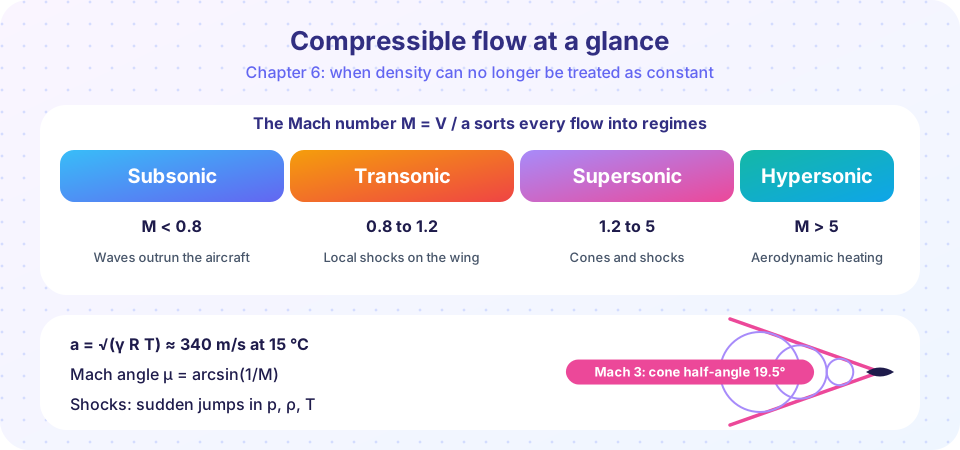
What you will learn
- What Mach number is and why it, not speed alone, controls compressibility.
- How to relate temperature, pressure and density in smooth high-speed flow.
- What a shock wave is and why it costs energy.
- How wings behave near and beyond the speed of sound.
The chapter in slides
Speed is relative to sound
Smooth compression
Abrupt compression
Wings near Mach 1
What each lesson covers
- Speed of sound, Mach number and isentropic flow: where compressibility comes from, the Mach cone, stagnation properties and the area-Mach relation for nozzles.
- Shock waves and expansion fans: normal and oblique shocks, the θ-β-M relation, Prandtl-Meyer expansion, and a complete shock-expansion calculation for a flat plate.
- Transonic and supersonic wings: critical Mach number, drag divergence, supercritical airfoils, the area rule and linearized supersonic theory.
- Chapter 6 review: the one-page summary and a ten-question quiz.
Key terms
Mach number (M): flight speed divided by the local speed of sound.
Compressible flow: flow in which density changes are significant, usually M > 0.3.
Shock wave: a very thin region across which pressure, density and temperature rise abruptly.
Wave drag: drag caused by shock waves, which appears at transonic and supersonic speeds.
Try it
Speed of sound depends on temperature, and temperature falls with altitude in the troposphere, so the same ground speed is a higher Mach number up high. The table uses the International Standard Atmosphere temperatures.
Press Run (or Ctrl + Enter) to see the result here.
Program input · what you'd type while the program runs
Type the answers before you press Run, one per line. Each time the program reads a line (with input()), it gets the next line from this box.
Check your understanding
Quick check · 4 questions
of 4 answered You scored / 4 · perfect!
-
1. What does a Mach number of 0.5 mean?
M = V / a, so 0.5 means half the local speed of sound. -
2. Why does the same true airspeed correspond to a higher Mach number at altitude?
a = √(γRT) falls with temperature, which drops with height in the troposphere. -
3. Above roughly what Mach number is air flow usually treated as compressible?
At M = 0.3 density changes reach a few percent. -
4. A shock wave is
Shocks are abrupt, irreversible compressions only a few mean free paths thick.
Summary
- Compressibility is governed by the Mach number
M = V/a. - Smooth compression follows isentropic relations; abrupt compression is a shock.
- Near Mach 1, wave drag rises sharply; sweep and the area rule are the design responses.
Track your progress
Create a free account to tick off lessons and pick up where you left off on any device.
of Aerodynamics lessons completed