


















Lesson 28 of 49 · Compressible and Supersonic Flow
Speed of sound, Mach number and isentropic flow
Learn where the speed of sound comes from, how Mach number and Mach angle work, and how to use isentropic relations and the area-Mach equation for nozzles.
When you clap your hands, a pressure disturbance spreads out at the speed of sound. Every pressure change in a fluid, including the pressure field of a wing, travels that way. As long as the wing is slower than sound, its pressure "news" runs ahead and warns the air to move aside. Once the wing outruns sound, the news can no longer escape, and the flow must adjust abruptly. This lesson builds the tools for the smooth part of that story.
What you will learn
- Why the speed of sound is
a = √(γ R T)and what that means for flight at altitude. - How to compute Mach number and the Mach angle.
- How to use the isentropic relations to move between static and stagnation properties.
- How the area-Mach relation explains converging-diverging nozzles and choking.
Key terms
Speed of sound (a): the speed of small pressure disturbances, a = √(γ R T). For air, γ = 1.4 and R = 287 J/(kg K).
Stagnation (total) properties: the values the flow would reach if brought to rest without loss, written T₀, p₀, ρ₀.
Isentropic flow: flow that is adiabatic and reversible, so entropy stays constant.
Choked flow: a nozzle flow whose mass flow cannot rise any more because the throat has reached M = 1.
Where the speed of sound comes from
A sound wave is a small, rapid compression. It is so fast that heat has no time to flow, and so small that friction is negligible, so each air parcel undergoes an isentropic change. The wave speed is then a² = (∂p/∂ρ)ₛ. For a perfect gas with p = ρ R T and p/ρ^γ = const this evaluates to:
a = √(γ R T)
Only temperature matters. At 15 °C (288.15 K) a = √(1.4 · 287.05 · 288.15) ≈ 340.3 m/s. In the stratosphere at 216.65 K, a ≈ 295.1 m/s. That is why an airliner cruising at 250 m/s true airspeed at 11 km is at Mach 250 / 295.1 = 0.85, but the same speed near the ground is only Mach 0.73.
The Mach number is M = V / a. A flow with M < 1 everywhere is subsonic; M > 1 is supersonic. Why does Mach number measure compressibility? Because the pressure change a flow undergoes is of order ½ρV² and the pressure change needed to change density by a fraction is related to ρa². The density change is therefore roughly ½ M². At M = 0.3 it is about 4.6% (still often neglected). At M = 0.5 it is about 13%, and compressibility can no longer be ignored.
The Mach cone
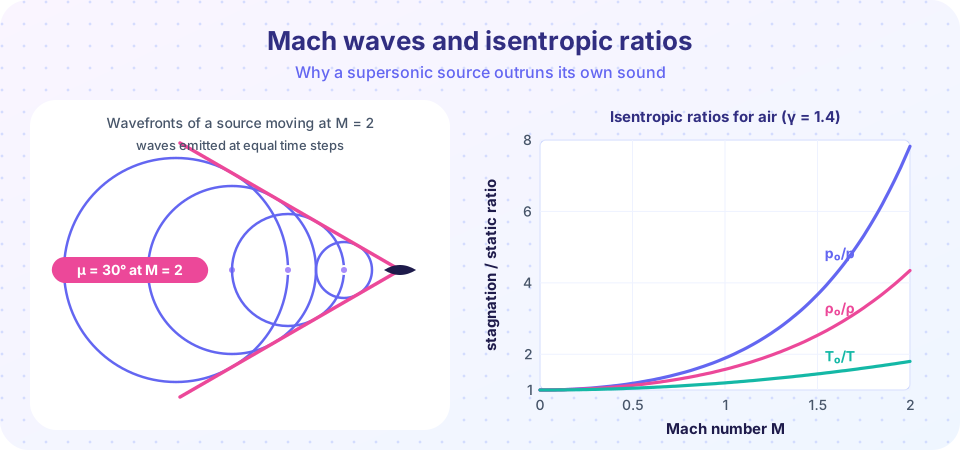
A moving source emits sound waves that expand as spheres at speed a. If the source is slower than sound, the waves stay ahead of it and the pattern is crowded in front. If it is faster, the source outruns them, and the spheres are all enclosed by a cone whose half-angle, the Mach angle μ, satisfies:
sin μ = a·t / (V·t) = 1 / M
At M = 2, μ = 30°; at M = 1, μ = 90° (a flat wavefront); at M = 5, μ ≈ 11.5°. Anyone outside the cone hears nothing until the cone passes. This is the sonic boom: the passing cone, a pressure disturbance, not a one-time "break" of a barrier.
Isentropic relations
When air changes speed smoothly (outside shock waves and boundary layers) the flow is isentropic and energy conservation (h + V²/2 = const) yields the relations between a point in the flow and its stagnation state:
T₀/T = 1 + (γ−1)/2 · M²                   = 1 + 0.2 M²
p₀/p = (T₀/T)^(γ/(γ−1))                   = (1 + 0.2 M²)^3.5
ρ₀/ρ = (T₀/T)^(1/(γ−1))                   = (1 + 0.2 M²)^2.5
At M = 1: T₀/T = 1.2, p₀/p = 1.893, ρ₀/ρ = 1.577. At M = 2: 1.8, 7.824, 4.347.
A worked example. A pitot-static probe on an airplane reads static p = 50 kPa, static T = 250 K at M = 0.8:
T₀ = 250 · (1 + 0.2 · 0.64) = 282 K
p₀ = 50 · 1.128^3.5          ≈ 76.2 kPa
The air heats by 32 K when brought to rest, which is why skin temperatures rise at high speed: at Mach 2 the stagnation temperature is 1.8 T, about 390 K in the stratosphere. Stagnation temperature stays constant in any adiabatic flow, shocks included.
The area-Mach relation and nozzles
In a steady quasi-one-dimensional duct, mass conservation ρ V A = const links area to speed. Differentiating and combining with the momentum equation gives a result that surprises everyone the first time:
dA / A = (M² − 1) · dV / V
- Subsonic (
M < 1): the factor is negative, so a shrinking duct speeds the flow up, as in a garden hose nozzle. - Supersonic (
M > 1): the factor is positive, so a growing duct speeds the flow up. - At
M = 1:dA = 0, so sonic flow can only happen at a throat, a minimum area.
To accelerate a gas from rest to supersonic speed you therefore need a converging-diverging (de Laval) nozzle: converge to a throat where M = 1, then diverge. Integrating gives the area-Mach relation, with A* the area where M = 1 would occur:
A / A* = (1/M) · [ (2/(γ+1)) · (1 + (γ−1)/2 · M²) ]^((γ+1) / (2(γ−1)))
For air the exponent is 3. A/A* = 1 at M = 1 and A/A* = 1.688 at M = 2, 4.235 at M = 3. For each A/A* > 1 there are two solutions, one subsonic and one supersonic. Once the throat is sonic the flow is choked: the mass flow is the maximum the duct can pass for the given p₀ and T₀, ṁ ≈ 0.0404 · p₀ · A* / √T₀ (SI units, air). Lowering the back pressure further cannot increase it.
Common misconceptions
"The speed of sound is a constant, 340 m/s." It depends on temperature (not pressure or density separately): about 295 m/s in the stratosphere.
"Compressibility depends on how high the pressure is." It depends on the Mach number: a high-pressure but slow flow is nearly incompressible.
"A supersonic nozzle should keep narrowing." Past the throat the area must grow; narrowing a supersonic flow slows it down.
Try it
First, plot the isentropic ratios and print a short table you can check by hand.
Press Run (or Ctrl + Enter) to see the result here.
Program input · what you'd type while the program runs
Type the answers before you press Run, one per line. Each time the program reads a line (with input()), it gets the next line from this box.
Second, a solver for the area-Mach relation. It finds both the subsonic and the supersonic Mach number for a given area ratio.
Press Run (or Ctrl + Enter) to see the result here.
Program input · what you'd type while the program runs
Type the answers before you press Run, one per line. Each time the program reads a line (with input()), it gets the next line from this box.
Check your understanding
Quick check · 5 questions
of 5 answered You scored / 5 · perfect!
-
1. What is the speed of sound in air at 216.65 K?
a = √(1.4 · 287.05 · 216.65) ≈ 295.1 m/s. -
2. A source moves at Mach 3. What is the Mach angle?
sin μ = 1/3, so μ = 19.47°. -
3. In an isentropic flow at M = 2, what is T₀/T?
T₀/T = 1 + 0.2 · 4 = 1.8. -
4. How must the area change to accelerate a supersonic flow?
dA/A = (M² − 1) dV/V, which is positive for supersonic flow. -
5. Where in a converging-diverging nozzle can the flow first reach M = 1?
dA = 0 when M = 1, so sonic flow occurs at the minimum area.
Summary
a = √(γ R T);M = V / a; the Mach angle issin μ = 1/M.- Isentropic relations:
T₀/T = 1 + 0.2 M²,p₀/p = (T₀/T)^3.5,ρ₀/ρ = (T₀/T)^2.5for air. dA/A = (M² − 1) dV/V: supersonic acceleration needs a diverging duct after a sonic throat.- Choked flow passes the maximum mass flow for given stagnation conditions.
Track your progress
Create a free account to tick off lessons and pick up where you left off on any device.
of Aerodynamics lessons completed