


















Lesson 7 of 49 · The Atmosphere and Flight Basics
Air density and the gas law
Use p = ρRT to find air density, learn why hot, high and humid days weaken lift and engines, compute density altitude, and meet viscosity and the speed of sound.
Lift is proportional to air density, and so is drag, and so is the power a piston engine can make. A pilot taking off from a high, hot airport meets thin air and needs a longer runway. To put numbers on this, we need one equation that ties pressure, density and temperature together: the equation of state of an ideal gas.
What you will learn
- The ideal-gas law
p = ρ R Tand what each symbol means for air. - Why hot, high and humid conditions reduce density.
- How to compute density altitude and use it.
- The role of viscosity and the speed of sound in aerodynamics.
Key terms
Equation of state: a relation among p, ρ and T. For air it is p = ρ R T, with R = 287.053 J/(kg·K).
Density altitude: the ISA altitude at which the air has the same density as the actual air.
Pressure altitude: the ISA altitude that matches the actual pressure.
Dynamic viscosity (μ): a measure of how strongly a fluid resists shearing; for air at 15 °C it is 1.789 × 10⁻⁵ Pa·s.
Speed of sound (a): a = √(γ R T), with γ = 1.4 for air.
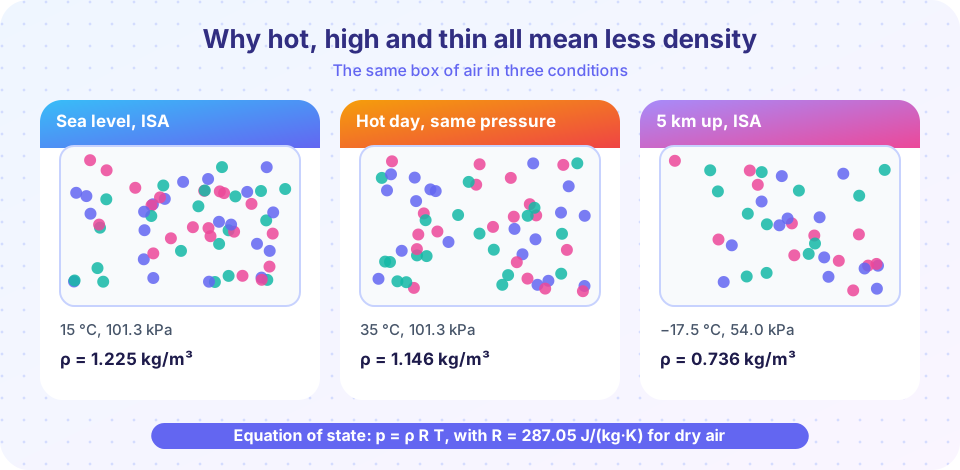
The equation of state
For a gas whose molecules barely interact (air at ordinary conditions), pressure, density and absolute temperature are tied by
p = ρ R T
where T must be in kelvin (K = °C + 273.15). Solve it for density and you can see all the trends at once:
ρ = p / (R T)
- Same pressure, hotter air: T is larger, so ρ is smaller. A hot day is a thin-air day.
- Same temperature, lower pressure (higher altitude): ρ is smaller.
Worked example. At the ISA sea-level values, ρ = 101,325 / (287.053 × 288.15) = 1.225 kg/m³. At the same pressure but 35 °C (308.15 K), ρ = 101,325 / (287.053 × 308.15) = 1.146 kg/m³. That is 6.5% less air, so 6.5% less lift at the same speed and angle of attack.
Humid air is lighter
The air is mostly nitrogen (molar mass 28) and oxygen (32), averaging about 29 g/mol. Water vapor has a molar mass of only 18 g/mol. Replace some of the heavier molecules with water vapor at the same pressure and temperature, and the mix becomes lighter. So humid air is slightly less dense than dry air. The effect is small (a few tenths of a percent to about 2% on a very warm, humid day), and ISA ignores it, but it is another reason that hot and humid is the worst combination for takeoff performance.
Density altitude
Aircraft performance depends on density, but pilots read pressure. Density altitude bridges the gap: it is the altitude in the standard atmosphere that has the same density as the actual air. A takeoff from an airport at 1,600 m with a hot day might feel like a takeoff from 2,500 m in ISA conditions, and the airplane performs as if it were there.
To compute it: take the pressure altitude from the altimeter (set to 1013.25 hPa), compute the true pressure from ISA, use the actual temperature to get ρ = p/(RT), and then find the ISA altitude with that density.
Rule of thumb used in pilot training: density altitude is about the pressure altitude plus 120 ft for every °C the temperature is above ISA at that level. This is an approximation; the calculator below gives the exact value.
Viscosity and the speed of sound
Two more air properties enter aerodynamics.
-
Viscosity controls friction and the boundary layer. For gases it rises with temperature (the opposite of liquids). Sutherland's law is a good model:
Textμ = 1.458 × 10⁻⁶ · T^1.5 / (T + 110.4) (μ in Pa·s, T in K)
At 288.15 K this gives about 1.789 × 10⁻⁵ Pa·s.
-
Speed of sound depends only on temperature:
a = √(γ R T). At 288.15 K it is 340.3 m/s; at 216.65 K it is 295.1 m/s.
The kinematic viscosity ν = μ / ρ is also used. At sea level it is about 1.46 × 10⁻⁵ m²/s, and it grows at altitude because density falls faster than viscosity.
Common misconceptions
"Density altitude is the altitude on the altimeter." The altimeter shows pressure altitude (or height above sea level with QNH), not density altitude. On a hot day the density altitude can be thousands of feet higher.
"Cold air is always safer." Cold air is denser, which helps lift and engines, but ice on surfaces ruins airfoil shape. Density and ice are different effects.
"Humidity makes air heavy." Water vapor molecules are lighter than nitrogen or oxygen molecules, so humid air is slightly lighter.
Try it
Press Run (or Ctrl + Enter) to see the result here.
Program input · what you'd type while the program runs
Type the answers before you press Run, one per line. Each time the program reads a line (with input()), it gets the next line from this box.
Check your understanding
Quick check · 5 questions
of 5 answered You scored / 5 · perfect!
-
1. In p = ρ R T, what unit must temperature have?
The ideal gas law uses absolute temperature, so convert Celsius by adding 273.15. -
2. At constant pressure, what happens to density when air is heated?
ρ = p/(RT), so a bigger T means a smaller ρ at the same p. -
3. Density altitude is defined as:
It converts the actual density into the standard-atmosphere altitude that has that density, so performance charts can be used. -
4. Why is humid air slightly less dense than dry air?
Replacing heavier N2 and O2 molecules with lighter H2O molecules at the same p and T lowers the average molar mass, so lowers ρ. -
5. How does the viscosity of air change when it is heated?
For gases viscosity rises with temperature (Sutherland's law), unlike liquids.
Summary
p = ρRTlinks the three state variables; at fixed p, hotter air is thinner.- Humid air is slightly lighter than dry air.
- Density altitude tells you what altitude the aircraft feels; it rises on hot, high days.
- Air viscosity grows with temperature (Sutherland); the speed of sound is √(γRT).
Track your progress
Create a free account to tick off lessons and pick up where you left off on any device.
of Aerodynamics lessons completed