


















Lesson 47 of 49 · Projects and Practice
Glossary of aerodynamics terms
A searchable glossary of the key terms and symbols from wings, compressible flow, stability and control, and computational aerodynamics, with short definitions.
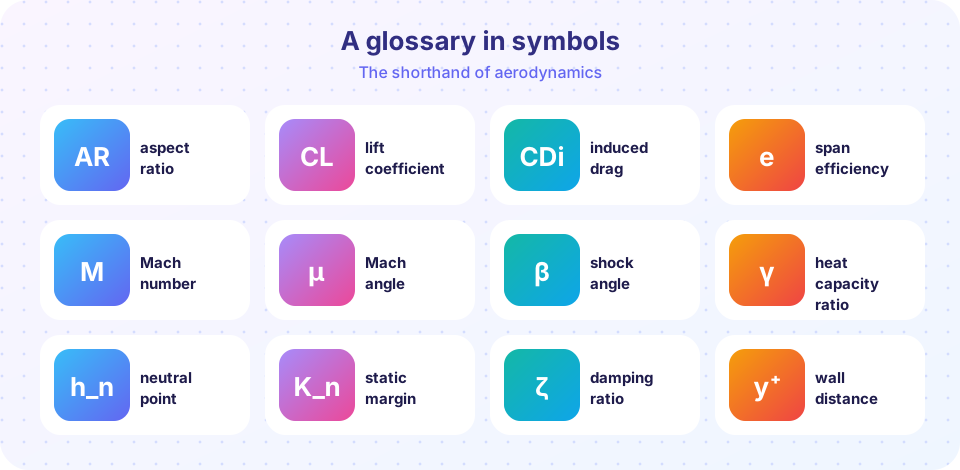
Aerodynamics has a dense vocabulary, and many symbols look alike (a is the speed of sound, a lift slope, or a coefficient, depending on the page). This glossary collects the terms from Chapters 5 to 8 in one place with short, precise definitions. Use the search box below the table to find a term quickly.
What you will learn
- The precise meaning of the main terms in each chapter.
- How common symbols are used and how to avoid confusing similar ones.
Wings and finite span (Chapter 5)
| Term | Meaning |
|---|---|
Aspect ratio, AR |
Span squared divided by wing area, b²/S. |
| Bound vortex | The vortex that represents the wing's circulation in lifting-line theory. |
Circulation, Γ |
Net rotation of the flow around a wing section; lift per unit span is ρVΓ. |
| Downwash | Downward velocity induced at the wing by trailing vortices. |
| Elliptical loading | A span loading shaped like an ellipse; gives minimum induced drag. |
Induced angle of attack, αᵢ |
The angle by which downwash tilts the local flow. |
| Induced drag | Drag that comes with producing lift on a finite wing; CDi = CL²/(π e AR). |
| Lifting line | Prandtl's model of a wing as a line of bound vortices. |
| Slat, flap | Leading-edge and trailing-edge high-lift devices. |
Span efficiency, e |
Measure of how close the loading is to elliptical; e ≤ 1. |
Sweep, Λ |
Angle between the quarter-chord line and a line perpendicular to the flow. |
Taper ratio, λ |
Tip chord divided by root chord. |
| Washout | Twist that lowers incidence toward the tip. |
Compressible flow (Chapter 6)
| Term | Meaning |
|---|---|
| Area rule | Shape the whole aircraft so cross-sectional area changes smoothly, to reduce wave drag. |
| Choked flow | Flow through a throat at M = 1; the mass flow cannot increase further. |
| Critical Mach number | Freestream Mach number at which the local flow first reaches M = 1. |
| Drag divergence | The sharp rise in drag coefficient above a certain Mach number. |
| Expansion fan | Isentropic fan of Mach waves at a convex corner. |
| Isentropic | Adiabatic and reversible: constant entropy. |
Mach angle, μ |
arcsin(1/M); half-angle of the Mach cone. |
Mach number, M |
Speed divided by the local speed of sound. |
| Normal shock | A shock perpendicular to the flow; the flow behind it is subsonic. |
| Oblique shock | An inclined shock that turns a supersonic flow by θ at shock angle β. |
| Prandtl-Glauert rule | Subsonic compressibility correction factor 1/√(1 − M²). |
Prandtl-Meyer function, ν |
Turning angle of an expansion from M = 1 to M. |
Speed of sound, a |
√(γRT). |
| Stagnation properties | Values reached when the flow is brought to rest isentropically. |
| Supercritical airfoil | Section with a flat top and aft camber, shaped to delay wave drag. |
| Wave drag | Drag due to shock waves. |
Stability and control (Chapter 7)
| Term | Meaning |
|---|---|
| Adverse yaw | Yaw opposite to the direction of roll produced by aileron drag differences. |
| Aerodynamic center | Point about which the pitching-moment coefficient is constant with angle of attack. |
| CG envelope | Allowed range of center-of-gravity positions. |
Damping ratio, ζ |
0 for no damping, 1 for critical damping. |
| Dutch roll | Lateral-directional oscillation combining yaw and roll. |
Neutral point, h_n |
CG position at which Cm,α = 0. |
| Phugoid | Slow oscillation trading speed and altitude. |
| Short period | Fast, well-damped pitching oscillation. |
Static margin, K_n |
h_n − h, as a fraction of the mean chord. |
| Trim | State with zero net moment so the airplane flies hands-off. |
| Weathercock stability | Cn,β > 0: the nose turns into the wind. |
Computational aerodynamics (Chapter 8)
| Term | Meaning |
|---|---|
| CFL number | c Δt / Δx; must not exceed 1 for simple explicit schemes. |
| Closure problem | The averaged equations contain more unknowns than equations. |
| Finite volume | Discretization that balances fluxes through the faces of each cell. |
| GCI | Grid convergence index: uncertainty estimate from grid refinement. |
| Kutta condition | The flow leaves a sharp trailing edge smoothly. |
| LES, DES, DNS | Large-eddy, detached-eddy and direct numerical simulation. |
| Numerical diffusion | Smearing introduced by the numerical scheme. |
| Order of accuracy | Error scales like Δxᵖ. |
| Panel method | Potential-flow method with singularities on the body surface. |
| RANS | Reynolds-averaged Navier-Stokes equations. |
| Validation, verification | Checking against reality, and checking that the equations are solved right. |
y⁺ |
Dimensionless wall distance y u_τ/ν. |
Key terms
Symbol: a letter standing for a quantity; always check its units and its context.
Coefficient: a dimensionless number, such as CL, formed by dividing a force or moment by q S or q S c̄.
Derivative notation: Cm,α means the derivative of Cm with respect to α.
Try it
A small search tool. Type part of a term to filter the glossary entries (a shortened sample).
Check your understanding
Quick check · 4 questions
of 4 answered You scored / 4 · perfect!
-
1. What does Cm,α mean?
A subscript after a comma denotes a derivative. -
2. Which term describes the cross-sectional area rule?
The area rule reduces wave drag by smoothing the area distribution. -
3. What is the Kutta condition?
It fixes the circulation in potential-flow models. -
4. Short period and phugoid are both
They are the two longitudinal dynamic modes.
Summary
- Terms are grouped by chapter; symbols often change meaning with context.
- A subscript after a comma is a derivative; coefficients are dimensionless.
- Keep this page open while you work through the problems and projects.
Next: Aerodynamics cheat sheet
Track your progress
Create a free account to tick off lessons and pick up where you left off on any device.
of Aerodynamics lessons completed