


















Lesson 31 of 49 · Compressible and Supersonic Flow
Chapter 6 review: compressible and supersonic flow
Review Mach number, isentropic relations, shock waves, expansion fans and transonic and supersonic wings with a one-page summary and a ten-question quiz.
This chapter took you from nearly incompressible flow to the realm where shocks and expansions shape every force. The picture and table below collect the formulas worth remembering. Use the calculator to test your understanding on the numbers you meet in practice, then take the quiz.
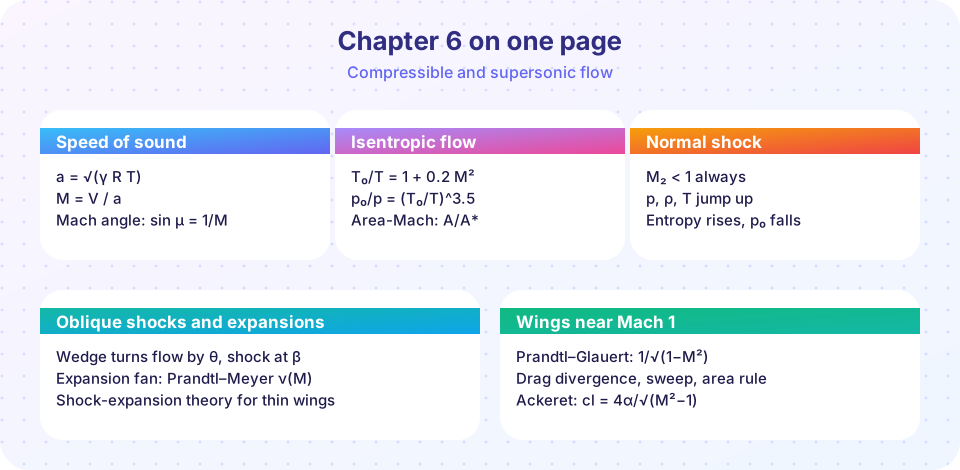
The chapter in a table
| Topic | Key relations (air, γ = 1.4) | Remember |
|---|---|---|
| Sound and Mach | a = √(γRT), M = V/a, sin μ = 1/M |
a depends on temperature only |
| Isentropic flow | T₀/T = 1 + 0.2M², p₀/p = (T₀/T)^3.5 |
Valid without shocks or friction |
| Nozzles | dA/A = (M² − 1) dV/V |
Sonic only at a throat |
| Normal shock | M₂ < 1, p₂/p₁ = 1 + 1.1667(M₁² − 1) |
Stagnation pressure falls |
| Oblique shock | Mₙ₁ = M₁ sin β, weak and strong solutions |
Beyond max θ the shock detaches |
| Expansion | θ = ν(M₂) − ν(M₁) |
Isentropic, accelerates the flow |
| Subsonic wing | a = a₀/√(1 − M²) |
Valid to about M = 0.7 |
| Supersonic wing | cl = 4α/√(M² − 1) |
Thin, sharp sections |
Try it
Chain the relations together: a probe in a supersonic stream measures the stagnation pressure behind a normal shock (the Rayleigh pitot formula); work backward to the Mach number.
Press Run (or Ctrl + Enter) to see the result here.
Program input · what you'd type while the program runs
Type the answers before you press Run, one per line. Each time the program reads a line (with input()), it gets the next line from this box.
Check your understanding
Quick check · 10 questions
of 10 answered You scored / 10 · perfect!
-
1. What is the speed of sound at 300 K (γ = 1.4, R = 287 J/kg·K)?
a = √(1.4 · 287 · 300) = √120540 ≈ 347 m/s. -
2. At M = 1 what is T₀/T?
1 + 0.2 · 1 = 1.2. -
3. An aircraft at Mach 2 produces a Mach cone with half-angle
sin μ = 1/2, so μ = 30°. -
4. To accelerate supersonic flow in a duct you need
dA/A = (M² − 1) dV/V is positive for acceleration at M > 1. -
5. Across a normal shock which of the following is true?
Static pressure rises, stagnation temperature is constant, and the flow turns subsonic. -
6. A weak oblique shock compared with a normal shock at the same M₁
Only the normal component Mₙ₁ = M₁ sin β is compressed, and a smaller Mₙ₁ means a weaker shock. -
7. Expansion around a convex corner produces
Supersonic flow turning away from itself expands through a fan. -
8. The Prandtl-Glauert factor at M = 0.8 is
1/√(1 − 0.64) = 1/0.6 = 1.667. -
9. Which of these delays drag divergence?
A flat-topped supercritical section keeps the supersonic region weak. -
10. Why is a supersonic wing thin with sharp edges?
Wave drag grows with (t/c)² and blunt noses make strong shocks.
Summary
- Mach number measures compressibility; the speed of sound depends on temperature.
- Smooth flow is isentropic; shocks are irreversible and reduce stagnation pressure.
- Oblique shocks and expansion fans turn supersonic flow and give exact forces on thin bodies.
- Near and above Mach 1, wing design is a fight against wave drag: sweep, thinness, supercritical shapes and the area rule.
Track your progress
Create a free account to tick off lessons and pick up where you left off on any device.
of Aerodynamics lessons completed