


















Lesson 25 of 49 · Wings and Finite Span Effects
Sweep, taper and high-lift devices
Learn why fast aircraft have swept wings, what taper and twist do, and how flaps and slats raise maximum lift so aircraft can take off and land slowly.
A wing must do two very different jobs. In cruise it should slice through the air near the speed of sound with little drag. On take-off and landing it must carry the whole aircraft at low speed, and that demands a lot of lift. One fixed shape is a poor answer to both. Designers therefore combine sweep and taper (shaping the wing for cruise) with flaps and slats (reshaping it for low speed). This lesson explains why each exists and what it costs.
What you will learn
- The independence principle: why only
V cos Λacts like the "real" airspeed on a swept wing. - The benefits and the low-speed problems of sweep, and how designers cope.
- What taper and twist do to the span loading.
- How flaps and slats change the lift curve, and how to compute stall speed from
CLmax.
Key terms
Sweep angle (Λ): the angle between the wing's quarter-chord line and a line perpendicular to the flow direction.
Taper ratio (λ): tip chord divided by root chord.
Washout: twisting the wing so the tip has a lower angle of incidence than the root.
Maximum lift coefficient (CLmax): the highest lift coefficient the wing reaches before it stalls.
Why sweep helps
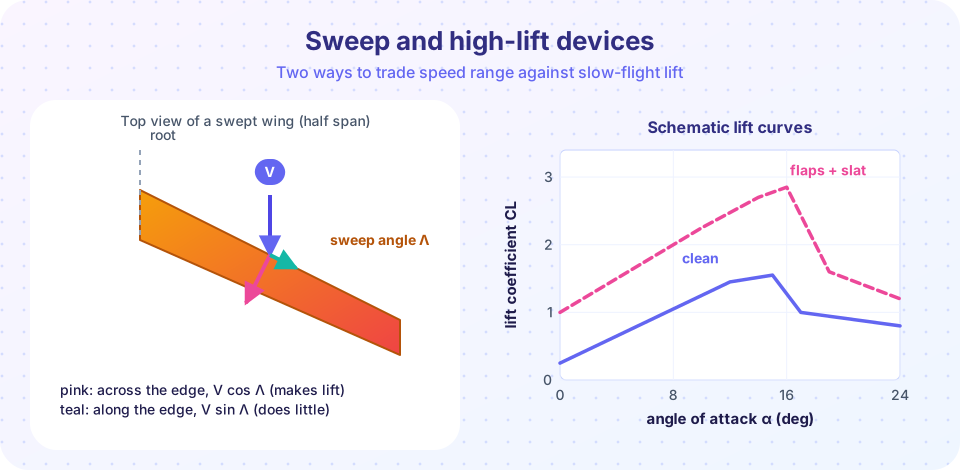
Picture a long wing swept back at angle Λ in a flow of speed V. Split the velocity at the leading edge into a part across the edge, V cos Λ, and a part along it, V sin Λ. The part along the edge barely touches the pressure distribution: air moving along a leading edge does not "see" the curvature of the section. To a good approximation, the pressures on an infinitely long swept wing are those of an unswept wing flying at V cos Λ. This is the independence principle.
The payoff arrives near the speed of sound. Shock waves and the drag that comes with them depend on the Mach number across the leading edge. At a flight Mach number M = 0.82 and Λ = 30°, the effective Mach number is 0.82 × cos 30° = 0.71. That is comfortably subsonic, which is why airliners that cruise at about Mach 0.8 are swept at 25° to 35°. You will see the compressibility details in Chapter 6.
Why sweep hurts at low speed
Real wings are not infinitely long, so sweep brings trouble.
- Lower lift slope. A swept wing makes less lift per degree. As a first approximation the slope scales with
cos Λ. - Lower CLmax. Spanwise flow along the wing thickens the boundary layer toward the tips, so the wing stalls earlier there than the independence principle predicts.
- Tip stall and pitch-up. On a back-swept wing the tips are behind the center of gravity. If the tips stall first, the lift moves forward and the nose pitches up even more, an unsafe, self-worsening situation.
Designers fight these with washout (tip at lower incidence so the root stalls first), leading-edge devices on the outer wing, wing fences or vortex generators to block spanwise flow, and high-lift systems. Forward-swept wings exist (for example the X-29 research aircraft) but they invite structural twisting that increases the angle of attack toward the tip. They need stiff, specially tailored composite structures.
Taper and twist
A rectangular wing is simple, but its loading peaks at the root where the structure is heaviest. Tapering the chord moves loading outward and, for one taper ratio, gets very close to the ideal elliptical loading. You found numbers for this in the previous lesson: an aspect-ratio-8 wing has its best span efficiency at a taper ratio of roughly 0.4. Tapering has side benefits: a thin tip is light, and a thick, long-chord root holds fuel and carries bending loads. A small drawback is that the small tip chords operate at lower Reynolds numbers and stall earlier, so twist is added to protect them.
High-lift devices
In steady level flight, lift equals weight:
W = ½ ρ V² S CL so the stall speed is Vs = √( 2 W / (ρ S CLmax) )
To land slowly you need either a bigger wing or a higher CLmax. A bigger wing costs weight and cruise drag, so designers extend high-lift devices that raise CLmax only when needed.
- Plain and split flaps hinge down part of the trailing edge. They add camber, which shifts the whole lift curve upward.
- Slotted and Fowler flaps slide backward and downward, opening gaps that feed energy into the boundary layer, and a Fowler flap also adds wing area. Airliners use multi-element slotted Fowler flaps.
- Leading-edge slats and Krueger flaps extend forward from the nose. A slat lets high-energy air flow through a gap and stay attached, delaying stall to a higher angle of attack.
- Droop noses curve the leading edge down to help flow turn around the nose.
Flaps mostly lift the curve (the zero-lift angle becomes more negative) while slats extend it to higher angles. Typical clean CLmax values are around 1.2 to 1.6. With flaps and slats deployed an airliner can reach roughly 2.5 to 3. Nothing is free: deployed flaps add drag, so take-off uses a moderate setting for good climb performance and landing uses the full setting. Aircraft normally approach at around 1.3 times the stall speed for a safety margin.
A worked example. An airplane lands at W = 392,400 N (a mass of 40,000 kg) on a wing of S = 80 m² at sea level:
Clean:           Vs = √(2·392400 / (1.225·80·1.5)) ≈ 73 m/s
With flaps/slats (CLmax = 2.8): Vs = √(2·392400 / (1.225·80·2.8)) ≈ 53.5 m/s
The high-lift system cuts the stall speed by roughly 27%, and since the landing distance scales with speed squared, it shortens the landing run by about half.
Common misconceptions
"Sweep is used because it makes more lift." The opposite: sweep reduces lift slope. It is used to delay compressibility drag.
"Flaps work by making the wing bigger." Only Fowler-type flaps add area. Most of the effect is a change of camber and better flow turning.
"A slat is just a spare wing." A slat works by passing air through its gap, which re-energizes the boundary layer on the main element.
Try it
Stall speed is the cleanest way to see the benefit of high lift. Vary CLmax and watch the stall speed of the airplane from the worked example fall.
Press Run (or Ctrl + Enter) to see the result here.
Program input · what you'd type while the program runs
Type the answers before you press Run, one per line. Each time the program reads a line (with input()), it gets the next line from this box.
Next, a small console calculator for the effective Mach number across a swept leading edge. It uses the independence principle, so treat the numbers as first estimates.
Press Run (or Ctrl + Enter) to see the console output here.
No output.
Check your understanding
Quick check · 5 questions
of 5 answered You scored / 5 · perfect!
-
1. A wing is swept 35° and flies at Mach 0.80. What is the Mach number across the leading edge (independence principle)?
0.80 × cos 35° = 0.80 × 0.819 = 0.655. -
2. Why is tip stall a particular danger on back-swept wings?
The tips are behind the center of gravity, so losing their lift pitches the nose up further. -
3. Which device delays stall to a higher angle of attack?
A slat passes air through its gap and keeps the flow attached around the nose. -
4. The weight stays the same and CLmax doubles. By what factor does the stall speed change?
Vs is proportional to 1/√CLmax, and 1/√2 ≈ 0.71. -
5. What does washout do?
Twisting the tip down delays tip stall and keeps ailerons effective.
Summary
- On a swept wing the leading edge sees
V cos Λ, which delays compressibility effects. - Sweep reduces lift slope and
CLmaxand invites tip stall; washout, fences and slats help. - Taper moves loading toward the ideal elliptical shape.
- Flaps raise the lift curve, slats extend it to higher angles, and
Vs = √(2W/(ρ S CLmax))shows their benefit.
Next: Chapter 5 review
Track your progress
Create a free account to tick off lessons and pick up where you left off on any device.
of Aerodynamics lessons completed