


















Lesson 5 of 49 · The Atmosphere and Flight Basics
Chapter 2 overview: The atmosphere and flight basics
A guided tour of Earth's atmosphere for aerodynamics: the four layers, how temperature, pressure and density change with height, and what this chapter covers.
An aircraft's wings do not work on their own. They work on air, and air is different at every altitude: colder, thinner and with a different speed of sound. Before we study airfoils, we need to know what the air is doing. This chapter gives you a working model of the atmosphere and the speed measurements pilots and engineers rely on.
What you will learn
- The four main layers of the atmosphere and where aircraft operate.
- Why pressure and density fall quickly with height.
- What the lessons in this chapter cover and how they connect.
Key terms
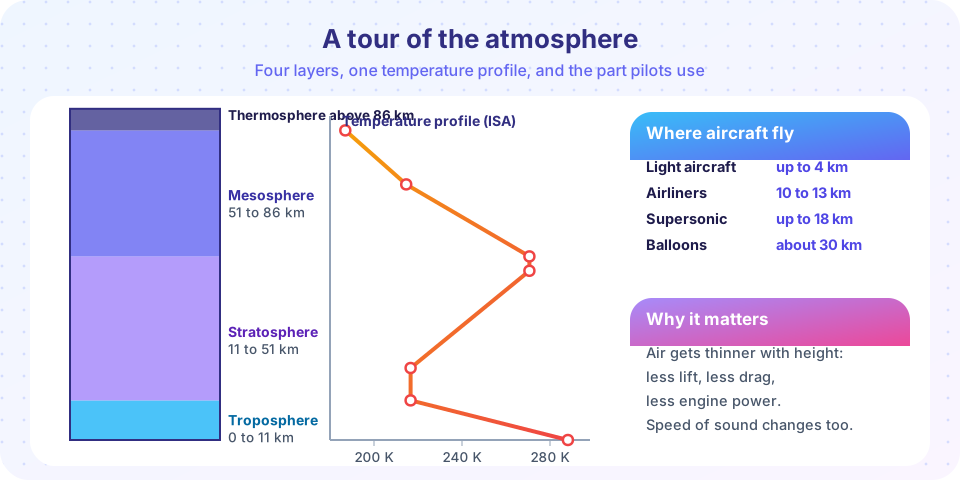
Troposphere: the lowest layer (surface to about 11 km at mid-latitudes), where weather happens and temperature falls with height.
Tropopause: the boundary at the top of the troposphere, near 11 km in the standard atmosphere.
Stratosphere: the layer above, where temperature is first constant and then rises.
Lapse rate: the rate at which temperature falls with height, 6.5 K per km in the standard troposphere.
The big picture
The atmosphere is a thin skin of gas around a planet 12,742 km wide. Roughly 99% of its mass lies below 30 km, and half of it lies below about 5.5 km. Gravity pulls the gas down, and the lower air carries the weight of all the air above it. That is why pressure is highest at the ground and falls with altitude.
Temperature follows a more complicated pattern, controlled by what absorbs sunlight. Near the ground, sunlight heats the surface, which warms the air above, and the air cools as it rises and expands. Higher up, ozone absorbs ultraviolet light, warming the stratosphere.
Troposphere: where we live
Stratosphere: calm and cold
Mesosphere and above
What it means for wings
What this chapter covers
- The standard atmosphere defines a reference model (ISA) so that everyone computes with the same numbers.
- Air density and the gas law explains why a hot day at a high airport is dangerous for takeoff, using the equation of state.
- Airspeeds and dynamic pressure explains how an airspeed indicator works and the four kinds of airspeed.
- Chapter 2 review pulls the formulas together with a quiz.
Common misconceptions
"There is no air in the stratosphere." There is, just thin. At 11 km the density is still about 30% of sea level, and an airliner flies there every day.
"Higher is always colder." Not above the tropopause. Temperature stays constant from 11 to 20 km in the standard model and then rises.
Try it
Press Run (or Ctrl + Enter) to see the result here.
Program input · what you'd type while the program runs
Type the answers before you press Run, one per line. Each time the program reads a line (with input()), it gets the next line from this box.
Check your understanding
Quick check · 4 questions
of 4 answered You scored / 4 · perfect!
-
1. In which layer do almost all airliners cruise?
Airliners cruise at 10 to 13 km, which straddles the tropopause near 11 km. -
2. Why does pressure fall with altitude?
Pressure at a height is the weight of the air column above that point, which shrinks as you climb. -
3. What is the standard tropospheric lapse rate?
The standard atmosphere cools 6.5 kelvin for every kilometer of height up to 11 km. -
4. Which statement about the stratosphere is true?
In the standard atmosphere T stays at 216.65 K from 11 to 20 km and rises above that because ozone absorbs ultraviolet.
Summary
- The atmosphere has four layers; aircraft fly in the troposphere and lower stratosphere.
- Pressure falls with height because less air lies above; half the pressure is gone by about 5.5 km.
- Temperature falls 6.5 K/km in the troposphere, holds at 216.65 K above 11 km, then rises.
- The chapter builds the standard atmosphere, the gas law, and airspeed definitions.
Next: The standard atmosphere
Track your progress
Create a free account to tick off lessons and pick up where you left off on any device.
of Aerodynamics lessons completed