


















Lesson 6 of 49 · The Atmosphere and Flight Basics
The standard atmosphere
Derive and use the International Standard Atmosphere: hydrostatic balance, temperature layers, pressure and density formulas, a worked example and a runnable ISA table.
The real atmosphere changes with place, season and time of day. If every aircraft designer and pilot used a different air, nobody could compare performance numbers. So the world uses a single reference: the International Standard Atmosphere (ISA), an idealized, dry-air model with fixed temperature layers. In this lesson you will derive its pressure formula from first principles and then use it.
What you will learn
- The ISA sea-level reference values and its temperature layers.
- How the hydrostatic equation and the gas law combine to give pressure and density.
- How to compute T, p, ρ and the speed of sound at any height up to 20 km.
- How a pressure altimeter turns a pressure into an altitude.
Key terms
ISA: the International Standard Atmosphere, a reference model with fixed sea-level values and temperature gradients.
Hydrostatic equation: dp = −ρ g dh, which says pressure drops with height by the weight of the air layer.
Gradient layer: a layer where temperature changes linearly with height (the lapse rate is constant).
Isothermal layer: a layer with constant temperature.
Pressure altitude: the altitude in the ISA at which the ambient pressure would occur.
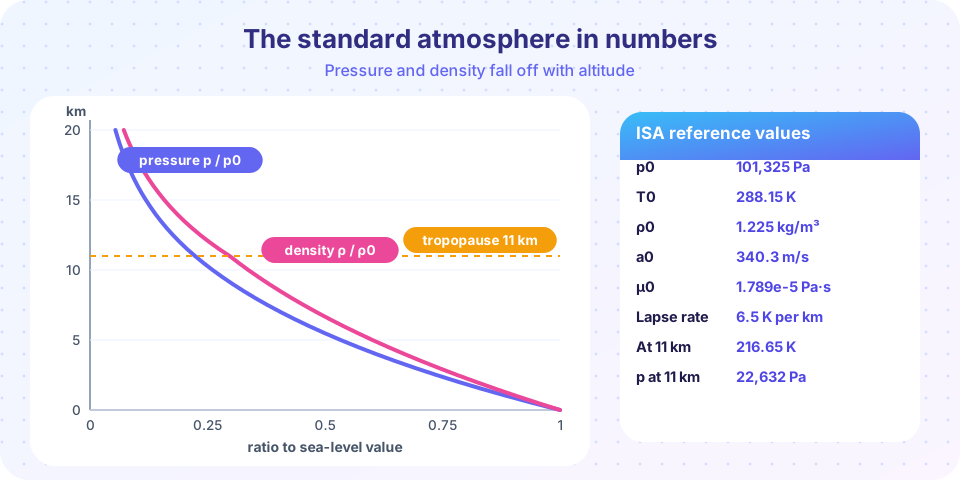
The reference values
At sea level (mean sea level, h = 0) the ISA fixes:
| Quantity | Value |
|---|---|
| Temperature T₀ | 288.15 K (15 °C) |
| Pressure p₀ | 101,325 Pa |
| Density ρ₀ | 1.225 kg/m³ |
| Speed of sound a₀ | 340.3 m/s |
| Dynamic viscosity μ₀ | 1.789 × 10⁻⁵ Pa·s |
| Gravity g₀ | 9.80665 m/s² |
| Gas constant R (dry air) | 287.053 J/(kg·K) |
Temperature then follows layers: it falls at 6.5 K per km from the ground to 11 km (the tropopause), stays at 216.65 K from 11 to 20 km, and then rises at 1 K per km up to 32 km. (This course uses up to 20 km.)
Deriving the pressure formula
Take a thin horizontal slab of air with thickness dh. The pressure below the slab must support the pressure above plus the slab's weight, so
dp = −ρ g dh
Use the gas law p = ρ R T to replace ρ with p/(R T):
dp / p = −(g / (R T)) dh
Now there are two cases.
Gradient layer (T = T₁ + L·(h − h₁), with L = −0.0065 K/m in the troposphere). Integrating gives
p / p₁ = (T / T₁)^( −g / (L R) )
and, for the troposphere, −g / (L R) = 9.80665 / (0.0065 × 287.053) = 5.2559. So
p = p₀ (T / T₀)^5.2559, with T = 288.15 − 0.0065 h
Isothermal layer (T constant). The integral is simpler and gives an exponential:
p = p₁ · exp( −g (h − h₁) / (R T) )
At the tropopause, h = 11,000 m: T = 216.65 K and p = 22,632 Pa. The density follows from ρ = p / (R T), and the speed of sound from a = √(γ R T) with γ = 1.4.
Worked example: 3,000 m. T = 288.15 − 0.0065 × 3000 = 268.65 K. Then T / T₀ = 0.9323, and raising it to the power 5.2559 gives 0.692. So p ≈ 70.1 kPa. The density is ρ = 70,100 / (287.053 × 268.65) ≈ 0.909 kg/m³, and the speed of sound is √(1.4 × 287.053 × 268.65) ≈ 328.6 m/s.
From pressure to altitude
Invert the troposphere formula and you get the pressure altitude:
h = (T₀ / 0.0065) · [ 1 − (p / p₀)^(1 / 5.2559) ]
This is how a pressure altimeter works. It is really a barometer with a scale labeled in meters or feet. When the pilot sets the local sea-level pressure (called QNH) on the altimeter's subscale, it indicates height above mean sea level; when the pilot sets the standard 1013.25 hPa, it indicates pressure altitude, which is the "flight level" used by airliners above a transition altitude.
Common misconceptions
"ISA describes the real air." It is a convention. On a hot day the real air at 5 km can be 10 K warmer than ISA, and the real density is lower. Aircraft performance charts correct for this with an ISA deviation.
"Pressure falls linearly with altitude." It falls roughly exponentially, with a "scale height" of about 7 to 8 km for the lower atmosphere. Linear approximations only work over a few hundred meters.
Try it
Press Run (or Ctrl + Enter) to see the result here.
Program input · what you'd type while the program runs
Type the answers before you press Run, one per line. Each time the program reads a line (with input()), it gets the next line from this box.
Press Run (or Ctrl + Enter) to see the result here.
Program input · what you'd type while the program runs
Type the answers before you press Run, one per line. Each time the program reads a line (with input()), it gets the next line from this box.
Check your understanding
Quick check · 5 questions
of 5 answered You scored / 5 · perfect!
-
1. What are the ISA sea-level temperature and pressure?
ISA is anchored at 15 °C (288.15 K) and 101,325 Pa, which gives a density of 1.225 kg/m³. -
2. Which equation is the starting point for the pressure-altitude relation?
The hydrostatic balance dp = −ρ g dh, combined with p = ρRT, gives the ISA pressure formulas. -
3. What is the ISA temperature at 11 km?
288.15 − 6.5 × 11 = 216.65 K, which is −56.5 °C. -
4. Between 11 and 20 km the ISA temperature is:
That region is an isothermal layer, so pressure falls exponentially with height. -
5. A pilot sets 1013.25 hPa on the altimeter subscale. It now shows:
With the standard setting, the altimeter reads altitude in the ISA that matches the measured pressure.
Summary
- ISA fixes sea-level values (288.15 K, 101,325 Pa, 1.225 kg/m³) and temperature layers.
- Hydrostatics plus the gas law give
p = p₀ (T/T₀)^5.2559in the troposphere and an exponential above 11 km. - Density comes from ρ = p/(RT); speed of sound from a = √(γRT).
- An altimeter is a barometer calibrated with the ISA formula.
Track your progress
Create a free account to tick off lessons and pick up where you left off on any device.
of Aerodynamics lessons completed