


















Lesson 15 of 49 · Airfoils and Lift
Chapter 3 review: Airfoils and lift
Review airfoil geometry, the pressure coefficient, Kutta-Joukowski, thin-airfoil theory, stall speed and high-lift devices, with a recap table, practice code and a 10-question quiz.
Chapter 3 answered the question "how does a wing lift?" at three levels: qualitatively (three views of lift), geometrically (the airfoil and its NACA code) and mathematically (Cp, circulation, cl = 2π(α − α0), stall). Check yourself with the table, the practice code and the quiz.
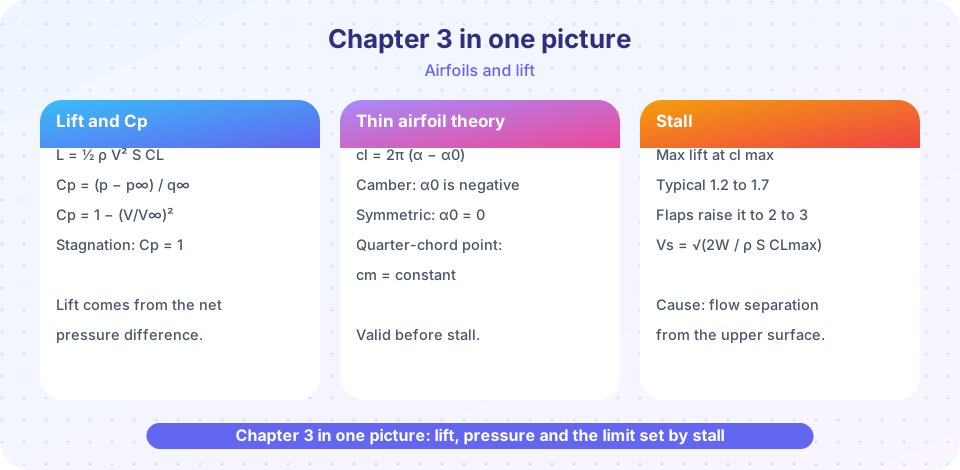
Recap table
| Idea | Key statement | Lesson |
|---|---|---|
| Three views of lift | Pressure difference, downward momentum, circulation | Chapter 3 overview |
| Geometry | Chord, camber, thickness; NACA MPTT | Airfoil geometry |
| Cp | Cp = 1 − (V/V∞)²; stagnation Cp = 1 |
Pressure and lift |
| Kutta–Joukowski | L' = ρ V Γ; Kutta condition fixes Γ |
Pressure and lift |
| Thin airfoil | cl = 2π(α − α0); aerodynamic center at c/4 |
Thin-airfoil theory |
| Stall | Separation at CLmax; Vs = √(2W/(ρ S CLmax)) |
Stall and high-lift devices |
| High lift | Flaps add camber, slats delay stall | Stall and high-lift devices |
Try it
Press Run (or Ctrl + Enter) to see the result here.
Program input · what you'd type while the program runs
Type the answers before you press Run, one per line. Each time the program reads a line (with input()), it gets the next line from this box.
Press Run (or Ctrl + Enter) to see the console output here.
No output.
Check your understanding
Quick check · 10 questions
of 10 answered You scored / 10 · perfect!
-
1. Which of these is NOT one of the three views of lift?
The equal-transit-time argument is a myth. The other three are valid descriptions of the same flow. -
2. A NACA 2412 has:
Digits: maximum camber, its position in tenths of chord, thickness. -
3. What is Cp where the air speed is 1.4 V∞?
Cp = 1 − 1.4² = −0.96. -
4. The Kutta–Joukowski theorem gives lift per unit span as:
L' = ρ V∞ Γ. -
5. What is cl for a symmetric airfoil at 3°?
cl = 2π × 3° × π/180 = 0.329. -
6. Which statement about camber is correct?
Camber produces lift at zero angle of attack, moving the zero-lift angle below zero. -
7. In thin-airfoil theory, the moment about the aerodynamic center changes with α:
The aerodynamic center is defined as the point where the moment is independent of α. -
8. An aircraft stalls at 30 m/s in level flight. In a 60° banked turn its stall speed is about:
n = 2 so Vs rises by √2 = 1.41: 30 × 1.41 = 42 m/s. -
9. Which device extends the usable angle of attack of the wing?
Slats energize the boundary layer at the nose so separation happens at a higher α. -
10. Trailing-edge stall develops mostly on:
On thicker sections separation creeps forward from the trailing edge, giving a gentler stall.
Summary
- Lift can be described by pressure, momentum or circulation; all three agree.
- NACA MPTT decodes camber and thickness; camber moves α0 negative.
Cp = 1 − (V/V∞)², Kutta–JoukowskiL' = ρVΓ, thin airfoilcl = 2π(α − α0).- Stall limits CLmax;
Vs = √(2W/(ρ S CLmax)), scaled by √n in turns; flaps and slats lower it.
Track your progress
Create a free account to tick off lessons and pick up where you left off on any device.
of Aerodynamics lessons completed