


















Lesson 37 of 49 · Computational Aerodynamics
Chapter 8 overview: computational aerodynamics
A map of computational aerodynamics: panel methods, grids and finite differences, turbulence modelling, and how to trust a simulation, with a cost estimator.
Wind tunnels and flight tests still decide the final answer in aerodynamics, but nearly every design begins on a computer. Computational aerodynamics replaces experiments, at least partly, with numerical solutions of the equations of fluid motion. A modern airliner wing is shaped by thousands of simulations before a model ever enters a tunnel. This chapter shows how those simulations work, where they are strong, and where they quietly mislead.
What you will learn
- The range of methods, from cheap potential-flow panel codes to full Navier-Stokes solvers.
- The workflow of a simulation and where errors enter.
- How grids, finite differences and turbulence models work in outline.
- Why verification and validation are as important as the solver.
The chapter in slides
A ladder of fidelity
The workflow
Three kinds of error
Earn the trust
What each lesson covers
- Panel methods: potential flow, singularities, the Kutta condition and a working source-panel code.
- Grids and finite differences: how derivatives become arithmetic, what accuracy and stability mean, and why schemes smear or wiggle.
- Turbulence modelling and validation: Reynolds averaging, RANS, LES, DNS, wall spacing, grid convergence and credibility.
- Chapter 8 review.
Key terms
CFD (computational fluid dynamics): numerical solution of the equations of fluid flow.
Mesh (grid): the set of cells or points that discretizes the flow domain.
Convergence: the iterative solution approaching a steady answer; not the same as grid convergence.
Verification and validation: checking that the equations are solved correctly, and that they represent reality.
The governing equations in one glance
Everything in this chapter approximates the same laws: conservation of mass, momentum and energy. For a viscous compressible gas they are the Navier-Stokes equations. Drop viscosity and heat conduction and you get the Euler equations, which still capture shocks. If, in addition, the flow is irrotational and incompressible, a single linear equation remains, Laplace's equation ∇²φ = 0 for a velocity potential φ, which is cheap enough for a calculator and is the basis of panel methods.
Try it
How expensive would it be to simulate everything, even the smallest eddies, in a boundary layer? Direct numerical simulation needs a number of cells that grows roughly with Re^(9/4) for a whole flow. The table below is an order-of-magnitude illustration only, not a prediction for a specific code.
Press Run (or Ctrl + Enter) to see the result here.
Program input · what you'd type while the program runs
Type the answers before you press Run, one per line. Each time the program reads a line (with input()), it gets the next line from this box.
Check your understanding
Quick check · 4 questions
of 4 answered You scored / 4 · perfect!
-
1. Which equations include viscosity and heat conduction?
Navier-Stokes is the full model; Euler drops viscosity and conduction. -
2. What does verification check?
Verification concerns solving the equations right; validation concerns solving the right equations. -
3. Why is DNS not used for full aircraft?
Resolving all scales is far too expensive at flight Reynolds numbers. -
4. Which is the cheapest of these methods?
Panel methods solve a small linear system for the body surface only.
Summary
- Computational aerodynamics ranges from panel methods to DNS, trading cost for fidelity.
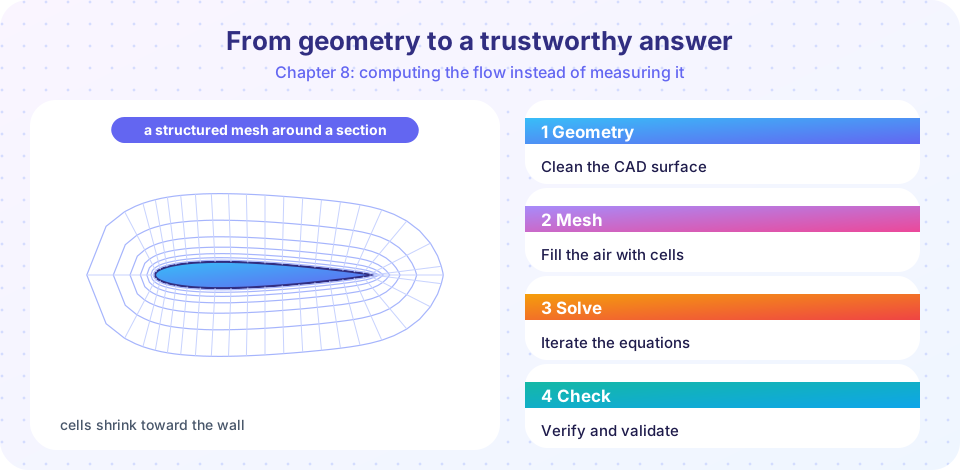
- The workflow is geometry, mesh, solve, check; errors enter at every step.
- Verification and validation decide whether results can be trusted.
Next: Panel methods
Track your progress
Create a free account to tick off lessons and pick up where you left off on any device.
of Aerodynamics lessons completed