


















Lesson 21 of 49 · Drag and Performance
Chapter 4 review: Drag and performance
Review the boundary layer, form and friction drag, drag buildup, the parabolic drag polar, maximum L/D, glide and the Breguet range equation, with practice code and a 10-question quiz.
You have now covered the first half of a classical aerodynamics course: the air, the wing, lift and drag. The tools in this chapter turn directly into performance numbers: the best glide ratio, the range and the speed to fly. Use this review to make sure the chain of ideas holds together.
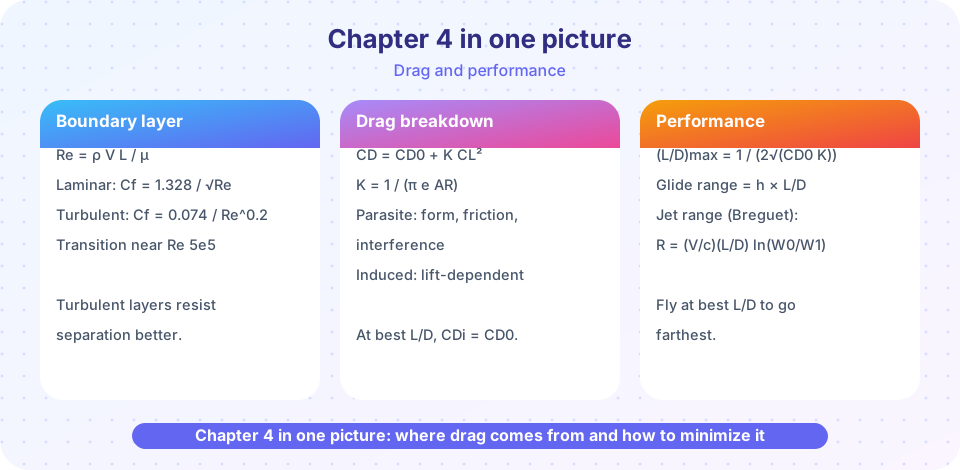
Recap table
| Idea | Key statement | Lesson |
|---|---|---|
| Drag family | Form, friction, interference (parasite) plus induced and wave | Chapter 4 overview |
| Boundary layer | Re = ρVL/μ; laminar Cf = 1.328/√Re, turbulent 0.074/Re^0.2 |
The boundary layer and Reynolds number |
| Form drag | Wake size sets it; streamlining reduces it | Types of drag |
| Buildup | CD0 = Σ Cf·FF·Swet / S plus extras |
Types of drag |
| Polar | CD = CD0 + K CL², K = 1/(π e AR) |
The drag polar |
| Best L/D | 1/(2√(CD0 K)) at CL = √(CD0/K) |
The drag polar |
| Glide | R = h (L/D); min sink slower than best glide |
Glide, range and endurance |
| Breguet | R = (V/(c_t g))(L/D) ln(W0/W1) |
Glide, range and endurance |
Try it
Press Run (or Ctrl + Enter) to see the result here.
Program input · what you'd type while the program runs
Type the answers before you press Run, one per line. Each time the program reads a line (with input()), it gets the next line from this box.
Press Run (or Ctrl + Enter) to see the console output here.
No output.
Check your understanding
Quick check · 10 questions
of 10 answered You scored / 10 · perfect!
-
1. Which drag does NOT depend on the lift being produced?
Parasite drag (form, friction, interference) exists even at zero lift. -
2. A plate has Re = 2 × 10⁵ at its trailing edge. Its flow is most likely:
Transition on a smooth plate in a quiet stream is near Re = 5 × 10⁵, which this plate never reaches. -
3. Why does a streamlined body have little form drag?
An attached flow recovers pressure at the rear, nearly cancelling the pressure at the front. -
4. CD0 = 0.03 and K = 0.06. What is (L/D)max?
1/(2√(0.03 × 0.06)) = 1/(2 × 0.0424) = 11.8. -
5. At the best L/D the induced drag is:
At CL = √(CD0/K) we have K CL² = CD0. -
6. A glider with L/D = 30 flies from 2,000 m in still air. Its maximum glide distance is:
R = 2,000 × 30 = 60,000 m. -
7. Which speed gives the least sink rate?
Minimum sink is at CL = √(3CD0/K), about 76% of the best-glide speed. -
8. Doubling the fuel fraction of an aircraft doubles its range.
The Breguet equation has ln(W0/W1), which gives diminishing returns. -
9. What does a turbulent boundary layer do compared with a laminar one?
Mixing brings fast air to the wall, raising shear but helping the layer resist an adverse gradient. -
10. Which change reduces induced drag most directly?
K = 1/(π e AR), so more aspect ratio gives a smaller induced-drag factor.
Summary
- Total drag = parasite (form, friction, interference) + induced (+ wave at high speed).
- Boundary-layer state sets friction; wake size sets form drag.
- The polar
CD = CD0 + K CL²gives(L/D)max = 1/(2√(CD0 K)). - Glide range is
h·L/D; Breguet gives jet and propeller range from L/D, fuel consumption and fuel fraction. - Chapter 5 asks what happens when the wing is finite: span, taper and the origin of K.
Track your progress
Create a free account to tick off lessons and pick up where you left off on any device.
of Aerodynamics lessons completed