


















Lesson 42 of 49 · Projects and Practice
Chapter 9 overview: projects and practice
Plan the final chapter: three hands-on aerodynamics projects, a practice problem bank, a glossary, a cheat sheet and ideas for further study.
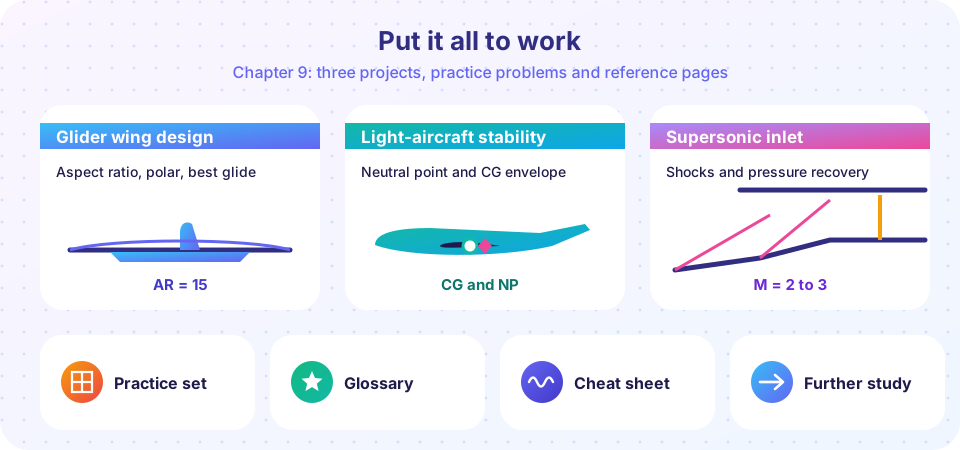
You now have the main tools of aerodynamics: lift and drag, finite wings, compressible flow, stability and control, and numerical methods. Tools only become skills when you use them on a whole problem with competing requirements. This last chapter gives you three complete mini-projects, each ending in a design decision you can defend with numbers, then a problem bank, a glossary, a one-page cheat sheet and a map of where to go next.
What you will learn
- How to turn requirements into a sequence of calculations.
- How the chapters combine: wings, performance, stability and compressible flow in one design.
- How to check your own work with sanity bounds and limiting cases.
The chapter in slides
Project 1: a glider wing
Project 2: stability study
Project 3: supersonic inlet
Then consolidate
What each lesson covers
- Glider wing design: requirements, aspect ratio, the drag polar, best glide, minimum sink and the effect of changing the design.
- Light-aircraft stability study: neutral point, loading and the CG envelope, and the effect of tail size.
- Supersonic inlet and nozzle: oblique-shock inlets, pressure recovery, and a converging-diverging nozzle.
- Practice problems: twelve problems with a checker you can run.
- Glossary, cheat sheet and further study.
How to work a project
A good engineering project follows the same rhythm every time:
- Requirements: write down what the design must do, with numbers.
- Model: choose the simplest model that captures the physics, and say what it ignores.
- Calculate: do the numbers with code, and keep units visible.
- Check: test limits and orders of magnitude. Does a longer wing lower induced drag? Is the answer a sensible size?
- Decide and explain: state the choice, the margin and what would change your mind.
Key terms
Requirement: a measurable thing the design must achieve.
Trade study: varying a design parameter to see how performance changes.
Margin: the cushion between a design value and its limit.
Sanity check: a quick estimate or limit that an answer must satisfy.
Try it
Projects mix units: knots, kilometers per hour, meters per second. A small converter that also reports Mach number saves mistakes. Run it, then adapt it for your project.
Press Run (or Ctrl + Enter) to see the result here.
Program input · what you'd type while the program runs
Type the answers before you press Run, one per line. Each time the program reads a line (with input()), it gets the next line from this box.
Check your understanding
Quick check · 3 questions
of 3 answered You scored / 3 · perfect!
-
1. What is the first step of a design project?
Requirements define success; everything else follows from them. -
2. A sanity check is
For instance, a longer wing must reduce induced drag; if your calculation says otherwise, something is wrong. -
3. What is a trade study?
It exposes sensitivities and helps choose between designs.
Summary
- The three projects combine wings, performance, stability and compressible flow.
- Work in the rhythm requirements, model, calculate, check, decide.
- Use sanity checks and trade studies to build confidence in your numbers.
Next: Glider wing design
Track your progress
Create a free account to tick off lessons and pick up where you left off on any device.
of Aerodynamics lessons completed