


















Lesson 34 of 49 · Stability and Control
Trim, control surfaces and CG limits
Learn how the elevator trims an airplane, how to compute trim deflection and the allowed center-of-gravity range, and how ailerons, rudder and lateral stability work.
Stability tells you what an airplane does when left alone. Control is how the pilot (or autopilot) changes it. The two main jobs of the elevator are to trim the airplane, so it balances at the desired angle of attack with no pilot force, and to maneuver it, pitching up and down on command. Along with the ailerons and rudder, it forms the set of three primary controls. This lesson shows how much control is needed and why that limits where the center of gravity may sit.
What you will learn
- How elevator deflection shifts the pitching-moment curve and selects the trim angle.
- How to compute trim deflection and the forward and aft CG limits.
- What ailerons, rudders and trim tabs do.
- The basics of lateral and directional static stability.
Key terms
Elevator effectiveness (Cm,δe): change in pitching moment per radian of elevator deflection.
Trim tab: a small surface on a control surface that sets the no-force position.
Weathercock stability: the tendency of the nose to turn into the relative wind, Cn,β > 0.
Dihedral effect: a rolling moment that opposes sideslip, Cl,β < 0.
Elevator and trim
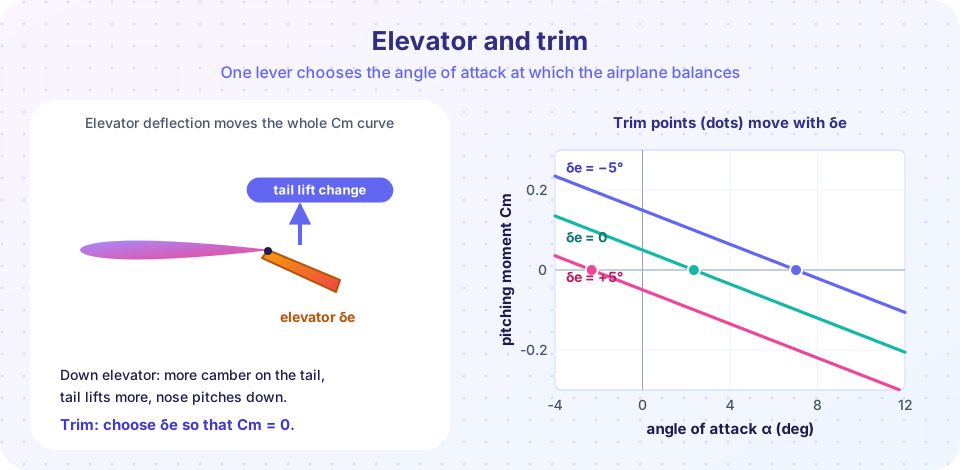
Deflecting the elevator trailing edge down increases the camber of the whole tail surface, so it makes more lift. That extra upward force acts behind the CG, so it pitches the nose down. The effect on the pitching moment is a constant shift of the curve, without changing its slope:
Cm = Cm0 + Cm,α · α + Cm,δe · δe
Cm,δe = − η · V_H · a_t · τ         with  V_H = l_t S_t / (c̄ S)
Here τ is the flap effectiveness parameter (typically about 0.4 to 0.6 for an elevator that is 30% to 40% of the tail chord) and V_H is the horizontal tail volume ratio (typically 0.5 to 1.0 for light aircraft). For the airplane of the last lesson, V_H = 5.0 × 3.2 / (1.5 × 16) = 0.667 (that is S_t/S = 0.2), and with η = 0.95, a_t = 3.6, τ = 0.5: Cm,δe = −0.667 · 0.95 · 3.6 · 0.5 ≈ −1.14 per radian. By convention, positive δe is trailing edge down, so Cm,δe is negative.
Trim means Cm = 0. For steady level flight we also need a specific lift coefficient: CL = W / (q S). Link angle of attack and lift by CL = CL0 + a α, and solve for the elevator angle:
δe,trim = − [ Cm0 + Cm,α · (CL − CL0) / a ] / Cm,δe
With Cm0 = 0.05, CL0 = 0.2, a = 5.245, Cm,α = −1.22 and Cm,δe = −1.14: at CL = 0.5, δe,trim ≈ −1.0° (slightly up); at CL = 1.4, near stall, δe,trim ≈ −11.5°. The trend is the key: slower flight needs more up elevator, in proportion to the stability. The slope dδe/dCL = −Cm,α / (a · Cm,δe) of the trim curve is itself a measure of stability: if it were zero or reversed, the airplane would be at or beyond its (stick-fixed) neutral point. Pilots feel this as "stick back to slow down".
Control forces and trim tabs
A pilot holds the elevator against the aerodynamic hinge moment. In steady flight at a different speed the force would have to be held continuously. A trim tab is a small hinged surface at the trailing edge of the elevator that is deflected so the elevator floats at the right angle; the hinge moment is zero and the pilot lets go. On many transports the whole horizontal stabilizer is rotated electrically instead (a "trimmable stabilizer"). A stabilator (all-moving tail) combines both functions.
CG limits
The center of gravity cannot be anywhere on the airplane. There are two bounds:
- Forward limit. The elevator must be able to trim and flare the airplane at its lowest speed (highest
CL), with flaps down, which usually requires the largest nose-up tail moment. The more stable the airplane (CG far forward), the more elevator travel it needs, until it hits its limit. Also nose-wheel loads and tail download (and drag) rise. - Aft limit. Stability. Regulations and good practice want the CG ahead of the neutral point by at least a few percent of the chord, and, including the effect of stick-free control surfaces and power, a bit more margin. Too far aft and stability and control forces vanish.
The allowed range is the CG envelope that appears in every aircraft's loading chart. The program below computes it for our example airplane (the zero-lift moment is held fixed for simplicity).
Roll, yaw and lateral stability
Ailerons produce rolling moments by raising lift on one wing and lowering it on the other. The wing with the down-going aileron makes more lift and so more induced drag, which yaws the nose away from the direction of the roll: adverse yaw. Differential deflection (the up aileron moves more), Frise hinge geometry and rudder coordination reduce it. At high speed or high Mach, spoilers and roll control by wing flexing can replace ailerons.
The rudder yaws the airplane and fights asymmetric thrust. Beyond control there are two static stabilities:
- Directional (weathercock): if the nose yaws to one side, the side force on the vertical tail should push the nose back:
Cn,β > 0, set by the fin's area and arm (a "fin volume ratio") and the effect of the fuselage, which is destabilizing. - Lateral (dihedral effect): a sideslip should produce a roll away from the lower wing:
Cl,β < 0. Wing dihedral, high wing position and sweep all help. Too much dihedral effect relative to directional stability produces the oscillation called Dutch roll in the next lesson, and too little leads to the spiral mode.
Common misconceptions
"The elevator makes the airplane go up and down." It controls pitch (angle of attack); the airplane climbs or descends as a result of changing lift and thrust.
"The rudder turns the airplane." The turn comes from banking: lift tilts and pulls the airplane around. The rudder keeps the nose aligned with the flight path.
"Trim is only for the pilot's comfort." Trim is where the airplane's stability and control meet; without it the pilot must hold forces continuously.
Try it
First, compute the trim elevator deflection across the speed range, and find the forward and aft CG limits.
Press Run (or Ctrl + Enter) to see the result here.
Program input · what you'd type while the program runs
Type the answers before you press Run, one per line. Each time the program reads a line (with input()), it gets the next line from this box.
Second, a calculator for the aileron's rolling effect from a differential lift distribution (a simple strip model). It is a demonstration of how the rolling moment grows with aileron span.
Press Run (or Ctrl + Enter) to see the result here.
Program input · what you'd type while the program runs
Type the answers before you press Run, one per line. Each time the program reads a line (with input()), it gets the next line from this box.
Check your understanding
Quick check · 5 questions
of 5 answered You scored / 5 · perfect!
-
1. Deflecting the elevator trailing edge down causes
More tail lift behind the CG pitches the nose down. -
2. What happens to the trim elevator deflection as the airplane flies slower in a stable airplane?
Slower flight means higher CL; to hold the higher angle of attack the elevator must supply a larger nose-up moment. -
3. What sets the aft CG limit?
Beyond the aft limit the static margin is too small or negative. -
4. Adverse yaw is the yawing of the nose
The down-going aileron adds drag on the rising wing, yawing the nose the wrong way. -
5. Directional (weathercock) stability requires
A positive yawing moment per unit sideslip turns the nose back into the wind.
Summary
- The elevator shifts the
Cmcurve; trim picks the elevator angle at whichCm = 0for the requiredCL. - Slower flight needs more up elevator; the slope of that trend reflects the static margin.
- CG limits: forward by elevator authority, aft by stability.
- Ailerons roll (with adverse yaw), rudder yaws;
Cn,β > 0andCl,β < 0give lateral-directional static stability.
Next: Dynamic stability: phugoid, short period and the lateral modes
Track your progress
Create a free account to tick off lessons and pick up where you left off on any device.
of Aerodynamics lessons completed