


















Lesson 1 of 49 · Getting Started
Course map
Start here: a map of the whole aerodynamics course, who it is for, what you need to know first, and how to study it from the atmosphere to CFD.
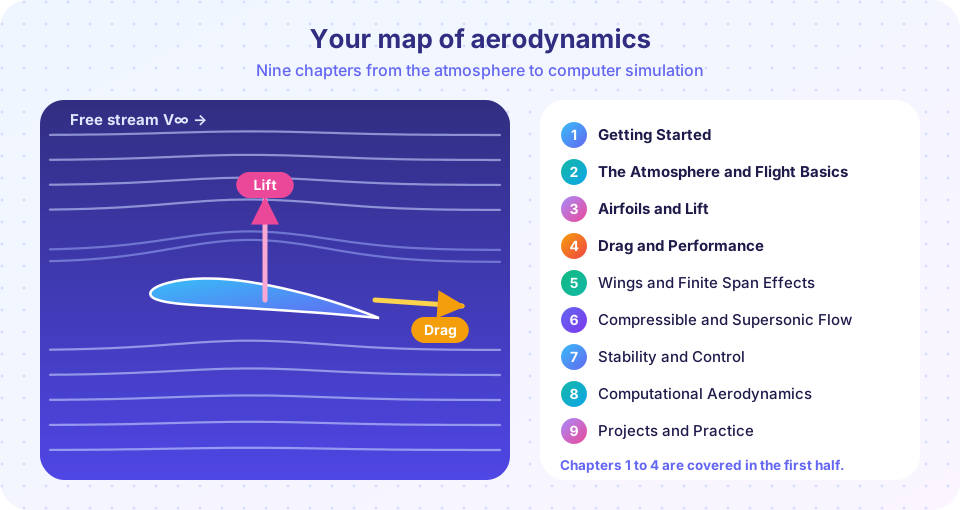
Every airplane, wind turbine blade, race car wing and golf ball moves through air, and air pushes back. Aerodynamics is the science of that push: how air flows around a body, and the forces and moments the flow creates. This course takes you from the basic physics of the atmosphere to the equations engineers use to design wings, and finishes with computer simulation and practice projects.
What you will learn
- What aerodynamics studies and why the same ideas apply to aircraft, cars and buildings.
- How the course is organized into nine chapters, and which ones this first half covers.
- What background you need and how to study efficiently.
- How to use the live calculators and plots that come with every lesson.
Key terms
Aerodynamics: the study of air in motion and its forces on bodies moving through it.
Airfoil: the cross-section of a wing, a blade or a fin, shaped to make useful force from the flow.
Lift: the aerodynamic force perpendicular to the oncoming air.
Drag: the aerodynamic force parallel to the oncoming air, opposing the motion.
Mach number: the speed of the flow divided by the speed of sound.
Who this course is for
The course is written for curious learners from about age 14 upward: students starting an engineering or physics degree, pilots and aircraft enthusiasts who want to understand why things work, and model-builders. It follows the common core of university-level introductions to aerodynamics, in SI units (meters, kilograms, seconds, pascals) with feet and knots mentioned where pilots use them.
You do not need to have studied fluid mechanics. You do need:
- Algebra: rearranging equations, powers and square roots.
- A little trigonometry: sine, cosine and tangent of an angle.
- Basic physics: force, mass, acceleration, pressure, energy.
- Calculus helps from chapter 3 onward, but every result is also explained in words and checked with numbers, so you can follow without it.
The nine chapters
Everything in this course builds on one idea: the air exerts pressure and friction on a surface, and the sum of those over the whole body is the force. The chapters add one layer at a time.
Chapters 1 and 2: the basics
- Getting Started
- The Atmosphere
Chapters 3 and 4: wings and drag
- Airfoils and Lift
- Drag and Performance
Chapters 5 and 6: real wings, high speed
- Finite Wings
- Compressible Flow
Chapters 7 and 8: control and computers
- Stability and Control
- Computational
Chapter 9: put it to work
- Projects
Chapters 1 to 4 are in this half of the course.
How to study
- Read with a pencil. Every worked example has numbers; redo them before you run the code.
- Run every Try it block. The Python blocks are real simulations, and the interactive widgets respond to sliders. Change one thing at a time and predict the result before you look.
- Keep a formula sheet. Each chapter ends with a one-picture review you can copy.
- Use the quizzes honestly. Answer from memory first, then read the explanation, even when you were right.
Below is a first widget. Slide the altitude and the speed to see the Mach number and the flow regime. Notice that the speed of sound itself changes with height, so the same speed means a different Mach number at different altitudes.
Try it
Press Run (or Ctrl + Enter) to see the result here.
Program input · what you'd type while the program runs
Type the answers before you press Run, one per line. Each time the program reads a line (with input()), it gets the next line from this box.
Check your understanding
Quick check · 4 questions
of 4 answered You scored / 4 · perfect!
-
1. Which pair of surface loads does air exert on a body?
Air presses perpendicular to the surface (pressure) and drags along it (shear stress). Lift and drag are the sums of those loads. -
2. At which Mach number does this course call the flow subsonic?
Fully subsonic flow is below about Mach 0.8; transonic flow, with local shock waves, sits around Mach 0.8 to 1.2. -
3. Why does the same speed give a different Mach number at 10 km than at sea level?
Mach is V divided by a, and a = sqrt(gamma R T) falls as the air gets colder with height (up to 11 km). -
4. What is an airfoil?
An airfoil is the shape you see when you slice a wing front to back.
Summary
- Aerodynamics is the study of air flow and the forces it creates through pressure and shear.
- The course has nine chapters; chapters 1 to 4 cover basics, the atmosphere, airfoils and lift, and drag.
- You need algebra, a little trigonometry and basic physics; calculus is a bonus.
- Run every Try it block and predict results before you look.
Next: What is aerodynamics?
Track your progress
Create a free account to tick off lessons and pick up where you left off on any device.
of Aerodynamics lessons completed