


















Lesson 30 of 49 · Compressible and Supersonic Flow
Transonic and supersonic wings
Understand the Prandtl-Glauert rule, critical Mach number, drag divergence, supercritical airfoils, the area rule and Ackeret theory for supersonic wings.
The most awkward range of flight speeds is near Mach 1. Even when an aircraft flies at Mach 0.85, the air accelerates over the curved upper surface of its wing, and somewhere the local flow can exceed the speed of sound. A small supersonic bubble forms, terminated by a shock. The wing is flying transonically: part of the flow is subsonic and part supersonic, no simple formula applies, and drag climbs steeply. This lesson follows a wing from low speed up through the sound speed.
What you will learn
- How the Prandtl-Glauert rule corrects subsonic results for compressibility.
- What critical Mach number and drag-divergence Mach number mean, and how to estimate them.
- How sweep, supercritical sections and the area rule delay or reduce wave drag.
- How Ackeret theory gives lift and wave drag of thin supersonic wings.
Key terms
Critical Mach number (Mcr): the freestream Mach number at which the flow first reaches M = 1 somewhere on the body.
Drag-divergence Mach number (Mdd): the Mach number at which wave drag begins to rise steeply, a little above Mcr.
Supercritical airfoil: a section shaped for a flat upper surface, so the supersonic region is weak.
Area rule: a design principle that keeps the total cross-sectional area smooth along the aircraft.
Subsonic compressibility: Prandtl-Glauert
For a thin wing at small angles in subsonic flow, linearized theory gives a simple rule. The pressure coefficient at Mach number M is the incompressible one divided by √(1 − M²):
Cp = Cp0 / √(1 − M²) cl = cl0 / √(1 − M²) lift slope a = a0 / √(1 − M²)
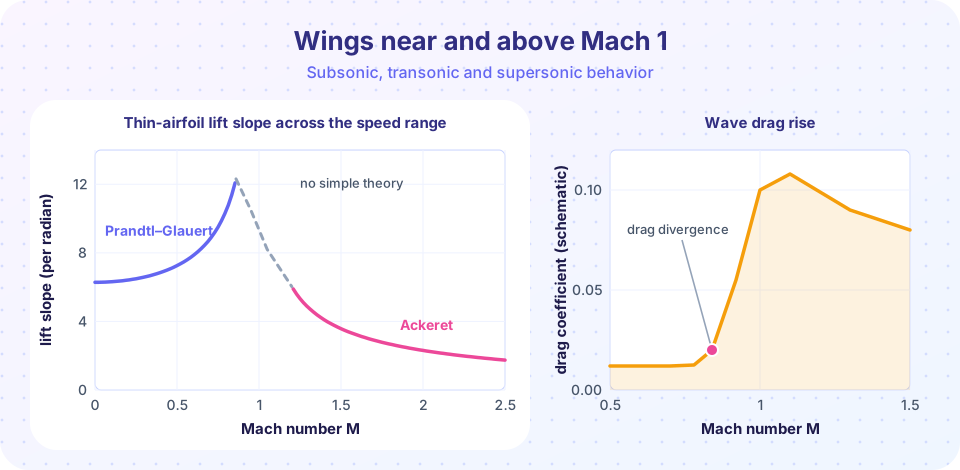
At M = 0.6 the factor is 1/0.8 = 1.25: pressure peaks are 25% larger, lift slope grows by 25%. At M = 0.8 it is 1.667. The factor grows without limit as M → 1; the theory breaks down before that because it ignores shocks. The rule explains why compressibility makes suction peaks stronger and so more likely to go supersonic.
Critical Mach number
Take a wing whose most negative incompressible pressure coefficient is Cp0,min. The corrected minimum rises in magnitude with M: Cp,min = Cp0,min / √(1 − M²). Meanwhile the pressure coefficient at which flow just reaches M_local = 1 (the critical pressure coefficient) is, for air:
Cp* = 2/(γ M²) · { [ (1 + 0.2 M²) / 1.2 ]^3.5 − 1 }
Cp* becomes less negative as M rises (for M = 0.7, Cp* ≈ −0.78; for M = 0.9, −0.19). Where the two curves cross, the wing's fastest point just becomes sonic: that is Mcr. A thicker or more cambered wing has a stronger suction peak (more negative Cp0,min), so a lower Mcr; a thin wing has a higher one. The first example below finds Mcr numerically.
Beyond Mcr a pocket of supersonic flow grows over the wing, ending in a shock. At about Mdd ≈ Mcr + 0.05 to +0.1 the shock becomes strong enough to thicken or separate the boundary layer, and the drag coefficient rises steeply (the drag-divergence). Airliners cruise just below Mdd.
Delaying wave drag
- Sweep. As you saw in Chapter 5, a wing swept by
Λbehaves like an unswept one atM cos Λ. Sweep of 30° raises the effectiveMcrby roughly the ratio1/cos Λ. - Thin sections. Lower thickness ratio means weaker suction peaks.
- Supercritical airfoils. Developed by Richard Whitcomb at NASA, these have a blunt nose, a flat upper surface, and aft camber. The flat top yields a long, weak supersonic region and a weaker shock, which typically delays drag divergence by roughly 0.05 to 0.1 in Mach number compared with older sections. Thicker wings then become possible, saving structural weight.
- The area rule. Wave drag of the whole aircraft behaves like that of a smooth body of revolution whose cross-section equals the aircraft's total cross-section at each station. Where the wings add area, the fuselage should be narrowed. This "Coke-bottle" waist, pioneered by Whitcomb in the 1950s, helped fighter aircraft such as the Convair F-102 reach supersonic speed.
Linear supersonic theory: Ackeret
For a thin airfoil in supersonic flow at small angle, Ackeret's theory (1925) gives the pressure coefficient on a surface inclined by small angle θ to the freestream:
Cp = ± 2θ / √(M² − 1)
(positive where the surface turns the flow into itself, negative where it turns away). Integrating over a flat plate at angle of attack α:
cl = 4α / √(M² − 1) cd,wave = 4α² / √(M² − 1)
Two lessons from this. First, lift slope falls with Mach number in supersonic flow, as the figure shows: at M = 2 it is 4/√3 = 2.31 per radian, much lower than 2π at low speed. Second, wave drag arises even for a flat plate at zero thickness, simply from lift: the drag coefficient is cl · α. Thickness adds more. For a symmetric double-wedge section with thickness ratio t/c at zero angle of attack, cd = 4 (t/c)² / √(M² − 1). At M = 2 and t/c = 0.05 that is 4 · 0.0025 / 1.732 = 0.0058, a large increase over subsonic drag. That is why supersonic wings are very thin with sharp leading edges and why Concorde used a slender ogival delta wing, which cruised at Mach 2.04 at around 18 km.
The sonic boom is the Mach cone's pressure signature heard on the ground: an N-shaped wave, a sudden rise, a gradual decline and a sudden recovery, with overpressures of order tens of pascals. Research on aircraft shaping aims to spread the compression over a longer time so the "boom" becomes a softer thump.
Common misconceptions
"The Prandtl-Glauert rule is valid up to Mach 1." It fails well before that, since shocks appear above Mcr; use it up to about M = 0.7 to 0.8.
"Wave drag only exists for supersonic aircraft." It appears on subsonic airliners above Mdd, because of local shocks.
"Supersonic flight is more efficient than subsonic." Wave drag and low lift slope make supersonic lift-to-drag ratios much lower; Concorde's cruise L/D was about 7 compared with about 17 for modern airliners.
Try it
First, a critical Mach number calculator. It finds where a wing's pressure peak first becomes sonic and plots the intersection.
Press Run (or Ctrl + Enter) to see the result here.
Program input · what you'd type while the program runs
Type the answers before you press Run, one per line. Each time the program reads a line (with input()), it gets the next line from this box.
Second, wave drag and lift slope of thin supersonic wings from Ackeret's theory. Try changing the thickness ratio.
Press Run (or Ctrl + Enter) to see the result here.
Program input · what you'd type while the program runs
Type the answers before you press Run, one per line. Each time the program reads a line (with input()), it gets the next line from this box.
Check your understanding
Quick check · 5 questions
of 5 answered You scored / 5 · perfect!
-
1. What is the Prandtl-Glauert factor for the lift slope at M = 0.6?
1/√(1 − 0.36) = 1/0.8 = 1.25. -
2. What defines the critical Mach number?
At Mcr the fastest point on the wing first becomes sonic. -
3. Why do airliners have swept wings?
Sweep reduces the Mach number across the wing, delaying shocks and wave drag. -
4. What does the area rule recommend?
A smooth distribution of total cross-sectional area minimizes wave drag. -
5. Ackeret's lift coefficient for a flat plate at α = 0.05 rad and M = 2 is closest to
cl = 4 · 0.05 / √3 = 0.1155.
Summary
- Prandtl-Glauert: subsonic
Cpandclscale by1/√(1 − M²), valid to aboutM = 0.7. Mcris where the suction peak first reaches sonic speed; drag divergence follows shortly after.- Sweep, thin and supercritical sections, and the area rule reduce wave drag.
- Ackeret:
cl = 4α/√(M²−1),cd,wave = 4α²/√(M²−1)(plus thickness). Supersonic wings are thin and sharp.
Next: Chapter 6 review
Track your progress
Create a free account to tick off lessons and pick up where you left off on any device.
of Aerodynamics lessons completed