


















Lesson 13 of 49 · Airfoils and Lift
Thin-airfoil theory
Learn thin-airfoil theory: why lift slope is 2π per radian, how camber sets the zero-lift angle, the quarter-chord aerodynamic center, and how to compute them numerically.
Wouldn't it be wonderful to predict the lift of a wing section with a short formula? Thin-airfoil theory does exactly that. Developed in the early 1900s (by Max Munk and Hermann Glauert among others), it replaces the airfoil with a thin sheet of circulation along its camber line and demands the Kutta condition at the trailing edge. The result is simple, elegant, and matches experiments closely over the straight-line part of the lift curve.
What you will learn
- The assumptions behind thin-airfoil theory.
- The lift formula
cl = 2π (α − α0)and its meaning. - How camber sets the zero-lift angle α0 and the pitching moment.
- Where the aerodynamic center is, and how to compute α0 numerically.
Key terms
Lift-curve slope (a0): the rate of change of cl with α; theory gives 2π per radian (0.1097 per degree).
Zero-lift angle (α0): the angle of attack at which cl = 0; negative for positive camber.
Aerodynamic center: the point on the chord about which the pitching moment does not change with α; at c/4 in thin-airfoil theory.
Pitching-moment coefficient (cm): moment per unit span divided by q∞ c²; nose-up is positive.
Assumptions
Thin-airfoil theory assumes:
- The flow is incompressible and inviscid (no friction).
- The airfoil is thin and the angle of attack and camber are small, so the shape can be replaced by its camber line.
- The flow leaves the trailing edge smoothly (the Kutta condition).
Under these assumptions the equations are linear, so the effects of angle of attack and camber simply add.
The result
Symmetric airfoil (zero camber). The theory gives
cl = 2π α (α in radians)
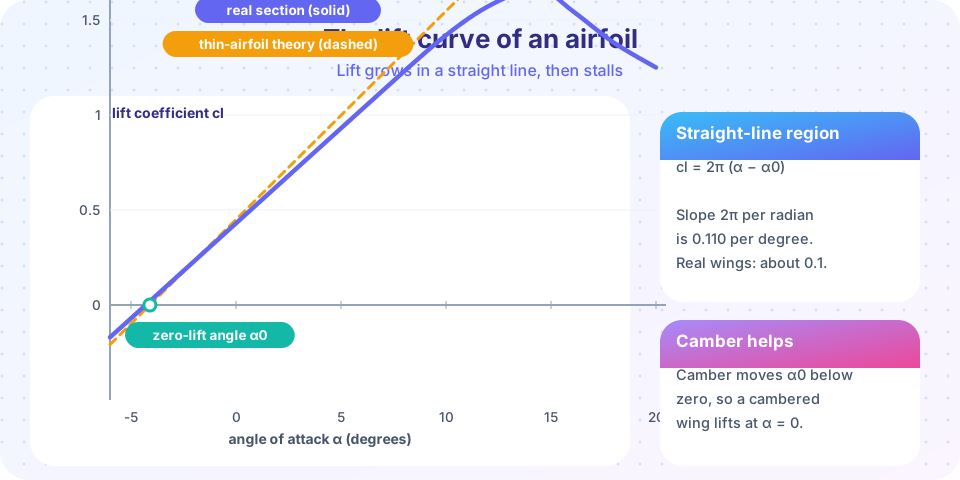
so the lift-curve slope is a0 = 2π ≈ 6.28 per radian ≈ 0.1097 per degree. A symmetric section at 5° should therefore have cl = 2π × 0.0873 = 0.548. Wind tunnel measurements for a NACA 0012 give a slope of about 0.10 to 0.11 per degree, so the theory is within a few percent.
Cambered airfoil. Camber simply shifts the line sideways along the α axis:
cl = 2π (α − α0)
The zero-lift angle α0 depends only on the camber line z(x). Putting x = (c/2)(1 − cos θ), with θ from 0 (leading edge) to π (trailing edge),
α0 = −(1/π) ∫₀^π (dz/dx) (cos θ − 1) dθ
Because camber slope is positive near the front and negative near the rear, and the weighting factor (cos θ − 1) is largest at the rear, positive camber gives a negative α0. A NACA 2412 has α0 close to −2°, a NACA 4412 close to −4°.
Pitching moment. Defining Fourier coefficients of the camber slope A1 = (2/π) ∫ (dz/dx) cos θ dθ and A2 = (2/π) ∫ (dz/dx) cos 2θ dθ, the moment about the quarter-chord point is
cm,c/4 = (π/4) (A2 − A1)
It is independent of α, which says the quarter-chord point is the aerodynamic center: lift effectively acts there, and changing α changes the lift but not the moment about that point. Cambered airfoils have negative (nose-down) cm,c/4, typically around −0.05 to −0.1, which is the reason tails must be able to push down.
Worked example
A NACA 4412 at α = 6°. Thin-airfoil theory with α0 ≈ −4.1° gives cl = 2π (6 + 4.1) × π/180 = 1.11. A wing of area 16 m² flying at 55 m/s at sea level then has L = ½ × 1.225 × 55² × 16 × 1.11 ≈ 32,900 N if it were two-dimensional (an infinite span). Real finite wings lift less per unit area at the same α (Chapter 5).
Limits of the theory
- Viscosity reduces the slope slightly (often 0.10 rather than 0.11 per degree) and sets maximum lift.
- Stall ends the straight-line region at around 12° to 16° for typical sections.
- Compressibility raises the slope as Mach number grows:
cl = cl0 / √(1 − M²)(the Prandtl–Glauert rule, Chapter 6). - Thickness has a modest effect on the slope but affects maximum lift and drag.
Common misconceptions
"The 2π slope means cl rises forever." The line holds only before stall. At large α the flow separates and the lift curve bends over.
"Lift acts at the quarter-chord point." Lift and a moment together act there. Moving the force to another point changes the moment. The force really acts along the whole surface as pressure.
"Symmetric airfoils cannot lift." They lift at any non-zero α, with cl = 2π α for small angles.
Try it
Press Run (or Ctrl + Enter) to see the result here.
Program input · what you'd type while the program runs
Type the answers before you press Run, one per line. Each time the program reads a line (with input()), it gets the next line from this box.
Press Run (or Ctrl + Enter) to see the result here.
Program input · what you'd type while the program runs
Type the answers before you press Run, one per line. Each time the program reads a line (with input()), it gets the next line from this box.
Check your understanding
Quick check · 5 questions
of 5 answered You scored / 5 · perfect!
-
1. What does thin-airfoil theory give for the lift-curve slope of an airfoil?
The theory predicts cl = 2π α for a symmetric airfoil, about 0.11 per degree. -
2. What is the section lift coefficient of a flat plate at α = 5°?
cl = 2π × 5° × (π/180) = 2π × 0.0873 = 0.548. -
3. Positive camber makes the zero-lift angle:
Camber produces lift at α = 0, so the angle at which lift vanishes lies below zero. -
4. Where is the aerodynamic center in thin-airfoil theory?
The moment about c/4 does not change with α, which defines the aerodynamic center. -
5. Which effect is NOT included in the basic theory?
The theory is inviscid, so it cannot predict boundary-layer separation or maximum lift.
Summary
- Thin-airfoil theory gives
cl = 2π(α − α0): slope 2π per radian (0.11 per degree). - Camber shifts α0 negative; thickness barely changes the slope.
- The quarter-chord point is the aerodynamic center; cambered sections have negative cm,c/4.
- The theory is linear and inviscid: it cannot predict stall.
Next: Stall and high lift
Track your progress
Create a free account to tick off lessons and pick up where you left off on any device.
of Aerodynamics lessons completed