


















Lesson 17 of 49 · Drag and Performance
The boundary layer and Reynolds number
Learn what a boundary layer is, how laminar and turbulent layers differ, how Reynolds number sets the transition, and how to estimate skin-friction drag on a flat plate.
In 1904 Ludwig Prandtl gave a talk that changed fluid dynamics. Air, he said, is only noticeably viscous in a thin layer next to the surface. Outside that layer, the flow behaves as if there were no friction at all. This insight let engineers use the simple theory of the last chapter away from the wall and a separate theory inside the thin layer. That thin layer is the boundary layer, and it is the origin of skin-friction drag and of stall.
What you will learn
- What a boundary layer is and how its thickness grows.
- The difference between laminar and turbulent boundary layers.
- What Reynolds number means and where transition occurs.
- How to estimate skin-friction coefficient and drag for a flat plate.
Key terms
No-slip condition: air touching a solid surface moves with the surface (zero relative velocity).
Boundary layer: the thin region next to a surface where the air speed rises from zero to nearly the free-stream value.
Boundary-layer thickness (δ): the height at which the speed reaches 99% of the free-stream speed.
Reynolds number (Re): Re = ρ V L / μ = V L / ν, the ratio of inertial to viscous forces.
Skin-friction coefficient (Cf): wall shear stress divided by dynamic pressure, Cf = τw / q.
Why a boundary layer exists
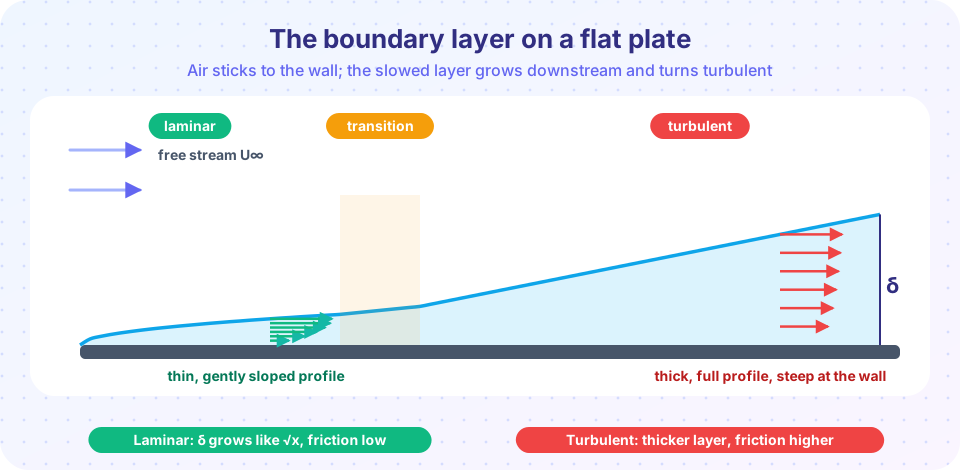
Air molecules at a solid surface stick to it: the no-slip condition. A few millimeters away the air moves at nearly the free-stream speed. The velocity must therefore change from 0 to V∞ across a thin layer, and a steep velocity change means a large shear stress. The friction on the wall is τw = μ (du/dy) at the wall, which is why a more viscous fluid or a steeper profile gives more friction.
The layer starts at the leading edge with zero thickness and grows as it moves downstream, because more and more air is slowed down by the wall. Its thickness δ is tiny compared with the length of the body: on a wing, a few millimeters at the trailing edge.
Laminar and turbulent layers
Near the front the flow is laminar: smooth layers sliding over each other. Further back small disturbances grow, and the flow transitions to turbulent: chaotic swirling eddies that mix fast fluid down to the wall.
| Property | Laminar | Turbulent |
|---|---|---|
| Thickness growth | δ ∝ √x (slow) | δ ∝ x⁴ᐟ⁵ (faster) |
| Velocity profile | gentle slope near wall | fuller, steeper at the wall |
| Skin friction | lower | higher |
| Resistance to separation | weak | stronger |
For a flat plate, the classical results at distance x from the leading edge, with local Reynolds number Rex = ρ V x / μ, are:
laminar:    δ = 5.0 x / √Rex           Cf (local) = 0.664 / √Rex
turbulent:  δ ≈ 0.37 x / Rex^0.2       Cf (average, 5×10⁵ < Re < 10⁷) = 0.074 / Re^0.2
For the average friction coefficient over a plate of length L, Cf = 1.328 / √ReL (laminar) is twice the local value at the trailing edge. With transition at Re ≈ 5 × 10⁵, the common formula for a plate with a laminar front and turbulent rear is
Cf = 0.074 / Re^0.2 − 1742 / Re
Transition happens at a Reynolds number of about 5 × 10⁵ on a smooth plate in a quiet stream, but it comes earlier with surface roughness, noise or free-stream turbulence, and is delayed by a favorable (falling) pressure gradient. This is why some modern wings use "laminar flow" airfoils with the thickest point at 40% to 50% of the chord: they try to keep the flow laminar over more of the surface.
Friction drag of a plate
The friction drag of a plate of wetted area Swet (count both sides!) is
Df = Cf · q · Swet
Worked example. A smooth plate 2 m long and 1 m wide in air at 30 m/s (sea level, ν = 1.46 × 10⁻⁵ m²/s): Re = 30 × 2 / 1.46 × 10⁻⁵ = 4.1 × 10⁶. Turbulent: Cf = 0.074 / (4.1×10⁶)^0.2 = 0.0035. With q = 0.5 × 1.225 × 30² = 551 Pa and Swet = 2 × 2 = 4 m², Df = 0.0035 × 551 × 4 ≈ 7.8 N. The run below checks it.
Reynolds number and scale
Reynolds number also tells you when two flows are similar. A wind-tunnel test of a model produces the same Cf, Cp and CL curves as the full-size flight only if the Reynolds numbers match. A typical comparison:
- Model glider wing (chord 0.1 m, 10 m/s): Re ≈ 7 × 10⁴.
- Light aircraft wing (chord 1.5 m, 55 m/s): Re ≈ 5.6 × 10⁶.
- Airliner wing (mean chord 4 m, 250 m/s at 11 km): Re ≈ 2 × 10⁷ to 3 × 10⁷.
Common misconceptions
"Turbulent flow is always worse." Turbulent layers cause more skin friction, but they cling to the surface better. On a bluff body or a wing near stall that can reduce the total drag or delay stall.
"The boundary layer is a separate layer of air." It is not a distinct sheet. It is simply the region of the flow where viscosity matters, and its edge is a matter of convention (99% of V∞).
"Re has units." Re is dimensionless: the units of ρ, V, L and μ cancel.
Try it
Press Run (or Ctrl + Enter) to see the result here.
Program input · what you'd type while the program runs
Type the answers before you press Run, one per line. Each time the program reads a line (with input()), it gets the next line from this box.
Check your understanding
Quick check · 5 questions
of 5 answered You scored / 5 · perfect!
-
1. What does the no-slip condition say?
Air molecules touching the wall have zero velocity relative to it, which creates the velocity gradient of the boundary layer. -
2. What is the Reynolds number for V = 30 m/s, L = 2 m and ν = 1.46 × 10⁻⁵ m²/s?
Re = V L / ν = 30 × 2 / 1.46e-5 = 4.1e6. -
3. Compared with a laminar layer, a turbulent boundary layer has:
Eddies mix high-speed air toward the wall, which raises wall shear but helps the layer fight an adverse pressure gradient. -
4. Where does transition typically occur on a smooth flat plate?
A rule of thumb transition Reynolds number is about 5 × 10⁵ for a smooth plate in a quiet free stream. -
5. When computing friction drag on a flat plate, wetted area means:
Both faces are rubbed by air, so Swet = 2 × length × width for a thin plate.
Summary
- A thin boundary layer carries all the viscous effects; it starts laminar and usually turns turbulent.
Re = ρVL/μ; transition near Re ≈ 5 × 10⁵ on a flat plate.- Laminar:
Cf = 1.328/√Re; turbulent:Cf = 0.074/Re^0.2; friction dragDf = Cf q Swet. - Turbulent layers have more friction but resist separation better.
Next: Types of drag
Track your progress
Create a free account to tick off lessons and pick up where you left off on any device.
of Aerodynamics lessons completed