


















Lesson 14 of 49 · Airfoils and Lift
Stall and high-lift devices
Understand flow separation and stall, compute stall speed from CLmax, and see how flaps and slats raise maximum lift so aircraft can land slowly, with runnable examples.
Lift grows with angle of attack, but not forever. At some angle the smooth flow over the top of the wing breaks away from the surface, lift collapses and drag soars. That is stall, and the maximum lift just before it sets the slowest speed at which an aircraft can fly. This lesson explains why the flow separates, derives the stall-speed formula, and shows how flaps and slats let a big jet land at a speed a pilot can manage.
What you will learn
- Why the flow separates and how stall appears on the lift curve.
- The stall-speed formula
Vs = √(2W / (ρ S CLmax))and how load factor and altitude change it. - How flaps and slats change the lift curve.
- Typical maximum lift coefficients.
Key terms
Flow separation: the boundary layer lifts off the surface and the flow behind that point is a slow, turbulent wake.
Adverse pressure gradient: pressure rising in the flow direction, which slows the near-wall air and leads to separation.
CLmax: the highest lift coefficient reached before stall.
Stall speed (Vs): the speed in steady level flight at which the wing is at CLmax.
Flap and slat: movable surfaces at the trailing and leading edge that change camber and delay separation.
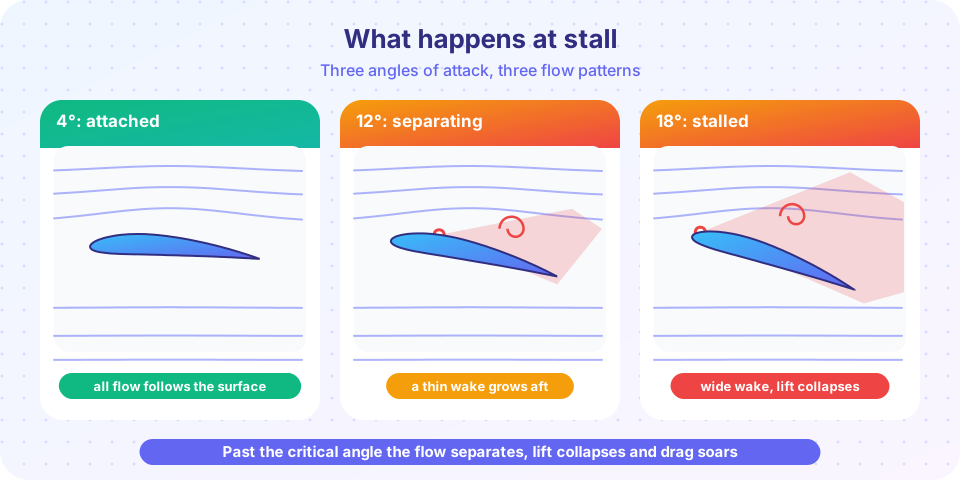
Why the flow separates
Look back at the Cp plot. Air accelerates around the nose to a suction peak and then has to climb the pressure back up toward the trailing edge, an adverse pressure gradient. The air right next to the wall has already been slowed by friction, so it has little energy. If the gradient is steep, the near-wall air stops, reverses, and the boundary layer separates from the surface.
As the angle of attack increases, the suction peak grows and moves forward, the adverse gradient steepens, and the separation point creeps from the trailing edge toward the leading edge. When most of the upper surface lies in the dead-air wake, lift falls and drag rises sharply.
Typical stall types:
- Trailing-edge stall (thick airfoils, around 12% or more): separation creeps forward gradually, so lift declines gently. Pilots feel a buffet before the stall.
- Leading-edge stall (medium-thin airfoils): a short bubble bursts and the whole upper surface separates quickly; lift drops abruptly.
- Thin-airfoil stall (very thin sections): a separation bubble grows slowly with α.
The stall-speed formula
In steady level flight lift equals weight, so W = ½ ρ V² S CL. The slowest possible speed uses the largest lift coefficient:
Vs = √( 2 W / (ρ S CLmax) )
Worked example. A light aircraft with W = 10,791 N, S = 16.2 m², CLmax = 1.6 at sea level: Vs = √(2 × 10,791 / (1.225 × 16.2 × 1.6)) = √(686) ≈ 26.2 m/s, about 51 knots. Published stall speeds for light aircraft of this size are in the same region.
Three factors change Vs:
- Weight:
Vs ∝ √W. A fuller aircraft stalls at a higher speed. - Load factor: in a turn or a pull-up
L = nW, soVs,n = Vs √n. At 60° of bank, n = 2 and the stall speed is 41% higher. - Density:
Vs ∝ 1/√ρ. The indicated stall speed hardly changes with altitude, but the true airspeed at stall increases as the air thins.
High-lift devices
To land safely, an airliner would like a low stall speed, but its wing is designed to be small and thin for cruise. The answer is high-lift devices that are deployed only for takeoff and landing.
- Plain and split flaps hinge the rear part of the airfoil down, increasing camber. They shift the lift curve upward (α0 becomes more negative) and slightly raise CLmax but lower the stall angle.
- Slotted and Fowler flaps slide backward and downward, also adding area (Fowler) and letting high-energy air through a slot that re-energizes the boundary layer. CLmax rises substantially.
- Leading-edge slats open a gap at the nose that directs air along the upper surface. They do not shift the lift curve; they extend it to a higher angle of attack, delaying stall.
- Leading-edge Krueger flaps hinge out from the lower surface and do a similar job on many airliners.
- Blown flaps and boundary-layer control add energy to the flow with engine bleed air or suction (used on some military and STOL aircraft).
Rough ranges of maximum lift coefficient (wing, not section):
| Configuration | CLmax |
|---|---|
| Clean light aircraft wing | 1.2 to 1.7 |
| Light aircraft, full flaps | 1.8 to 2.4 |
| Airliner, slats and slotted flaps | 2.5 to 3.2 |
The price: flaps also add drag, which is useful on approach because it lets you descend steeply, but the extended devices must be retracted to climb quickly or cruise.
Common misconceptions
"Stall means the engine stops." Stall is aerodynamic. The wing exceeds its critical angle of attack. It can happen at any speed, any attitude and any power setting.
"An aircraft stalls at a fixed airspeed." Vs rises with weight and load factor. A wing always stalls at the same critical angle of attack for a given configuration, but the speed at which that happens varies.
"Flaps always help." Flaps increase lift for a given speed, but they also add drag and change pitching moment; they are retracted for efficient cruise.
Try it
Press Run (or Ctrl + Enter) to see the result here.
Program input · what you'd type while the program runs
Type the answers before you press Run, one per line. Each time the program reads a line (with input()), it gets the next line from this box.
Check your understanding
Quick check · 5 questions
of 5 answered You scored / 5 · perfect!
-
1. What is the main cause of stall?
Beyond the critical angle of attack, an adverse pressure gradient separates the boundary layer, and lift falls. -
2. How does stall speed change when the wing carries a load factor n?
Lift is n W, so Vs,n = Vs √n. -
3. A 10,791 N aircraft with S = 16.2 m² and CLmax = 1.6 has Vs at sea level of about:
Vs = √(2 × 10,791 / (1.225 × 16.2 × 1.6)) ≈ 26 m/s. -
4. What do leading-edge slats mainly do?
Slats re-energize the boundary layer at the nose so the wing can reach a higher angle before stalling. -
5. Flaps increase CLmax mainly by:
More camber moves the whole lift curve up; Fowler flaps also add area.
Summary
- Stall is boundary-layer separation caused by an adverse pressure gradient at high α.
Vs = √(2W/(ρ S CLmax)); Vs rises with weight and with √n in turns.- Flaps raise camber and CLmax, slats extend the usable angle, and both are used for slow flight.
- Typical CLmax: about 1.2 to 1.7 clean, 2.5 to 3.2 on airliners with devices out.
Next: Chapter 3 review
Track your progress
Create a free account to tick off lessons and pick up where you left off on any device.
of Aerodynamics lessons completed