


















Lesson 20 of 49 · Drag and Performance
Glide, range and endurance
Use L/D to compute glide angle, best glide speed and minimum sink, then derive the Breguet range and endurance equations for jets and propeller aircraft, with worked code.
The drag polar is only the start. What a pilot or a mission planner really wants to know is: how far can I go, and for how long? This lesson turns L/D into performance. We start with the simplest case, an aircraft with the engine off, and then fly with fuel burning using the Breguet equations, which are among the most famous formulas in aeronautics.
What you will learn
- How glide angle, glide range and sink rate follow from L/D.
- The difference between the speed for best glide and the speed for minimum sink.
- The Breguet range and endurance equations for jet and propeller aircraft.
- Why long-range design pushes toward high L/D, low fuel consumption and a large fuel fraction.
Key terms
Glide ratio: horizontal distance traveled per unit of height lost, equal to L/D in steady still-air glide.
Sink rate: the rate of descent (m/s).
Range: the distance flown on a given amount of fuel.
Endurance: the time aloft on a given amount of fuel.
Thrust-specific fuel consumption (c_t): fuel mass flow per unit of thrust, in kg/(N·s).
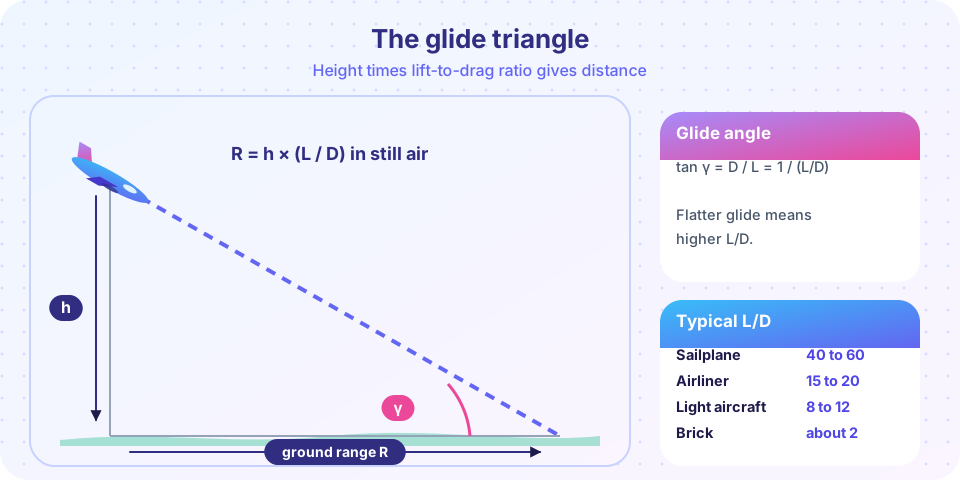
Steady glide
With the engine off (thrust zero) and a steady glide at angle γ below the horizon, the forces along and across the path are
D = W sin γ L = W cos γ
Dividing gives tan γ = D / L = 1 / (L/D). The glide angle depends only on the L/D ratio at which you fly. The horizontal distance from a height h in still air is
R = h / tan γ = h (L/D)
Worked example. A sailplane with L/D = 40 starting 1,000 m above the ground can travel 40 km. A light aircraft with L/D = 10 can travel 10 km. An airliner with L/D = 17 and engines idle, from 11,000 m, can cover about 187 km.
The best glide uses the maximum L/D, flown at CL* and the corresponding speed (from the previous lesson). It does not depend on weight: a heavy glider and a light one have the same glide angle, but the heavy one flies faster and sinks faster.
Sink rate and minimum sink
The sink rate (vertical velocity) is Vs = V sin γ ≈ V / (L/D). Minimum sink (for staying aloft longest, as thermal soaring pilots want) is a different speed from best glide. Using the parabolic polar, minimum sink occurs at
CL = √( 3 CD0 / K ) with V = √( 2 W / (ρ S CL) )
which is about 76% of the best-glide speed. At minimum sink, L/D is about 87% of its maximum.
| Condition | CL | L/D (example CD0 = 0.025, K = 0.05) |
|---|---|---|
| Best glide (max L/D) | √(CD0/K) = 0.71 | 14.1 |
| Minimum sink | √(3CD0/K) = 1.22 | 12.2 |
Range and endurance with fuel (Breguet)
An aircraft with engines burns fuel and becomes lighter. The weight at the start is W0 and at the end W1 (the difference is the fuel). Let c_t be the thrust-specific fuel consumption of a jet. In steady level flight, T = D = W/(L/D), so the rate at which weight is burned is dW/dt = −c_t g T = −c_t g W / (L/D). Integrating the time with the distance covered (dR = V dt) gives the Breguet equations.
Jet aircraft:
Endurance   E = (1 / (c_t g)) · (L/D) · ln(W0 / W1)
Range       R = (V / (c_t g)) · (L/D) · ln(W0 / W1)
Propeller aircraft, with propeller efficiency η and fuel consumption c_p per unit power (kg/(W·s)):
R = (η / (c_p g)) · (L/D) · ln(W0 / W1)
Look at what each factor means. To fly far you need a high L/D (aerodynamics), a low fuel consumption (engines), a high speed for a jet (but see below), and a large ratio of start to end weight, which means a big fuel fraction (structures: a light airframe can carry more fuel). The logarithm shows diminishing returns for extra fuel because fuel must also lift the fuel.
Worked example (jet). V = 250 m/s, L/D = 17, c_t = 1.6 × 10⁻⁵ kg/(N·s) (about 0.57 lb/(lbf·h)), and W0/W1 = 1.25, which means 20% of the starting weight is fuel. R = 250 / (1.6×10⁻⁵ × 9.80665) × 17 × ln 1.25 = 6.0 × 10⁶ m: about 6,000 km.
For a jet the flight speed enters the range formula directly, and L/D is highest at CL*. The speed for maximum range is therefore slightly higher than the speed for best L/D (it is where CL^½ / CD peaks, i.e. at about 1.32 times the speed of best L/D for the parabolic polar). For a propeller aircraft maximum range occurs at best L/D, and maximum endurance occurs at minimum power, which is the minimum-sink condition.
Common misconceptions
"The best glide speed gives the longest time aloft." Longest time aloft (minimum sink) is slower than best glide speed. Best glide gives the longest distance in still air.
"A headwind changes the glide angle." The glide angle through the air is unchanged. But the ground path steepens with a headwind and flattens with a tailwind, so pilots fly faster than best-glide speed into a headwind to improve their distance over the ground.
"More fuel always means proportionally more range." The range grows as ln(W0/W1), so adding fuel has diminishing returns.
Try it
Press Run (or Ctrl + Enter) to see the result here.
Program input · what you'd type while the program runs
Type the answers before you press Run, one per line. Each time the program reads a line (with input()), it gets the next line from this box.
Press Run (or Ctrl + Enter) to see the result here.
Program input · what you'd type while the program runs
Type the answers before you press Run, one per line. Each time the program reads a line (with input()), it gets the next line from this box.
Check your understanding
Quick check · 5 questions
of 5 answered You scored / 5 · perfect!
-
1. A sailplane with L/D = 40 starts a glide at 1,500 m in still air. How far can it go?
R = h × (L/D) = 1,500 × 40 = 60,000 m. -
2. How does the glide angle change if the aircraft is heavier (same polar)?
tan γ = D/L = 1/(L/D) depends only on L/D. -
3. Which speed gives the minimum sink rate?
Minimum sink occurs at CL = √(3CD0/K), at a lower speed than best glide. -
4. In the jet Breguet range equation, which factor improves with a lighter structure?
A lighter airframe can carry more fuel for the same takeoff weight, raising W0/W1. -
5. A jet has V = 250 m/s, L/D = 17, c_t = 1.6e-5 kg/(N s), W0/W1 = 1.25. Range is about:
250/(1.6e-5 × 9.81) × 17 × ln 1.25 ≈ 6.0 × 10⁶ m.
Summary
- In a steady glide
tan γ = 1/(L/D)andR = h (L/D), independent of weight. - Minimum sink (CL = √(3CD0/K)) is slower than best glide and gives the longest time aloft.
- Breguet:
R = (V/(c_t g))(L/D) ln(W0/W1)for jets;(η/(c_p g))replacesV/(c_t g)for propellers. - Long range needs high L/D, low fuel consumption and a high fuel fraction.
Next: Chapter 4 review
Track your progress
Create a free account to tick off lessons and pick up where you left off on any device.
of Aerodynamics lessons completed