


















Lesson 41 of 49 · Computational Aerodynamics
Chapter 8 review: computational aerodynamics
Review the CFD workflow, panel methods, finite differences, CFL stability, turbulence modelling, y+ and grid convergence with a summary picture and a ten-question quiz.
The computational toolbox ranges from a few-line panel code to supercomputer LES. What unites them is a habit of mind: define the model, discretize it, solve it, and then ask how much to trust the answer. This page collects the chapter's main results and lets you test yourself.
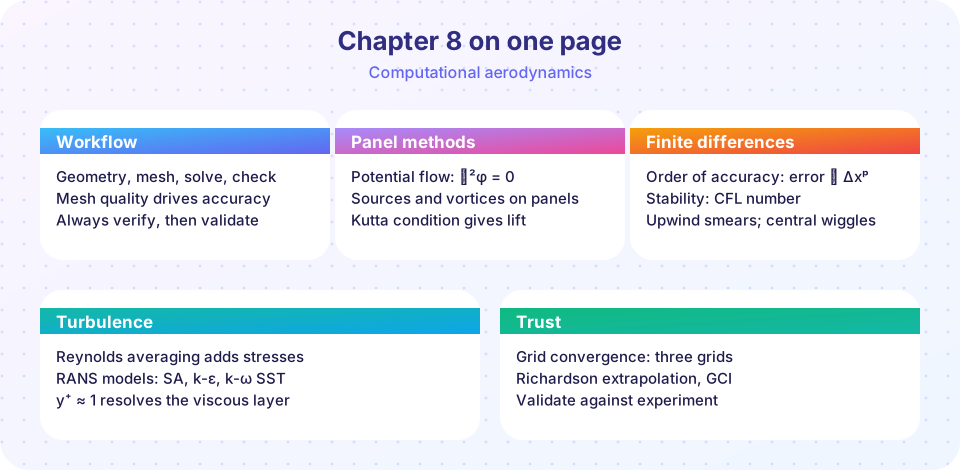
The chapter in a table
| Topic | Key idea | Remember |
|---|---|---|
| Workflow | Geometry, mesh, solve, check | Errors enter at every stage |
| Potential flow | ∇²φ = 0, superposition |
No drag, no separation, no shocks |
| Panel methods | Singularities on the surface | Kutta condition gives lift |
| Finite differences | Taylor series; order p |
Halve Δx: error falls by 2ᵖ |
| Stability | CFL = cΔt/Δx ≤ 1 for explicit schemes |
Upwind smears, Lax-Wendroff wiggles |
| RANS | Reynolds stresses modelled | SA, k-ε, k-ω SST |
| Wall treatment | y⁺ ≈ 1 resolved, 30 to 100 wall functions |
First cell: micrometers |
| Credibility | Grid convergence, verification, validation | Three grids, GCI |
Try it
Estimate how much a finer grid should help: given the formal order of a scheme, predict the error after refinement, then compare with a simple numerical test.
Press Run (or Ctrl + Enter) to see the result here.
Program input · what you'd type while the program runs
Type the answers before you press Run, one per line. Each time the program reads a line (with input()), it gets the next line from this box.
Check your understanding
Quick check · 10 questions
of 10 answered You scored / 10 · perfect!
-
1. In steady, incompressible, irrotational flow the governing equation for the velocity potential is
∇²φ = 0, which is linear and allows superposition. -
2. What does the Kutta condition do in a panel method?
It removes the ambiguity in circulation and gives the lift. -
3. What is predicted by potential flow for the drag of a body?
d'Alembert's paradox: no viscosity, no drag. -
4. A scheme is third order. Halving Δx reduces the error by about
2³ = 8. -
5. What happens to an explicit upwind scheme if CFL > 1?
The numerical domain of dependence no longer contains the physical one. -
6. Numerical diffusion is
It is an error term acting like extra viscosity. -
7. Which turbulence approach models only the smallest eddies?
LES resolves the large eddies and models the small ones. -
8. A wall-resolved mesh typically puts the first cell at
That lets the model resolve the viscous sublayer. -
9. Verification and validation differ in that
Verification: solving the equations right. Validation: solving the right equations. -
10. The grid convergence index quantifies
GCI is a standard estimate of discretization uncertainty.
Summary
- Methods trade cost for fidelity: potential flow, Euler, RANS, LES, DNS.
- Discretization brings order of accuracy, stability limits and numerical diffusion.
- Turbulence modelling and wall spacing decide viscous accuracy; verification and validation decide trust.
Track your progress
Create a free account to tick off lessons and pick up where you left off on any device.
of Aerodynamics lessons completed