


















Lesson 8 of 49 · The Atmosphere and Flight Basics
Airspeeds and dynamic pressure
Learn how a pitot-static system measures airspeed, what dynamic pressure is, and how to convert indicated airspeed to equivalent and true airspeed and Mach number.
Speed seems simple until you ask: speed relative to what, and measured how? A pilot reads a number from the airspeed indicator, a navigator needs the speed over the ground, and an aerodynamicist needs the speed that decides how hard the air pushes. They are different numbers. This lesson explains each, and shows how a simple tube and a pressure gauge turn pressure into speed.
What you will learn
- What dynamic pressure
q = ½ρV²means and why it governs aerodynamic forces. - How a pitot-static system measures airspeed.
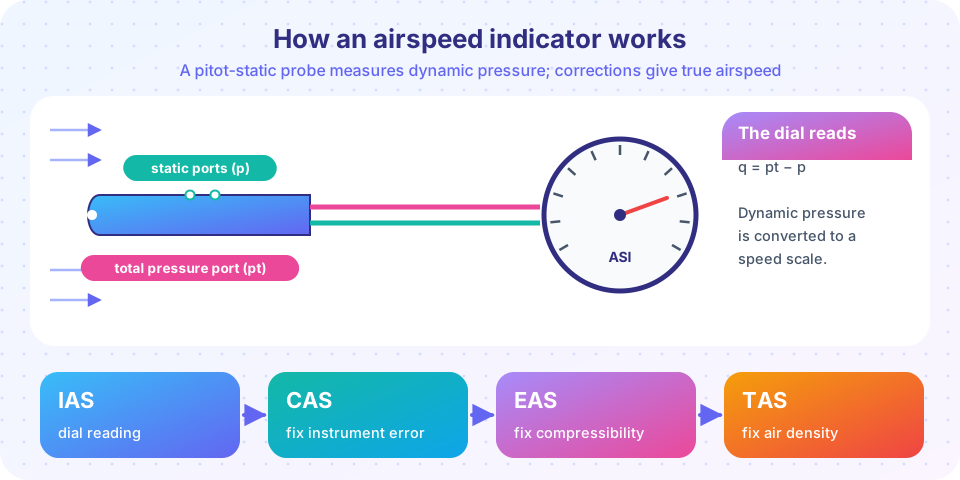
- The four airspeeds IAS, CAS, EAS, TAS and how to convert between them.
- How compressibility changes the airspeed relation near Mach 0.3 and above.
Key terms
Dynamic pressure (q): ½ ρ V², the kinetic energy per unit volume of the flow, in pascals.
Total (stagnation) pressure (pt): the pressure in air brought smoothly to rest, such as at the nose of a pitot probe.
Static pressure (p): the pressure of the undisturbed air, felt by a surface moving with the flow.
EAS and TAS: equivalent airspeed (sea-level-equivalent, sets the forces) and true airspeed (actual speed through the air).
Density ratio (σ): σ = ρ / ρ₀, with ρ₀ = 1.225 kg/m³.
Dynamic pressure and Bernoulli's equation
Consider air that flows steadily and smoothly (no friction, constant density). Along a streamline the sum of pressure and kinetic energy per volume stays constant:
p + ½ ρ V² = constant
This is Bernoulli's equation, from energy conservation. Where air speeds up, static pressure drops. At a stagnation point, where the air is brought to rest (V = 0), the pressure reaches its maximum, the total pressure:
pt = p + ½ ρ V² → q = pt − p
So the dynamic pressure is simply the excess of total pressure over static pressure. It is what lift and drag scale with, which is why the equations are L = q S CL and D = q S CD.
The pitot-static system
A pitot tube has an open nose that faces the flow, so the air inside comes to rest and pressure rises to pt. Small holes on the side of the probe or fuselage (the static ports) sense p without the dynamic effect. The two pressures reach the two sides of a diaphragm. The diaphragm's deflection measures pt − p = q, and the dial is simply marked in speed assuming sea-level density:
V_indicated = √( 2 (pt − p) / ρ₀ )
The same static pressure also drives the altimeter, which is why a blocked static port ruins both instruments.
The four airspeeds
- IAS (indicated airspeed): what the dial says. It includes instrument and position errors.
- CAS (calibrated airspeed): IAS corrected for instrument and position (static-source) errors, using a calibration table.
- EAS (equivalent airspeed): CAS corrected for compressibility. EAS is the speed at sea-level density that gives the same dynamic pressure as the real flight:
½ ρ₀ V_EAS² = ½ ρ V_TAS² = q. Structural limits and stall speeds are most naturally expressed in EAS. - TAS (true airspeed): the real speed through the air, needed for navigation and for Mach number.
The conversion between EAS and TAS comes straight from equating q:
V_TAS = V_EAS / √σ
Worked example. An aircraft at 5,000 m (ISA density 0.7364 kg/m³) reads 100 m/s EAS. Then σ = 0.7364 / 1.225 = 0.601, √σ = 0.775, and V_TAS = 100 / 0.775 = 129 m/s. The aircraft is moving 29% faster through the air than its dial suggests. Ground speed is TAS plus the wind component along the track; a 20 m/s headwind gives about 109 m/s over the ground.
Compressibility
Bernoulli's equation assumes constant density, which is fine below about Mach 0.3. At higher speeds, the air in front of the pitot tube is compressed as it stops, so pt is a little higher than the incompressible equation predicts. For subsonic flow, the exact relation (isentropic compression of air) is
pt / p = (1 + 0.2 M²)^3.5
and so Mach number follows from the two pressures alone:
M = √( 5 [ (pt/p)^(2/7) − 1 ] )
This is how an air-data computer produces Mach number. For small M, the dynamic pressure pt − p is larger than ½ρV² by the factor 1 + M²/4 + M⁴/40 + …. At Mach 0.3 the error is only 2.3%; at Mach 0.8 it exceeds 15%.
Common misconceptions
"The airspeed indicator measures speed." It measures a pressure difference and converts it to speed assuming sea-level density. It reads true airspeed only at sea level in standard conditions.
"Ground speed is what the wings feel." Lift and drag depend on the airspeed relative to the air, not to the ground. A strong tailwind raises ground speed without changing the lift.
"Pressure drops at the wing because the air is in a hurry." Bernoulli's equation is an energy balance along a streamline. It relates speed and pressure; it does not say which causes which. We come back to this in Chapter 3.
Try it
Press Run (or Ctrl + Enter) to see the result here.
Program input · what you'd type while the program runs
Type the answers before you press Run, one per line. Each time the program reads a line (with input()), it gets the next line from this box.
Check your understanding
Quick check · 5 questions
of 5 answered You scored / 5 · perfect!
-
1. Total pressure minus static pressure equals:
pt − p = ½ρV² in incompressible flow, by Bernoulli's equation. -
2. An aircraft at 5,000 m (σ = 0.601) has EAS = 100 m/s. TAS is about:
V_TAS = V_EAS / √σ = 100 / 0.775 = 129 m/s. -
3. Which airspeed would you use to compute Mach number?
Mach number is the true speed through the air divided by the local speed of sound. -
4. Why does the simple relation q = pt − p stop being accurate at high speed?
Above about Mach 0.3 density changes as air stops, so the isentropic relation pt/p = (1 + 0.2M²)^3.5 must be used. -
5. A 20 m/s headwind blows while TAS stays the same. What happens to ground speed?
Ground speed is TAS plus the tailwind component, so a headwind subtracts from it. The airspeed that governs lift and drag does not change.
Summary
- Dynamic pressure
q = ½ρV² = pt − pis the pressure scale for lift and drag. - A pitot-static system measures pt and p; the dial converts q to speed assuming sea-level density.
- IAS to CAS fixes instrument error, CAS to EAS fixes compressibility, EAS to TAS divides by √σ.
- Mach number follows from
pt/p = (1 + 0.2M²)^3.5.
Next: Chapter 2 review
Track your progress
Create a free account to tick off lessons and pick up where you left off on any device.
of Aerodynamics lessons completed