


















Lesson 35 of 49 · Stability and Control
Dynamic stability: phugoid, short period and the lateral modes
Learn the natural modes of an airplane: the short-period and phugoid oscillations, roll subsidence, spiral and Dutch roll, with a runnable phugoid simulation.
Static stability tells you which way the first push goes. It says nothing about what happens next. A restoring moment can overshoot, return with a swing that dies away, or swing back harder each time. Dynamic stability is the study of that motion over time. Every airplane has a handful of natural motions, called modes, and the pilot's job, or the autopilot's, depends on how quickly they decay or grow.
What you will learn
- The vocabulary of dynamic response: natural frequency, damping ratio and time to double.
- The two longitudinal modes: short period and phugoid, and how to estimate them.
- The three lateral-directional modes: roll subsidence, spiral and Dutch roll.
- How yaw dampers and similar devices fix poor modes.
Key terms
Mode: a characteristic pattern of motion the airplane follows when disturbed and then left alone.
Damping ratio (ζ): 0 for an undamped oscillation, 1 for critical damping; positive values decay, negative values grow.
Natural frequency (ωₙ): the oscillation rate in radians per second without damping.
Time to double: for an unstable mode, how long the amplitude takes to double.
Reading a response
Think of a mass on a spring with a damper. With positive damping an offset dies out in a decaying oscillation; with ζ = 0 it oscillates forever at constant size; with negative damping it grows. An airplane in small disturbances behaves like several of these at once. The motions are:
- Oscillatory modes: described by
ωₙandζ. The period isT = 2π/(ωₙ √(1 − ζ²))and the amplitude falls by half every0.693 / (ζ ωₙ)seconds. - Non-oscillatory modes: simply decay or grow exponentially with a time constant.
Longitudinal modes
Short period
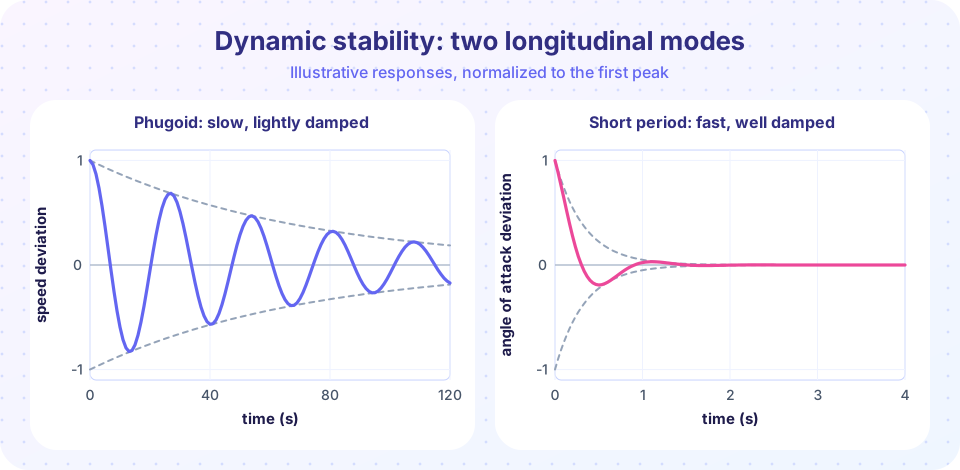
After a gust the airplane pitches rapidly about its center of gravity. The angle of attack and pitch rate swing together, while speed hardly changes. The restoring moment is the static stability from the last lesson (Cm,α), and the damping comes mostly from the tail, which sees extra angle of attack when the airplane rotates (Cm,q). A first estimate of the frequency is ωₙ ≈ √(−Mα), with Mα = q S c̄ Cm,α / Iy: a larger static margin raises the frequency. Typical periods are 1 to 3 seconds and the mode is usually well damped (ζ between 0.3 and 0.8). Pilots perceive it as how crisply the airplane responds to elevator, and it must be damped enough that it does not feel "bouncy". The program below solves the two-state model properly.
Phugoid
The phugoid is a slow trade between speed and altitude at nearly constant angle of attack. Pitch up and the airplane climbs and slows; with less speed the lift drops and the nose falls; it dives, gains speed and climbs again. F. W. Lanchester described it in 1908 by assuming constant lift coefficient and no thrust change, which gives remarkably good simple results:
ωₚ ≈ √2 · g / V        period  T = π √2 · V / g ≈ 0.453 · V   (V in m/s, T in s)
ζₚ ≈ 1 / ( √2 · L/D )
At V = 60 m/s, T ≈ 27 s; at 100 m/s, 45 s. With L/D = 12, ζₚ ≈ 0.059, very lightly damped. The phugoid is slow enough that the pilot can damp it without noticing; it is acceptable even if mildly unstable (a time to double of more than about 12 seconds). Notice what this means: the damping depends on the aerodynamic efficiency. A slippery glider has a worse phugoid than a draggy trainer.
Lateral-directional modes
Sideways motions are coupled between roll and yaw. Their three modes are:
| Mode | What happens | Typical behavior |
|---|---|---|
| Roll subsidence | Rolling rate dies out because the downgoing wing has more angle of attack | Fast, heavily damped, a fraction of a second to about a second |
| Spiral | A slow banking, descending turn that tightens or loosens | Very slow: stable or mildly unstable with a doubling time of tens of seconds |
| Dutch roll | Combined yaw and roll oscillation, like an ice skater's rocking motion | Oscillation of several seconds, can be lightly damped on swept-wing jets |
The spiral and the Dutch roll trade against each other. Strong dihedral effect (Cl,β very negative) compared with the directional stability (Cn,β) makes the Dutch roll worse and the spiral more stable. Weak dihedral effect and strong directional stability make the spiral unstable. Swept-wing airliners need a yaw damper: a rate gyro that feeds yaw rate to the rudder automatically to improve Dutch roll damping.
Common misconceptions
"Statically stable means the airplane is safe." A statically stable airplane can still have an unstable oscillation (for example if damping is negative).
"The phugoid is dangerous because it is unstable." Its low frequency and long period make it easy to handle, and many airplanes have mildly unstable phugoids.
"The Dutch roll has something to do with the Netherlands." The name probably comes from the rocking gait of skaters; the physics is the coupled yaw-roll oscillation.
Try it
First, simulate the phugoid with a full point-mass model (fixed lift coefficient, thrust equal to the drag at the initial speed) and compare the numerical period and damping with Lanchester's estimate.
Press Run (or Ctrl + Enter) to see the result here.
Program input · what you'd type while the program runs
Type the answers before you press Run, one per line. Each time the program reads a line (with input()), it gets the next line from this box.
Second, the short-period mode from a two-state model (angle of attack and pitch rate). Slide the CG forward and aft and see how frequency and damping change.
Press Run (or Ctrl + Enter) to see the result here.
Program input · what you'd type while the program runs
Type the answers before you press Run, one per line. Each time the program reads a line (with input()), it gets the next line from this box.
Check your understanding
Quick check · 5 questions
of 5 answered You scored / 5 · perfect!
-
1. Which mode is a slow exchange of kinetic and potential energy at nearly constant angle of attack?
The phugoid swaps speed and altitude over tens of seconds. -
2. Estimate the phugoid period at V = 80 m/s using Lanchester's formula.
T = π√2 · V/g = 4.443 · 80/9.81 ≈ 36 s. -
3. How does a higher lift-to-drag ratio affect phugoid damping?
ζ ≈ 1/(√2 L/D): efficient airplanes have more lightly damped phugoids. -
4. A yaw damper mainly improves
It feeds yaw rate to the rudder, adding damping to the Dutch roll. -
5. Moving the CG aft toward the neutral point does what to the short-period frequency?
A smaller static margin means a weaker restoring moment, so the natural frequency falls.
Summary
- Dynamic stability concerns how disturbances evolve: frequency, damping ratio and time to double.
- The short period is fast and well damped; its frequency rises with static margin.
- The phugoid is slow with
T ≈ π√2 V/gandζ ≈ 1/(√2 L/D). - Lateral modes: roll subsidence (fast), spiral (slow) and Dutch roll (oscillatory); yaw dampers fix the last.
Next: Chapter 7 review
Track your progress
Create a free account to tick off lessons and pick up where you left off on any device.
of Aerodynamics lessons completed